Last Updated: October 28, 2026
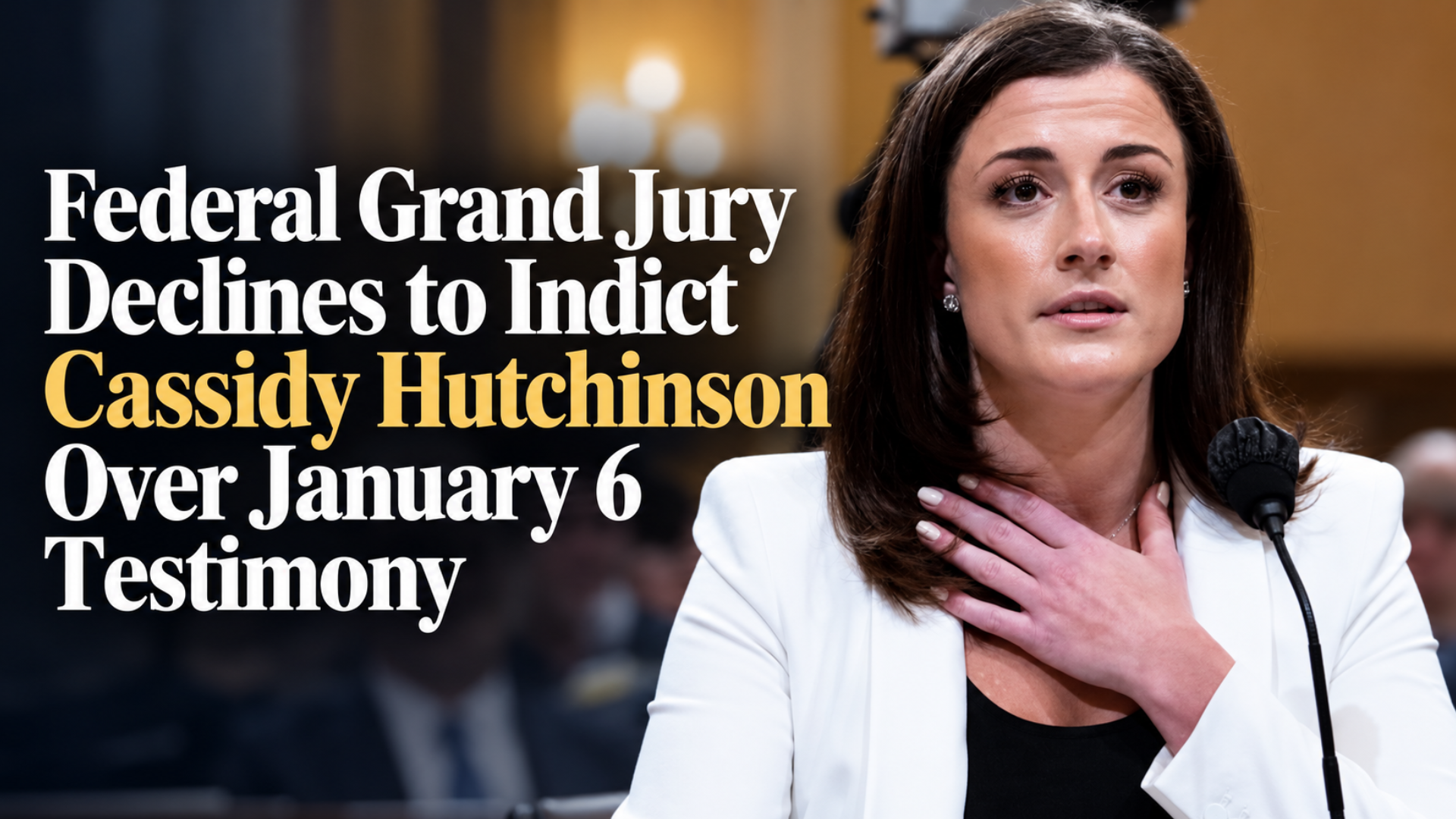
Image Source: Instagram
| Quick Report: A federal grand jury in Washington, D.C., declined on October 27 to indict former White House aide Cassidy Hutchinson following a Justice Department investigation into her 2022 congressional testimony about the January 6, 2021, U.S. Capitol attack. During a federal court proceeding, a Justice Department attorney confirmed that grand jurors had not approved a proposed indictment, although he did not publicly identify the individual involved. Multiple sources familiar with the matter identified Hutchinson. The decision prevents the proposed charges from proceeding through that indictment but does not constitute an acquittal or permanently prohibit further prosecutorial action. |
Federal Grand Jury Rejects Proposed Indictment
The Justice Department’s attempt to obtain criminal charges against Hutchinson ended without an indictment on October 27.
During a brief appearance before U.S. Magistrate Judge Zia M. Faruqui, Justice Department attorney Neville S. Hedley stated that a federal grand jury had not concurred on a proposed indictment.
Hedley, who identified himself as acting senior litigation counsel in the department’s Civil Rights Division, did not publicly identify the proposed defendant or specify the charges.
However, multiple people familiar with the proceedings confirmed that the rejected indictment concerned Hutchinson.
The Justice Department had been investigating whether Hutchinson provided false information during her congressional testimony concerning President Donald Trump’s actions surrounding the January 6 Capitol attack.
The grand jury’s decision means federal prosecutors did not obtain an indictment through that proceeding. The precise allegations contained in the proposed indictment were not publicly disclosed.
Investigation Followed Congressional Referrals
The federal investigation followed allegations raised by Republican lawmakers who questioned the accuracy of Hutchinson’s testimony.
Representatives Jim Jordan of Ohio and Barry Loudermilk of Georgia referred concerns about Hutchinson’s statements to the Justice Department in 2026.
The lawmakers alleged that portions of her testimony before the House committee investigating the Capitol attack were false or misleading.
Federal prosecutors subsequently examined whether her statements could support criminal charges.
By early October, the Justice Department had begun presenting evidence concerning Hutchinson to a federal grand jury in Washington.
The investigation was handled by the Justice Department’s Civil Rights Division, rather than the U.S. Attorney’s Office for the District of Columbia.
Hutchinson has maintained that her congressional testimony was truthful.
The allegations raised by lawmakers have not been established through a criminal conviction or judicial finding against her.
Hutchinson's January 6 Testimony Drew National Attention
Hutchinson previously served as an aide to Mark Meadows, who was White House chief of staff during Trump’s first administration.
On June 28, 2022, she testified publicly before the House committee investigating the January 6, 2021, attack on the U.S. Capitol.
Her testimony addressed discussions and events within the White House before and during the attack.
Among other matters, Hutchinson testified that Trump had been informed that some supporters attending his rally possessed weapons.
She also recounted an account she said she received from then-White House official Anthony Ornato concerning Trump’s reported reaction when Secret Service personnel did not take him to the Capitol.
According to Hutchinson’s testimony, Ornato told her that Trump had reached toward the steering wheel of the presidential vehicle and lunged toward a member of his security detail.
Hutchinson did not claim to have personally witnessed that alleged confrontation inside the vehicle.
The Secret Service agent who drove the vehicle later disputed the reported steering-wheel incident.
These conflicting accounts became a significant subject of scrutiny surrounding Hutchinson’s testimony.
However, disagreement between witness accounts does not, by itself, establish that a witness knowingly provided false testimony.
What Does the Grand Jury's Decision Mean?
A federal grand jury determines whether prosecutors have presented sufficient evidence to establish probable cause for criminal charges.
An indictment is a formal accusation that allows a federal criminal prosecution to proceed. It does not establish that the accused person is guilty.
When a grand jury declines to approve an indictment, the result is commonly called a “no bill.”
In Hutchinson’s case, the grand jury did not approve the charges prosecutors sought.
This outcome is legally different from an acquittal following a criminal trial.
An acquittal generally follows a determination of guilt or innocence through criminal proceedings. A grand jury’s refusal to indict occurs before that stage and does not establish whether the person committed an offense.
The decision also does not automatically prevent prosecutors from pursuing additional investigative steps or, where legally permitted, presenting the matter to a grand jury again.
Federal Justice Department policies place restrictions on resubmitting matters after a grand jury has declined to indict.
As of October 28, no renewed indictment attempt had been publicly confirmed.
What Happens Next?
The Justice Department has not publicly confirmed whether it intends to pursue another indictment against Hutchinson.
Prosecutors may evaluate their available legal options, subject to federal law and applicable Justice Department policies.
The October 27 decision leaves the government without an indictment arising from the grand jury presentation concerning Hutchinson.
No criminal trial against her has resulted from that unsuccessful indictment attempt.
Further developments would depend on whether prosecutors pursue additional investigative or charging steps.
For now, the grand jury’s refusal to indict represents the latest significant procedural development in the investigation into Hutchinson’s congressional testimony.
Disclaimer: This article provides general information and does not constitute legal advice. It reflects publicly available reporting reviewed through October 28, 2026. Allegations that Cassidy Hutchinson provided false congressional testimony have not been established through a criminal conviction or judicial finding. The grand jury’s refusal to indict does not constitute an acquittal or a determination of the truth of every disputed statement.