Last Updated: November 3, 2026
Quick Report: |
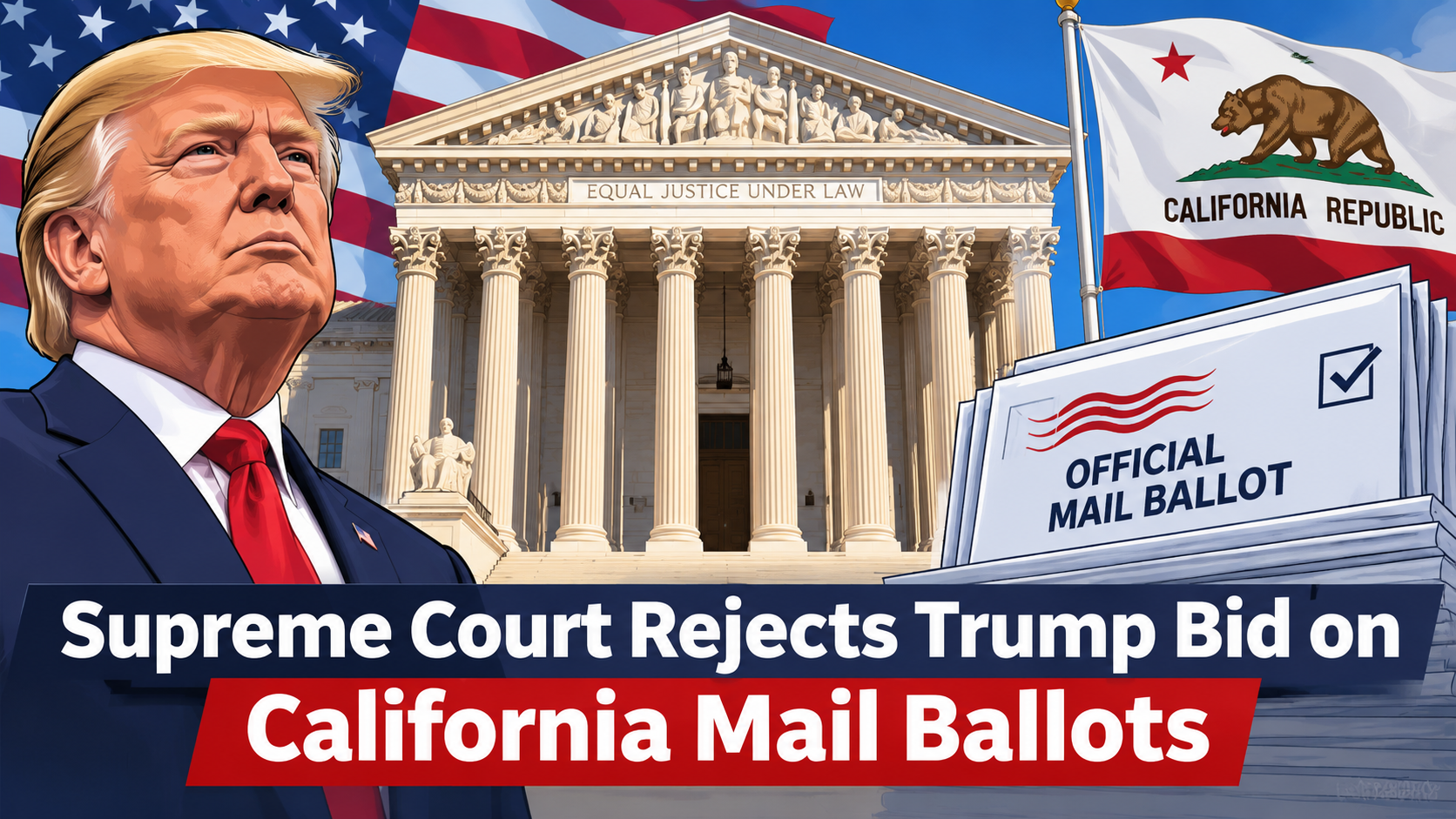
Supreme Court Denies Emergency Request Over California Mail Ballots
The Trump administration asked the Supreme Court to intervene in an ongoing dispute over California’s handling of mail ballots ahead of the November 3 elections.
Solicitor General D. John Sauer requested an injunction requiring election officials to segregate ballots associated with individuals federal authorities had identified as likely noncitizens.
The administration argued that once mail ballots are separated from their identifying envelopes and combined with other ballots, officials cannot reliably identify individual votes for subsequent review. The emergency application was presented to Justice Elena Kagan, who referred it to the full Court.
On November 2, the justices denied the request without providing an explanation. No dissent was publicly recorded. The ruling addressed the administration’s request for immediate relief rather than the ultimate merits of its claims.
Justice Department Challenges California’s Handling of 20,000 Voter Records
Federal authorities developed a list of individuals they believed were noncitizens registered to vote in California.
On October 12, 2026, the federal government submitted the list to California officials and requested that ballots associated with those individuals be separated until their citizenship status could be verified.
California officials questioned the reliability of the information and declined to implement the requested procedure.
The Justice Department filed its lawsuit on October 15, alleging that California’s handling of the ballots conflicted with federal law prohibiting noncitizens from voting in federal elections.
Under 18 U.S.C. § 611, noncitizens are generally prohibited from voting in federal elections, subject to limited statutory exceptions.
California disputed the allegations and argued that the federal government’s information had not established that the identified individuals were ineligible to vote.
The dispute therefore concerned both the reliability of the government’s voter records and whether federal law authorized the requested changes to California’s election procedures.
Ninth Circuit Rejects Request for Emergency Injunction
Before approaching the Supreme Court, the administration sought emergency relief in the lower federal courts.
On October 28, U.S. District Judge David O. Carter denied the government’s application for a temporary restraining order.
The Justice Department appealed to the U.S. Court of Appeals for the Ninth Circuit. On October 30, a three-judge panel denied the requested injunction in a 2-1 decision.
Judges Mark J. Bennett and Gabriel P. Sanchez concluded that the administration had not established entitlement to emergency relief.
The majority determined that 18 U.S.C. § 611 did not authorize the particular ballot-segregation procedures sought by the federal government under the circumstances presented.
The judges also identified concerns involving the National Voter Registration Act and the potential disruption of election procedures shortly before voting concluded.
Judge Patrick J. Bumatay dissented, arguing that the federal government should be permitted to preserve the disputed ballots while officials verified voter eligibility.
The appellate ruling left the district court’s denial of immediate relief undisturbed.
Why Courts Refused to Change Election Procedures
The Ninth Circuit’s decision focused on the legal requirements for obtaining an emergency injunction and the potential consequences of changing election procedures shortly before Election Day.
The majority found that the government had not sufficiently established its likelihood of success, irreparable harm, or that the balance of hardships and public interest favored its requested relief.
The court also cited concerns about the reliability of the federal government’s voter list and the possibility that last-minute procedural changes could prevent eligible voters from having their ballots counted.
These considerations are relevant when courts evaluate requests for injunctive relief.
The California dispute is separate from the earlier litigation involving federal mail-ballot regulations, which Brownstone Law covered in Supreme Court Rejects Trump Bid to Enforce USPS Mail-Ballot Rules.
What Happens Next?
The Supreme Court’s November 2 order leaves the lower courts’ refusal to grant emergency ballot segregation in place.
California election officials are not required by the requested federal injunction to separate the disputed ballots ahead of the November 3 election. The underlying lawsuit, United States v. California, remains pending in the U.S. District Court for the Central District of California.
The district court has appointed a special master to examine the federal government’s voter data, and further proceedings may address the reliability of the disputed records and the parties’ legal claims.
The Supreme Court’s decision does not establish whether the individuals on the federal government’s list are eligible to vote or whether any unlawful votes were cast.
For now, the administration has failed to obtain emergency relief, while the broader dispute over federal authority and California’s election procedures remains unresolved.
The case highlights the distinction between emergency applications and final judgments in U.S. Supreme Court proceedings.
Disclaimer: This article provides general information and does not constitute legal advice. It reflects publicly available court filings and orders reviewed through November 3, 2026. The allegations concerning voter eligibility remain disputed. The Supreme Court’s November 2 order denied emergency relief but did not determine the merits of the underlying lawsuit or establish that any identified individual voted unlawfully.