Last Updated: October 9, 2026
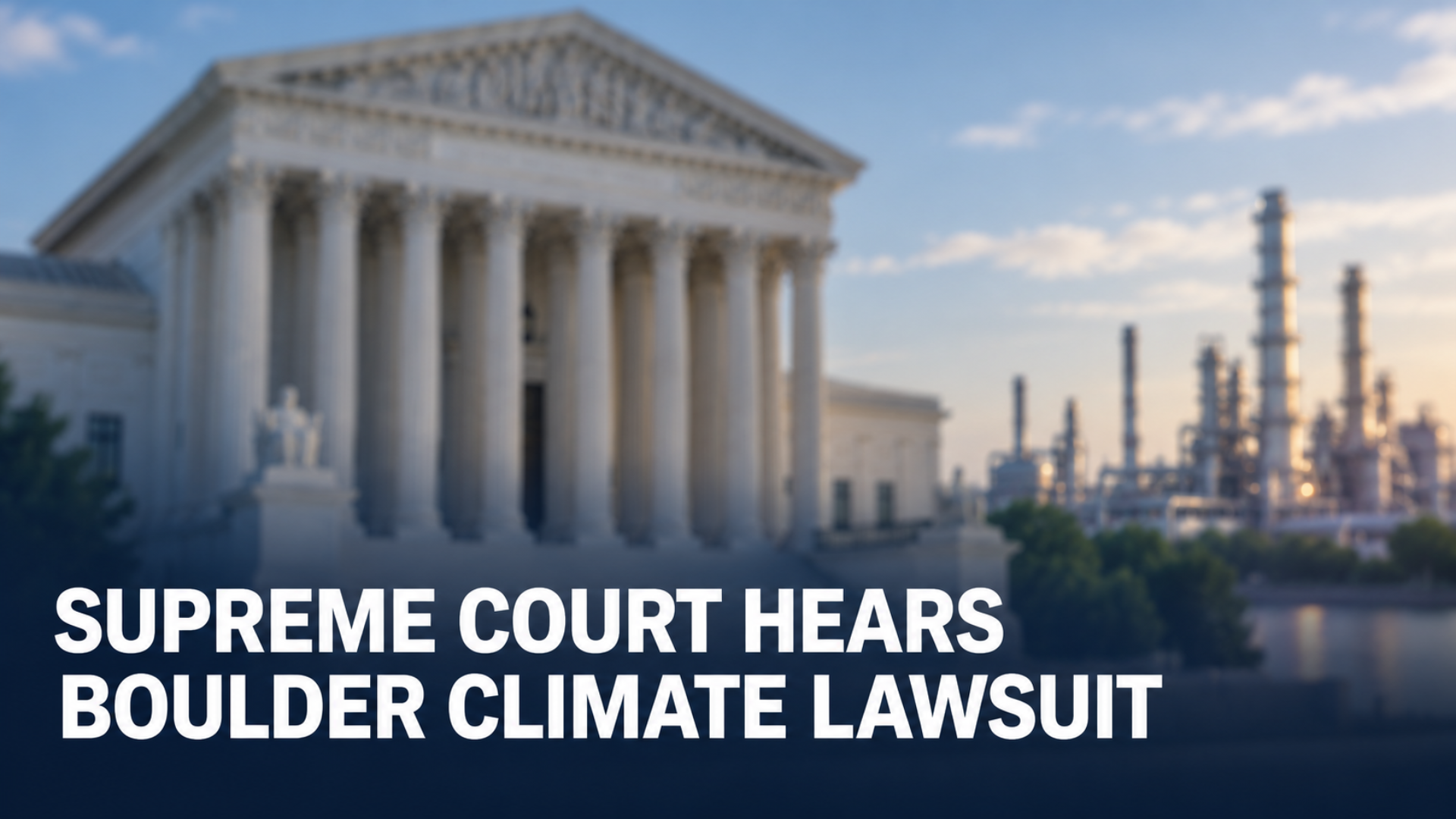
| Quick Report: The U.S. Supreme Court heard arguments on October 5 in ExxonMobil and Suncor Energy’s challenge to a climate damages lawsuit brought by the City of Boulder and Boulder County, Colorado. The companies argue that federal law bars the state-law claims. Boulder contends that it should be allowed to seek compensation for alleged local harms. The justices are also considering whether they have jurisdiction to review the case at this stage. No decision has been issued. |
The U.S. Supreme Court opened its new term Monday with a dispute over whether Boulder’s climate damages lawsuit against ExxonMobil and Suncor Energy can continue under Colorado law.
The case, Suncor Energy (U.S.A.) Inc. v. County Commissioners of Boulder County, No. 25-170, reached the justices after the Colorado Supreme Court rejected the companies’ federal preemption arguments.
The proceedings concern the legal availability of Boulder’s claims. They have not established that the companies are liable for the alleged damages.
Boulder Seeks Compensation for Alleged Climate-Related Harms
Boulder’s lawsuit, filed in 2018, alleges that the companies knowingly contributed to climate change while concealing the dangers associated with their fossil fuel products and misleading the public.
The city and county seek to recover costs associated with protecting their communities and property from climate-related harms. Their position is that those costs should not fall entirely on local taxpayers.
In a statement following Monday’s hearing, Boulder County said the plaintiffs were seeking the opportunity to have their claims heard in court. The allegations remain contested, and the Supreme Court hearing did not determine their factual merits.
Oil Companies Argue Federal Law Bars the Claims
The companies contend that claims involving the effects of interstate and international greenhouse gas emissions cannot proceed under individual states’ laws.
Their arguments invoke the Constitution’s structure, the federal Clean Air Act and federal authority over foreign affairs.
They maintain that litigation seeking compensation for global climate effects intrudes on matters governed at the national level.
Boulder disputes that federal law prevents its claims. It argues that the Clean Air Act displaced federal common law governing interstate pollution without eliminating the state-law remedies it seeks to pursue.
The Trump administration supports the companies’ position and participated in the Supreme Court argument.
Colorado Supreme Court Allowed the Litigation to Continue
The lawsuit previously moved through federal proceedings over whether it belonged in federal or state court. It ultimately returned to Colorado state court.
On May 12, 2025, the Colorado Supreme Court concluded that federal law did not preempt Boulder’s claims and returned the case to the trial court for further proceedings.
That ruling addressed the companies’ legal objections to the lawsuit moving forward. It did not resolve whether Boulder could prove its allegations or recover damages.
The companies subsequently sought U.S. Supreme Court review. The justices granted their petition on February 23, 2026.
Justices Also Consider Their Authority to Hear the Case
Alongside the federal preemption dispute, the Supreme Court is considering a threshold issue: whether it has statutory and constitutional jurisdiction to hear the case now.
When granting review, the Court expressly directed the parties to address that question.
Boulder argues that the Colorado Supreme Court’s decision is not a final judgment eligible for review at this stage. The underlying lawsuit has not yet produced a final determination of liability.
That jurisdictional issue could affect whether the justices reach the broader question of federal law’s effect on Boulder’s claims.
Decision Could Affect Other Climate Damages Lawsuits
The dispute carries potential consequences beyond Colorado because other state and local governments have brought similar lawsuits against fossil fuel companies.
A decision accepting a broad federal bar could restrict comparable claims. The effect on other cases would depend on the Court’s reasoning and the claims involved.
If Boulder’s lawsuit survives this review, further proceedings would still be necessary to determine whether the plaintiffs can establish liability and any entitlement to damages.
Supreme Court Ruling Remains Pending
Justice Samuel Alito is not participating in the case, leaving eight justices to consider the dispute. The Court’s docket records the October 5 argument but contains no subsequent decision as of October 7.
A ruling is expected by summer 2027.
Disclaimer: This article provides general information about publicly available court proceedings. Allegations are attributed to the parties and have not been established as findings of liability. This article does not constitute legal advice.