Last Updated: November 16, 2026
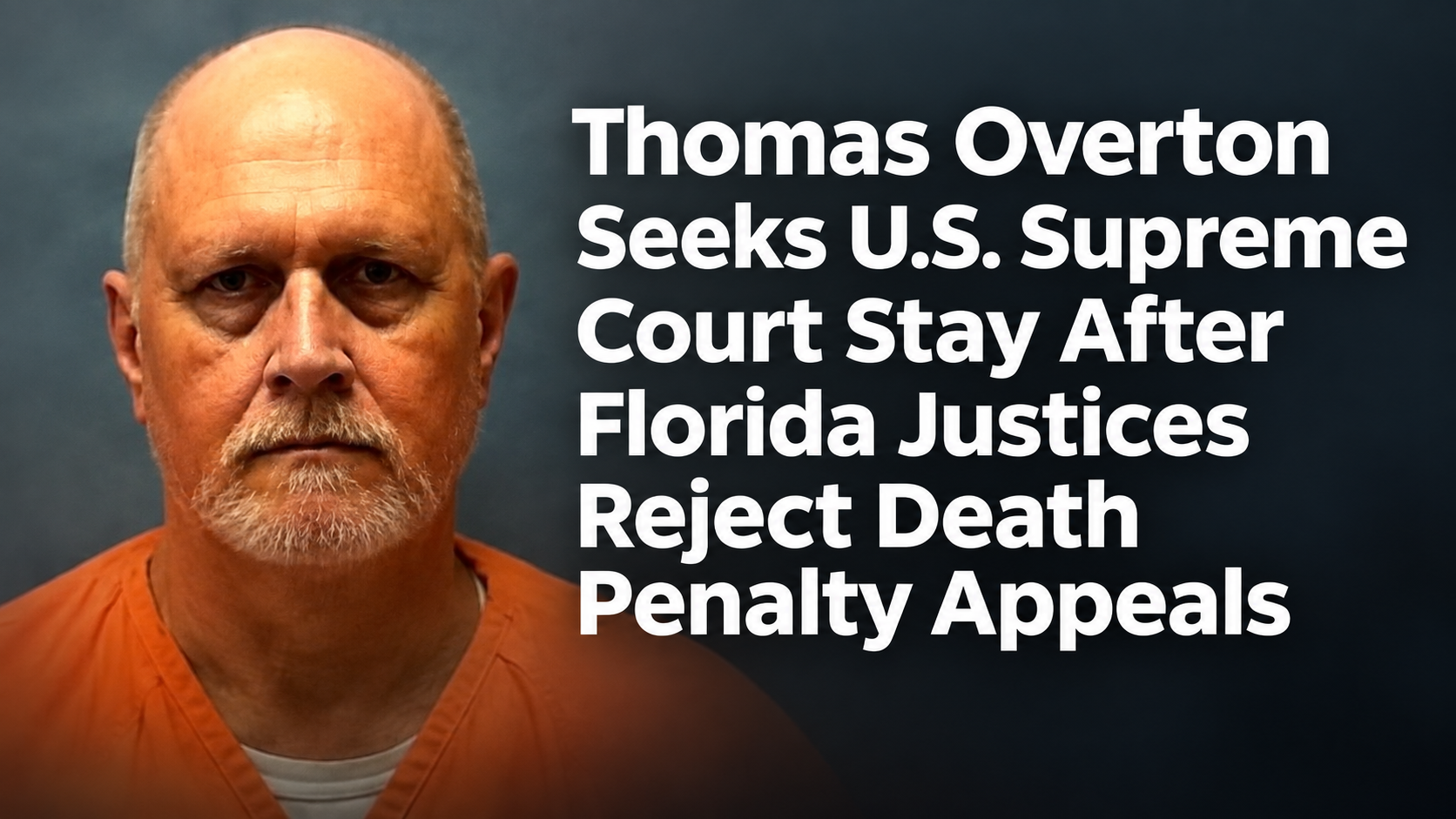
Image Source: Instagram
| Quick Report: Florida death-row prisoner Thomas Overton filed an emergency application with the U.S. Supreme Court on November 14, seeking to halt his scheduled November 19 execution. The filing followed a November 13 ruling in which the Florida Supreme Court upheld the denial of his latest post-conviction motion, rejected his separate habeas corpus petition, and declined to stay the execution. Overton’s attorneys challenge Florida’s clemency and execution-warrant procedures on constitutional grounds. His emergency application remained pending at the time of this report. |
Overton Asks U.S. Supreme Court to Halt November 19 Execution
Overton’s attorneys submitted an emergency application for a stay of execution to U.S. Supreme Court Justice Clarence Thomas on November 14.
The application was docketed as No. 26A686 and seeks to prevent Florida from carrying out Overton’s death sentences while the Court considers his related petition for a writ of certiorari.
Overton’s emergency application followed the state court’s rejection of his claims, bringing the dispute into the broader framework of U.S. Supreme Court appeals and emergency relief.
Overton argues that Florida’s death-warrant and clemency procedures violate constitutional protections, including due process, equal protection, and the separation of powers.
His application also raises concerns under the Eighth Amendment’s prohibition against cruel and unusual punishment.
The defense maintains that federal review is necessary because the state courts rejected his constitutional challenges without granting the requested relief.
The filing does not automatically suspend the execution. A stay would require action by the U.S. Supreme Court or another court with appropriate authority.
As of November 16, the Supreme Court’s public docket showed the application pending without an order granting a stay.
Florida Supreme Court Rejects Latest Post-Conviction Claims
On November 13, the Florida Supreme Court affirmed a lower court’s summary denial of Overton’s third successive motion for post-conviction relief.
The decision, issued in Overton v. State, Case Nos. SC2026-1724 and SC2026-1725, addressed multiple claims raised shortly before the scheduled execution.
The decision highlights the role of Florida appellate review in examining legal challenges to criminal convictions and sentences.
Overton argued that he was actually innocent and challenged aspects of Florida’s clemency and death-warrant process.
The court rejected his actual-innocence claim, explaining that Florida law does not recognize a freestanding post-conviction claim of actual innocence independent of newly discovered evidence.
The justices also concluded that Overton had not identified new evidence sufficient to support relief under the applicable procedural requirements.
Instead, the court determined that his arguments largely repeated earlier challenges to the prosecution’s trial evidence.
The ruling did not involve a new trial or an evidentiary finding establishing Overton’s innocence.
Court Rejects Clemency and Public Records Challenges
Overton also challenged Florida’s procedures for considering clemency and issuing execution warrants.
His attorneys argued that the state’s process lacked adequate constitutional safeguards.
The Florida Supreme Court rejected those arguments, relying on earlier decisions addressing similar challenges to the state’s clemency procedures.
Overton separately sought access to records from the Executive Office of the Governor, the Florida Commission on Offender Review, and the Department of Legal Affairs.
The requested materials concerned clemency decisions, correspondence, and matters connected to his case.
The trial court had sustained objections to those requests.
The Florida Supreme Court found no abuse of discretion in that decision, concluding that the requests lacked a sufficient connection to legally cognizable post-conviction claims or were overly broad.
The court emphasized that capital post-conviction public records procedures do not authorize unrestricted searches for potentially useful information.
Separate Habeas Corpus Petition Also Denied
Alongside his post-conviction appeal, Overton filed a separate habeas corpus petition challenging the constitutionality of Florida’s capital sentencing framework.
His petition argued that the state’s death-penalty system lacked sufficient safeguards against unconstitutional sentencing practices.
The Florida Supreme Court rejected the claim, citing established precedent upholding the constitutional safeguards provided by Florida’s capital punishment laws.
The court denied habeas relief and concluded that no stay of execution was warranted.
It directed that its mandate issue immediately and stated that no motion for rehearing would be entertained.
These rulings concluded the state Supreme Court proceedings addressed in the November 13 decision but did not prevent Overton from requesting federal Supreme Court review.
Death Sentences Stem From 1991 Florida Keys Murders
Overton was convicted in connection with the August 1991 murders of Susan MacIvor and her husband, Michael MacIvor, at their home in the Florida Keys.
Susan was eight months pregnant at the time.
The couple was last seen alive after attending a childbirth class on August 21. They were discovered dead inside their home the following day.
Investigators determined that both victims had been strangled and that Susan had been sexually assaulted.
DNA evidence collected during the investigation eventually linked Overton to the crime.
Overton was arrested in an unrelated attempted burglary in 1996. Investigators subsequently matched his DNA to evidence recovered from the murder scene, and additional testing confirmed the result.
A jury convicted Overton of multiple offenses, including first-degree murder, and he received death sentences for the killings.
The Florida Supreme Court affirmed his convictions and death sentences on direct appeal in 2001.
Since then, Overton has pursued multiple state and federal challenges to his convictions and sentences, including post-conviction motions, requests for DNA testing, and habeas corpus petitions.
Overton’s lengthy litigation history illustrates how post-conviction relief in Florida can involve constitutional claims, newly discovered evidence, and challenges raised after direct appeals.
Those proceedings did not result in the reversal of his death sentences.
What Happens Next?
Overton’s execution remains scheduled for The decision highlights the role of November 19, 2026, at 6:00 p.m. Eastern Time.
The U.S. Supreme Court must determine whether to grant his emergency request for a stay while his petition for review is considered.
A stay, if granted, would temporarily prevent the execution from proceeding as scheduled. It would not by itself overturn Overton’s convictions or death sentences.
If the application is denied and no other court grants relief, Florida may proceed with the execution under the existing warrant.
The November 13 Florida Supreme Court decision remains in effect. No U.S. Supreme Court order granting emergency relief had been verified as of November 16.
Related Reading: Understanding Capital Punishment and Appeals
Overton’s latest application highlights the distinction between a state court’s denial of post-conviction relief and a request for emergency intervention by the U.S. Supreme Court.
A prisoner facing execution may seek review of qualifying federal constitutional questions, but filing an application does not itself postpone an execution or guarantee that the Court will consider the underlying claims.
Brownstone Law explains the stages of capital sentencing, appellate review, and post-conviction proceedings in its guide: What Is Capital Punishment? Understanding the Death Penalty in the United States.
Disclaimer: This article provides general information and does not constitute legal advice. It reflects publicly available court decisions, filings, and docket information reviewed through November 16, 2026. Constitutional objections described in Overton’s emergency application are legal claims advanced by his attorneys, not established judicial findings. The filing of an emergency stay application does not automatically suspend a scheduled execution.