Last Updated: September 22, 2026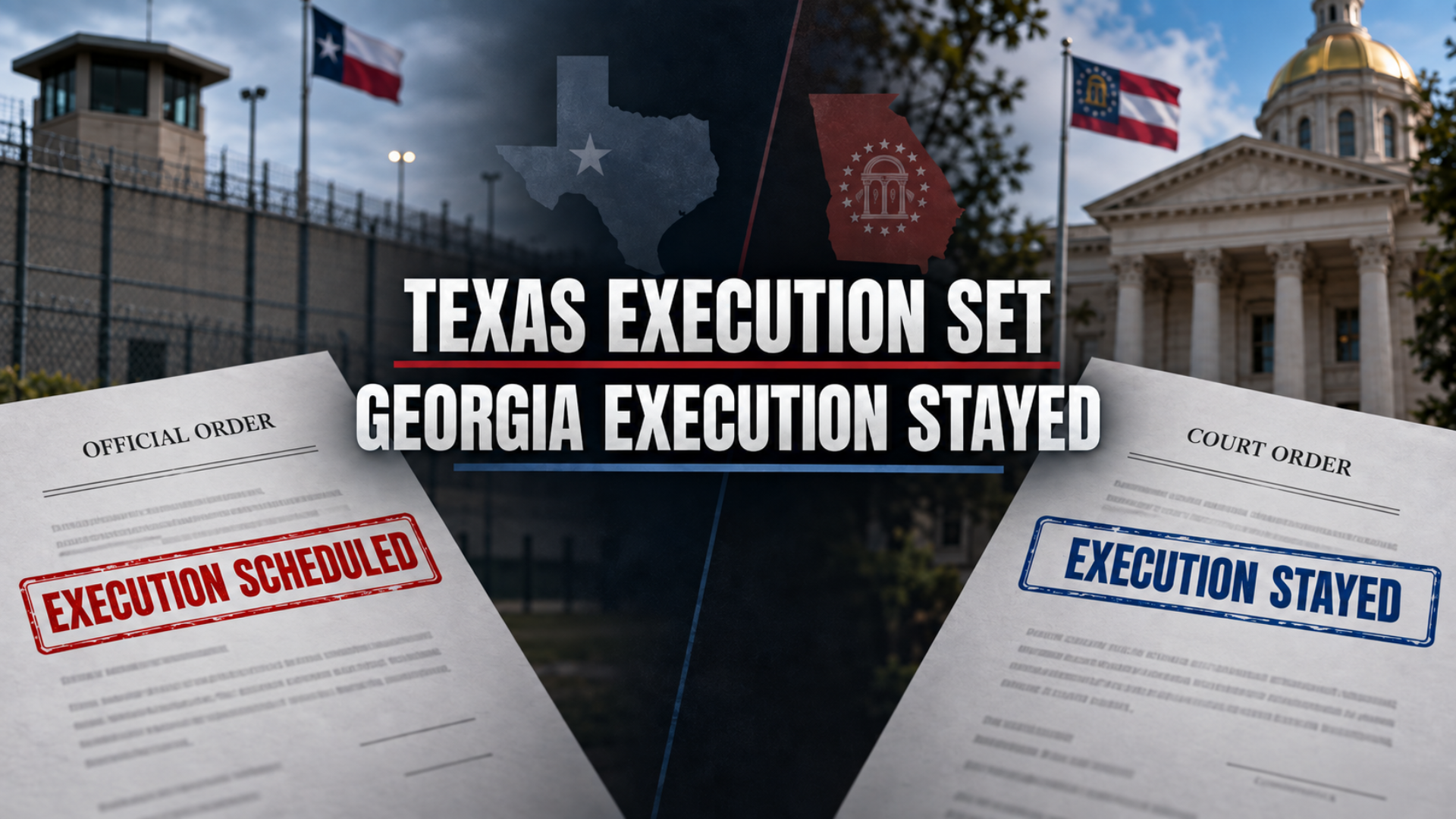
| Quick Report: Texas is scheduled to execute LeJames Norman on September 16, 2026, for the 2005 killings of Samuel Roberts, Tiffani Peacock and Celso Lopez in Edna. Norman’s attorneys have asked the U.S. Supreme Court to stay his execution after Texas courts rejected his latest request for relief. In Georgia, a judge has halted the execution of Stacey Humphreys, which was also scheduled for September 16, to allow a hearing under the Georgia Survivor Justice Act. |
Texas is preparing to carry out the execution of LeJames Norman, 40, while a separate execution scheduled for the same day in Georgia has been placed on hold by a state judge.
Norman is scheduled to receive a lethal injection at the Texas state penitentiary in Huntsville on September 16. Texas Department of Criminal Justice records continue to list his execution for that date.
Meanwhile, Cobb County Superior Court Judge Tyler Browning issued a stay preventing Georgia from immediately executing Stacey Humphreys, 53.
The order allows Humphreys to pursue a hearing seeking resentencing under a recently enacted Georgia law addressing defendants who experienced family violence or childhood abuse.
LeJames Norman Faces Execution for 2005 Texas Triple Murder
Norman was sentenced to death for the killings of Samuel Roberts, 24, Tiffani Peacock, 18, and Celso Lopez, 38, at a residence in Edna, Texas, on August 24, 2005.
Court records show Norman and co-defendant Ker’Sean Ramey entered the home intending to commit a robbery. The two believed cocaine was inside the residence, but no drugs were found. All three victims were fatally shot.
Norman was arrested approximately five months later while attempting to return to the United States from Mexico. He later pleaded guilty to capital murder, leaving a jury to determine his punishment. The jury sentenced him to death.
Ramey was separately convicted and sentenced to death for his role in the killings. Texas has scheduled his execution for September 23, one week after Norman’s scheduled execution.
Norman Seeks Supreme Court Stay Before Execution
Norman’s attorneys have continued pursuing last-minute judicial relief.
The Texas Board of Pardons and Paroles rejected requests to commute Norman’s death sentence or recommend a 90-day reprieve. The Texas Court of Criminal Appeals also denied a request to stay the execution based on claims concerning the prosecution’s presentation of evidence and arguments in Norman’s case.
On September 15, Norman submitted an application to the U.S. Supreme Court seeking a stay of execution while the justices consider his petition for a writ of certiorari.
His Supreme Court filing argues that his constitutional due-process rights were violated because, according to his attorneys, prosecutors relied on evidence and arguments at his sentencing that were materially inconsistent with positions taken in proceedings involving his co-defendant. The filing asks the Court to halt the execution while it considers that claim.
The Supreme Court previously declined in 2017 to review an earlier appeal from Norman concerning his legal representation at trial.
Texas nevertheless continues to list Norman’s execution for September 16.
Georgia Judge Halts Stacey Humphreys Execution
A separate execution scheduled for September 16 in Georgia has taken a different legal path.
Stacey Humphreys was sentenced to death for the 2003 murders of real estate agents Cyndi Williams, 33, and Lori Brown, 21, in Cobb County.
Georgia authorities had scheduled Humphreys to receive a lethal injection at 7 p.m. on September 16 at the Georgia Diagnostic and Classification Prison near Jackson. The execution order established a seven-day execution window running from September 16 through September 23.
The Georgia State Board of Pardons and Paroles denied Humphreys’ request for clemency on September 15. Later that day, however, Judge Browning issued a judicial stay of execution.
The stay allows further proceedings on Humphreys’ request for resentencing under the Georgia Survivor Justice Act.
What Is Humphreys Seeking Under the Georgia Survivor Justice Act?
Humphreys’ attorneys argue that severe abuse he experienced during childhood significantly contributed to his later conduct and that he is entitled to a resentencing hearing under the Georgia Survivor Justice Act.
The law provides a mechanism for certain people convicted of crimes to seek reduced sentences when they can establish that domestic violence or childhood abuse was a significant contributing factor to their criminal conduct.
The state argued that the legislation was not intended to provide this form of relief to death-row prisoners in Humphreys’ circumstances.
Judge Browning concluded that Humphreys was entitled to a hearing under the statute and stayed the execution so the claim could be considered. The ruling does not itself vacate Humphreys’ convictions or death sentence. Instead, it temporarily prevents the execution while the resentencing request moves through the courts.
Georgia may appeal the stay, meaning further appellate proceedings could determine whether the execution remains halted.
| Did You Know? A stay of execution temporarily stops a scheduled execution but does not, by itself, overturn the conviction or remove the death sentence. Read What Is a Stay of Execution? Meaning, Legal Process, and What Happens Next to understand when courts may grant a stay, how long it can remain effective, and what may happen after it ends. |
Humphreys Was Convicted of Two 2003 Murders
Humphreys was convicted of murdering Williams and Brown while they were working as real estate agents at a model home in Powder Springs, Georgia, on November 3, 2003.
According to the record summarized by Georgia authorities, Humphreys forced the women to disclose their bank PINs before killing them and later withdrew money from their accounts. He was arrested several days later in Wisconsin, where authorities recovered the firearm later identified as the murder weapon.
A jury found Humphreys guilty in 2007 of charges including malice murder, felony murder, aggravated assault, armed robbery and kidnapping with bodily injury. The jury recommended death sentences for the two murder convictions.
The Georgia Supreme Court affirmed his convictions and death sentences in 2010, and subsequent state and federal habeas proceedings did not overturn them.
What Happens Next in the Texas and Georgia Execution Cases?
The two cases now remain on different procedural tracks.
Norman’s execution remains scheduled in Texas for September 16 while his attorneys seek intervention from the U.S.
Supreme Court. His September 15 application specifically asks the justices to stay the execution while his new petition is considered.
In Georgia, Humphreys currently has a judicial stay preventing the state from carrying out his scheduled execution while his Survivor Justice Act claim is heard. The state can challenge that ruling through the appellate process.
Accordingly, Norman remains subject to an active execution date unless a court intervenes, while Humphreys’ execution cannot proceed under the present trial-court order unless that stay is lifted or otherwise modified.
Disclaimer: This article is provided for general informational purposes and reports on ongoing capital-punishment proceedings. Execution schedules, stays, clemency proceedings, and appellate rulings may change rapidly. The information reflects the status of these cases as of September 16, 2026, and does not constitute legal advice.