Last Updated: September 9, 2026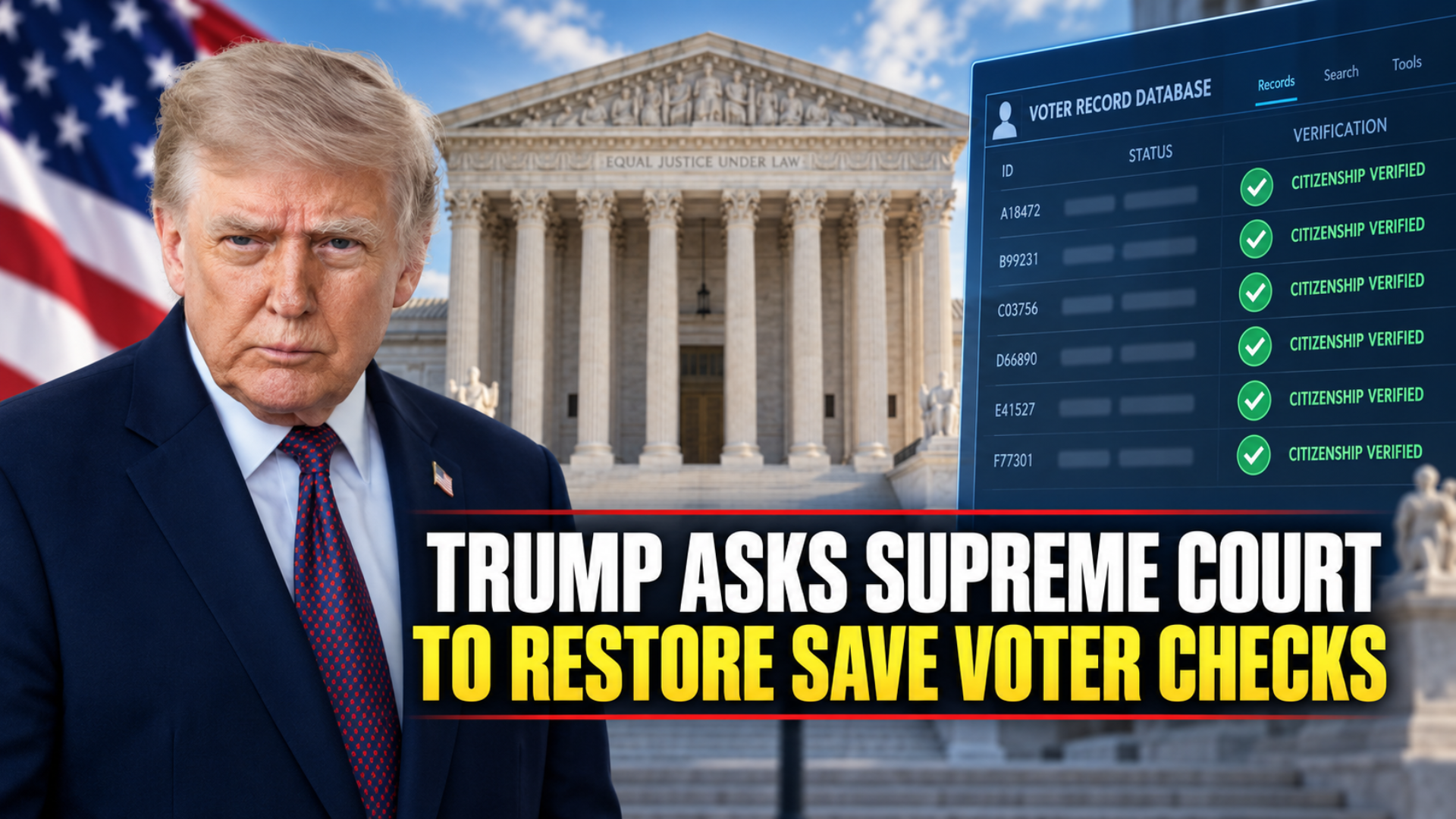
Image Source: Instagram
| Quick Report: The Trump administration has asked the U.S. Supreme Court to temporarily restore an expanded version of the federal SAVE database that states can use to check the citizenship status of registered voters. A federal district court blocked the modified system after concluding that federal agencies unlawfully combined and disclosed personal information, including Social Security Administration records. The administration argues that the system only provides verification information to states and does not itself remove anyone from a voter roll. |
The Trump administration has asked the U.S. Supreme Court to intervene in a dispute over the federal government’s expanded Systematic Alien Verification for Entitlements database, commonly known as SAVE.
On September 8, 2026, the Department of Homeland Security and other federal agencies filed an emergency application asking the justices to stay a lower-court judgment that prevents them from operating the modified SAVE system.
The expanded system allows authorized state and local officials to submit Social Security numbers and bulk voter-registration data when requesting citizenship verification. The administration maintains that these capabilities help states identify potentially ineligible voter registrations before the November 2026 midterm elections.
Voting-rights and privacy organizations contend that the modified system unlawfully uses sensitive personal information and can result in eligible U.S. citizens being incorrectly flagged for further review.
The Supreme Court has not ruled on the application. The expanded database functions challenged in the lawsuit therefore remain blocked.
What Is the SAVE Database?
SAVE is a federal verification service administered by U.S. Citizenship and Immigration Services, an agency within the Department of Homeland Security.
The system was originally developed to help federal, state, and local agencies verify a person’s immigration status or U.S. citizenship when administering public benefits, licenses, and other government programs. States have also used SAVE for voter-registration verification.
Before its 2025 modification, the system generally required a DHS-issued identifier, such as an alien registration number, and processed individual requests separately. Those limitations made it difficult to check the records of natural-born citizens, who ordinarily do not possess DHS immigration identifiers.
In May 2025, DHS announced significant changes to the system. The modified version allowed authorized agencies to:
1. search using full or partial Social Security numbers;
2. compare submitted information with Social Security Administration records;
3. check whether federal records identify a person as a citizen; and
4. upload multiple records for bulk verification.
The modifications followed an executive order directing federal agencies to make citizenship-verification resources available to state and local election officials.
SAVE does not independently determine whether a person is eligible to vote. State officials decide what action, if any, to take after receiving a response from the system.
Federal Court Blocked the Modified SAVE System
The League of Women Voters and other organizations challenged the expanded database in the U.S. District Court for the District of Columbia.
The plaintiffs argued that DHS and the Social Security Administration had improperly combined and repurposed personal records without satisfying federal privacy and administrative-law requirements. They also maintained that inaccuracies or incomplete citizenship information could cause eligible voters, particularly naturalized citizens, to face registration challenges or removal from voter rolls.
U.S. District Judge Sparkle Sooknanan ruled against the federal government in June 2026. The court concluded that the agencies’ implementation of the modified database violated federal law and vacated the challenged changes.
The district court’s judgment prevented the government from continuing to use the expanded SAVE functions, including the challenged exchange and disclosure of Social Security Administration information for voter verification.
The government asked the U.S. Court of Appeals for the District of Columbia Circuit to pause the judgment while its appeal proceeded. A divided D.C. Circuit panel declined to grant that relief, prompting the administration’s emergency application to the Supreme Court.
Trump Administration Challenges the Lower-Court Ruling
Solicitor General D. John Sauer filed the Supreme Court application on behalf of DHS, the Social Security Administration and other federal applicants.
The administration argues that the organizations and individual voters who filed the lawsuit lack Article III standing because SAVE does not cancel voter registrations or require states to take action against particular voters.
According to the application, the database provides citizenship or immigration-status information requested by government agencies. Any subsequent decision to investigate, challenge or cancel a voter registration is made by state officials under state law.
The government also contends that federal law requires DHS to respond when federal, state or local agencies request citizenship or immigration-status information for an authorized purpose.
Its filing disputes the conclusion that the data-sharing arrangement violates the Social Security Act. The administration states that SAVE users do not receive Social Security numbers from DHS and argues that the information provided through the system is authorized by federal immigration law.
These remain the administration’s legal arguments. The Supreme Court has not accepted them or determined that the lower courts applied the law incorrectly.
Challengers Raise Privacy and Voting-Rights Concerns
The organizations challenging the modified system argue that the federal government did not follow legally required procedures before connecting SAVE with Social Security Administration records and expanding its use.
They contend that citizenship information in Social Security records was collected for purposes unrelated to voter-registration reviews and may not reliably reflect a person’s current citizenship status.
For example, records can remain incomplete when a naturalized citizen does not subsequently update citizenship information with the Social Security Administration. A database response that fails to confirm citizenship does not necessarily establish that the person is not a citizen.
The challengers also argue that mass searches can expose substantially more voters to demands for citizenship documentation. They maintain that even though states make the final registration decisions, the federal system supplies the information that can trigger those actions.
The government counters that SAVE never conclusively identifies an individual as a noncitizen. According to its application, the system either confirms citizenship or informs the requesting agency that additional verification may be necessary.
Supreme Court Asked to Grant Emergency Relief
The case is before the Supreme Court as Department of Homeland Security v. League of Women Voters, No. 26A308.
The administration is seeking a stay pending further proceedings in the D.C. Circuit and, if necessary, the filing and disposition of a petition for Supreme Court review. Granting the application would temporarily suspend the district court’s judgment and permit the challenged SAVE functions to operate while the appeal continues.
To obtain a stay, the applicants generally must demonstrate, among other considerations, a reasonable probability of Supreme Court review, a fair prospect of succeeding on the merits, and a likelihood of irreparable harm if relief is withheld. The Court may also consider the relative harms to the parties and the public interest.
The administration argues that preventing states from using the expanded verification capabilities threatens election integrity and interferes with federal statutory responsibilities. The challengers maintain that restoring the system would expose eligible voters to privacy violations and potentially erroneous registration actions.
What Happens Next in the SAVE Database Dispute?
The Supreme Court may request a formal response from the organizations challenging the database before deciding the emergency application. It could then grant the requested stay, deny the application, or issue a temporary administrative order while considering the filings.
If the Court grants a stay, the federal government could resume the challenged SAVE operations while litigation proceeds in the D.C. Circuit. If the application is denied, the district court’s judgment would remain effective during the appeal.
An emergency order would address whether the modified system may operate temporarily. It would not necessarily resolve the underlying questions concerning federal privacy law, administrative procedure, standing, or the government’s authority to use Social Security Administration information for voter verification.
Disclaimer: This article is provided for general informational purposes and reports on ongoing litigation. The legal and factual claims described in the parties’ filings remain disputed. The U.S. Supreme Court has not restored the modified SAVE system or issued a final decision on the legality of its voter-verification functions. This article does not constitute legal advice.