Last Updated: September 17, 2026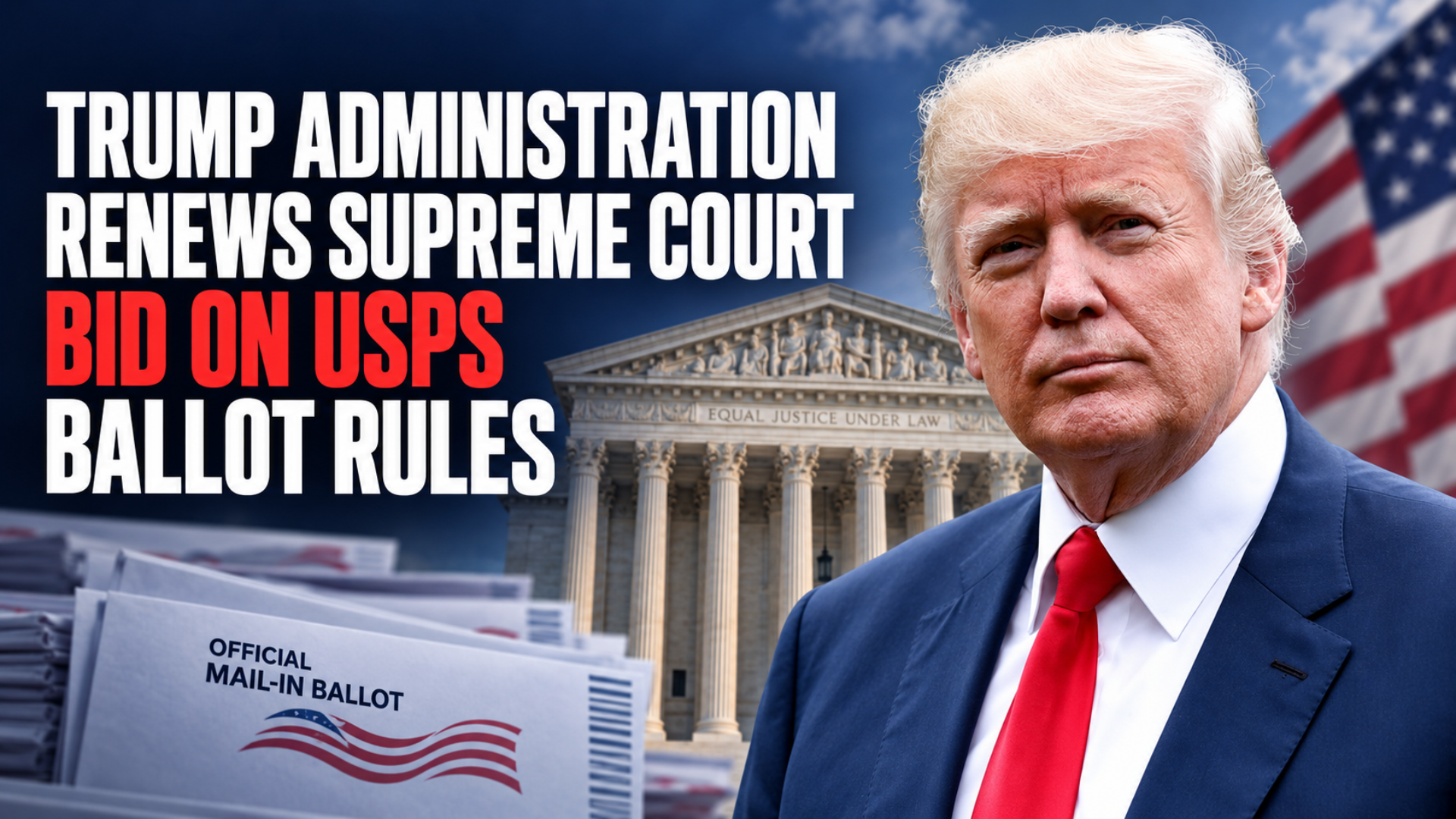
Image Source: Instagram
| Quick Report: The Trump administration has filed a new emergency application with the U.S. Supreme Court seeking to enforce key U.S. Postal Service requirements for federal mail ballots before the November 3, 2026, midterm elections. The filing follows a September 4 preliminary injunction by U.S. District Judge Indira Talwani blocking mandatory portions of the USPS rule. Justice Ketanji Brown Jackson ordered responses to the new application by 4 p.m. EDT on September 9. |
The Trump administration has again asked the U.S. Supreme Court to allow the U.S. Postal Service to implement new requirements governing federal election mail after a federal judge blocked mandatory portions of the rule.
The government filed its new emergency application on September 6, two days after U.S. District Judge Indira Talwani issued a preliminary injunction preventing USPS from implementing specified provisions of its final rule for elections taking place on or before November 3.
The Supreme Court docket identifies the matter as United States Postal Service, et al. v. California, et al., No. 26A305. The application was submitted to Justice Ketanji Brown Jackson, who handles emergency matters from the First Circuit.
The administration had previously filed a September 3 emergency application seeking relief from an earlier temporary restraining order. Brownstone Law previously reported on that request in its earlier Supreme Court filing.
After Judge Talwani issued the September 4 preliminary injunction, Solicitor General John Sauer withdrew the September 3 application and filed the new application challenging the preliminary injunction instead. The Supreme Court docket confirms that distinction.
Judge Blocks Mandatory Portions of USPS Rule
Judge Talwani issued a temporary restraining order on August 27 blocking USPS from implementing parts of the new mail-ballot system.
On September 4, she replaced that temporary order with a preliminary injunction covering the November 3 federal elections.
The injunction specifically prevents USPS from implementing or taking further preparatory steps to implement several mandatory provisions of its final rule, Ballot Mail for Federal Elections. The blocked provisions include requirements concerning USPS review of ballot envelopes, registration for the Postal Service’s federal ballot-mail portal, voter enrollment in that portal, and certain related ballot-mail processing requirements.
The order applies to elections occurring on or before November 3, 2026. Judge Talwani also dissolved the August 27 temporary restraining order when issuing the preliminary injunction.
The ruling is not a final judgment on the legality of the USPS rule. It provides interim relief while the underlying litigation continues.
| What is a preliminary injunction? The court’s order provides temporary relief while the USPS rule is being challenged; it does not decide the lawsuit’s final outcome. For an explanation of preliminary injunctions, temporary restraining orders, and how courts decide whether to grant them, read Brownstone Law’s guide: What Is Injunctive Relief? Types and Legal Requirements . |
Administration Asks Supreme Court to Stay Injunction
The administration is asking the Supreme Court to stay Judge Talwani’s September 4 injunction while its appeal proceeds.
The government argues that USPS has authority to establish requirements governing federal ballot mail and that the injunction creates uncertainty for election officials as states prepare to distribute ballots.
The administration maintains that the rule concerns the handling and processing of federal election mail rather than determining which voters are legally eligible to vote.
Opponents argue that the Postal Service rule goes beyond USPS’s authority and improperly interferes with state control over election administration. Judge Talwani’s September 4 order found that the challengers had made the showing required for preliminary injunctive relief and concluded that they were likely to succeed on several claims challenging the rule’s authority under federal law.
What the USPS Rule Changes
The USPS finalized its Ballot Mail for Federal Elections rule in August.
The rule establishes standards for federal ballot mail, including requirements relating to ballot-envelope design and the submission of voter information through a USPS portal.
Under the rule, states using USPS for federal election ballot mail would be required to follow specified mailpiece design and data-reporting standards. The rule also establishes procedures involving USPS review of ballot envelopes and voter enrollment information.
The district court’s injunction does not strike down the entire rule.
Instead, it blocks specifically identified mandatory provisions, including portions dealing with envelope standards, USPS portal registration, and voter enrollment for the November election.
The administration argues that these requirements fall within USPS’s authority to regulate the handling of mail. The challengers contend that the requirements effectively interfere with state election procedures and could create problems for voters if implemented shortly before the election.
Election Preparations Add Urgency
The dispute comes as states begin preparing and distributing mail ballots for the November midterm elections.
North Carolina has already begun sending absentee ballots to voters. The timing has become a central issue in the litigation because election officials would have limited time to modify established procedures if the USPS requirements take effect.
The administration argues that leaving the requirements blocked or voluntary could create uncertainty as states prepare their election mail systems.
Opponents argue that requiring states and local election officials to make substantial changes shortly before Election Day could itself create confusion and increase the risk of voters being affected by implementation problems. Judge Talwani’s September 4 order cited the practical difficulties of implementing the system before the upcoming election.
Supreme Court Had Previously Considered Related Litigation
The latest application follows earlier litigation over President Donald Trump’s March 2026 executive order concerning federal elections and mail voting.
In the earlier litigation, the Supreme Court granted the government’s request for a stay on August 24. Judge Talwani’s September 4 ruling explains that the earlier Supreme Court proceeding concerned an injunction involving the executive order before the current USPS rule had been fully challenged following its finalization.
The current emergency application concerns the September 4 preliminary injunction against mandatory portions of the finalized USPS rule.
The Supreme Court’s August 24 action therefore did not finally determine whether the finalized USPS rule is lawful.
Supreme Court Sets September 9 Deadline
Supreme Court Justice Ketanji Brown Jackson has ordered responses to the government’s new emergency application by 4 p.m. EDT on September 9, 2026. The Supreme Court docket confirms that the September 6 application, No. 26A305, replaced the government’s earlier September 3 application, No. 26A297.
As of September 7, the Supreme Court has not ruled on the new application.
The Court could grant a stay of the preliminary injunction, deny the request, or issue another order while the litigation continues. The underlying appeal is also proceeding in the U.S. Court of Appeals for the First Circuit.
Unless a higher court stays or modifies Judge Talwani’s order, the provisions specifically covered by the September 4 preliminary injunction will remain blocked for elections occurring on or before November 3.
Disclaimer: This article is provided for general informational purposes and is based on publicly available court filings and reporting concerning ongoing litigation over the U.S. Postal Service’s mail-ballot rule. As of September 7, 2026, the Supreme Court has not ruled on the government’s September 6 emergency application. The September 4 preliminary injunction is not a final determination regarding the legality of the USPS rule. Statements describing the positions of the government or the challengers reflect the parties’ arguments and should not be treated as judicial findings. The legal status of the disputed provisions may change as the litigation proceeds. This article does not constitute legal advice.