Last Updated: September 15, 2026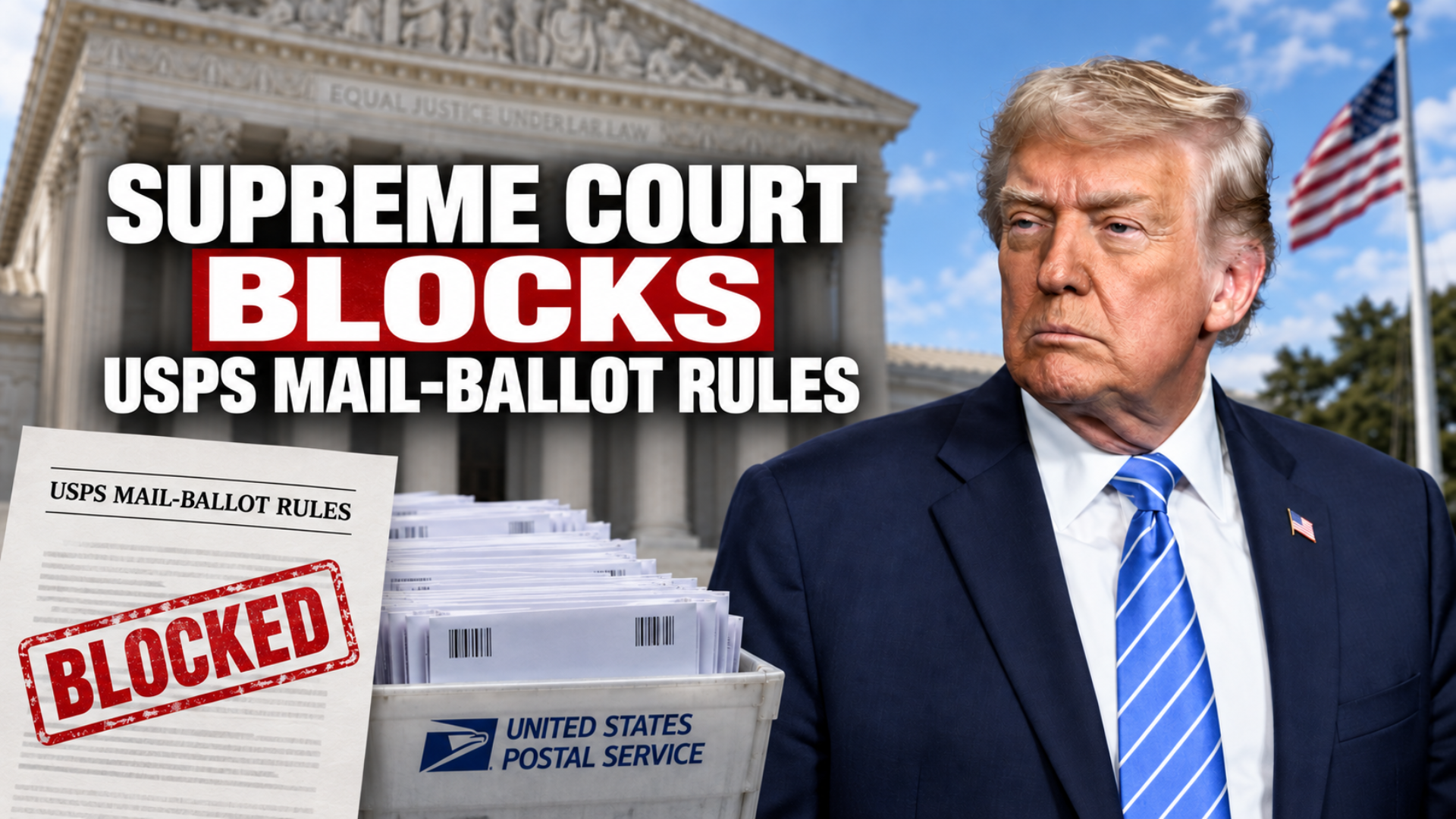
| Quick Report: The U.S. Supreme Court has rejected the Trump administration’s emergency request to enforce new U.S. Postal Service requirements for mail ballots before the November 2026 midterm elections. The Court’s September 14 action leaves a lower-court injunction blocking the rules in place. The disputed requirements would have directed states to submit information about eligible mail voters through a federal system and use approved ballot envelopes containing unique barcodes. Justices Samuel Alito and Clarence Thomas dissented, while Justice Brett Kavanaugh agreed that the rules should remain blocked for the upcoming election but indicated that the government’s legal arguments could receive further consideration in a future case. |
The U.S. Supreme Court has declined to allow the Trump administration to enforce new Postal Service rules governing mail ballots during the 2026 midterm elections.
The Court rejected the administration’s emergency application on September 14, leaving in effect an injunction issued by a federal judge in Massachusetts. As a result, states may continue distributing and processing mail ballots under their existing procedures without immediately complying with the disputed federal requirements.
The Supreme Court’s action came as mail voting had already begun in some states and election officials across the country were preparing to distribute millions of absentee and mail-in ballots ahead of the November 3 election.
The order does not finally resolve whether the Postal Service could adopt similar requirements in the future. It determines that the administration cannot enforce the challenged rules during the current election while the underlying litigation continues.
Supreme Court Leaves USPS Mail-Ballot Injunction in Place
The Trump administration asked the Supreme Court to stay a preliminary injunction that prevented the Postal Service from implementing its new mail-ballot regulations.
The rules were developed in response to a March 2026 executive order directing federal agencies to introduce additional requirements affecting voting by mail.
Under the finalized Postal Service rule, state and local election authorities using the mail to distribute ballots would have been required to provide information identifying eligible mail voters through a federal online portal.
Election officials also would have been required to use approved ballot envelopes containing unique barcodes connected to individual voters. The Postal Service could have returned batches of ballots that did not satisfy the new requirements, potentially delaying their delivery to voters.
A federal district court in Massachusetts blocked the regulations after concluding that the challengers were likely to succeed on their claim that the federal government had exceeded its authority over elections.
The Trump administration then sought emergency relief from the Supreme Court, asking the justices to permit enforcement of the rule before the midterm elections.
The Supreme Court declined that request, meaning the injunction remains in effect while the case proceeds through the federal courts.
Justices Reject Immediate Enforcement Before Midterms
The Supreme Court’s decision prevents the new Postal Service requirements from taking effect only weeks before Election Day.
Justices Samuel Alito and Clarence Thomas dissented from the Court’s refusal to lift the injunction.
Justice Brett Kavanaugh did not join the dissent. He agreed that the regulations should remain blocked for the 2026 election because implementing extensive new requirements after mail voting had already begun could disrupt election administration.
Kavanaugh nevertheless indicated that the Postal Service’s authority to establish requirements for election-related mail could warrant consideration in a future case presented outside the immediate pressures of an ongoing election.
The Court’s action therefore does not establish a final rule governing every future attempt by the Postal Service to regulate ballot mail.
Instead, it leaves the existing injunction in place for the current election while the underlying legal questions remain unresolved.
New Rules Required Voter Lists and Approved Envelopes
The challenged regulations would have imposed two major categories of requirements on election officials using the Postal Service to distribute mail ballots.
First, state and local authorities would have been required to submit identifying information for voters authorized to receive mail ballots. That information would have been uploaded to a federal portal and used by the Postal Service to verify ballot recipients.
Second, ballot envelopes would have been required to satisfy specific design and processing standards. These included approved election-mail markings, machine-readable formatting and unique barcodes associated with individual voters.
The Postal Service planned to examine samples from batches of outgoing ballots. A discrepancy between an envelope and the voter information submitted through the portal could have caused the entire batch to be returned to election officials for correction.
State election administrators challenging the plan argued that the portal and verification systems were not ready for nationwide use. They also warned that redesigning, printing and securing approval for ballot envelopes shortly before Election Day could lead to delays and prevent eligible voters from receiving ballots on time.
The administration maintained that the requirements were permissible regulations governing the Postal Service’s handling of election mail and were intended to strengthen election security.
Second Federal Judge Also Blocked the USPS Rules
Shortly before the Supreme Court acted, a federal judge in Washington, D.C., issued a separate preliminary injunction against the same Postal Service regulations.
That court concluded that the challengers were likely to establish that Congress had not authorized the Postal Service to create a voter-registration system or screen ballot recipients through a federal database.
The Washington ruling focused primarily on statutory authority, while the Massachusetts litigation also raised constitutional questions concerning the respective powers of the states, Congress and the executive branch over federal elections.
The existence of the second injunction meant that the regulations faced an additional legal barrier even if the Supreme Court had granted the administration’s request in the Massachusetts case.
Both rulings remain preliminary. The courts have not yet entered final judgments resolving all challenges to the legality of the Postal Service plan.
Decision Follows Multiple Supreme Court Applications
The September 14 ruling follows several rounds of emergency litigation over the administration’s mail-ballot plan.
As Brownstone Law previously reported in its coverage of the administration’s renewed Supreme Court application, the federal government asked the justices to allow enforcement of the finalized Postal Service regulations before the 2026 midterms.
Earlier proceedings had addressed provisions of the president’s executive order before the Postal Service completed its final rule. After the regulations were finalized, the challengers returned to court and obtained new preliminary relief directed at the completed requirements.
The September 14 action resolves the administration’s immediate request to enforce the finalized rule during the current election. It does not end the litigation or prevent the government from continuing to defend the Postal Service’s authority in the lower courts.
Existing Mail-Voting Procedures Remain in Place
Because the Supreme Court declined to stay the injunction, election officials are not required to adopt the new federal voter-list and ballot-envelope procedures for the November 2026 election.
The Postal Service must continue handling election mail without enforcing the challenged provisions while the injunction remains operative.
The ruling is particularly consequential for jurisdictions that had already printed or distributed ballot envelopes using their existing designs. Those jurisdictions will not be required to replace their materials or complete the new federal registration process immediately before the election.
Mail voting is available in every state in some form, including absentee voting for military personnel and Americans living overseas. Several states conduct elections predominantly by mail, while others permit absentee voting under varying eligibility requirements.
The Supreme Court’s decision avoids an immediate nationwide change to those procedures after the 2026 election process had already begun.
What Happens Next in the USPS Mail-Ballot Case?
The underlying lawsuits challenging the Postal Service regulations will continue in the federal courts.
The government may continue arguing that the Postal Service possesses statutory authority to regulate the conditions under which it processes and delivers election mail. The states and organizations challenging the rules may continue pursuing their constitutional and statutory claims.
The lower courts will eventually determine whether the regulations can lawfully be implemented in a future election or whether they exceed the authority granted to the executive branch and the Postal Service.
Any final judgment could be appealed and may ultimately return to the Supreme Court through the ordinary appellate process.
For the November 3, 2026, midterm elections, however, the Supreme Court’s September 14 decision means the new voter-list, verification and ballot-envelope requirements cannot presently be enforced.
Disclaimer: This article is provided for general informational purposes and reports on ongoing election-related litigation. The Supreme Court’s action concerns an emergency request to stay a preliminary injunction and does not constitute a final decision on the legality of the Postal Service regulations. The parties’ constitutional and statutory claims remain subject to further judicial proceedings. This article does not constitute legal advice.