
Did you or a loved one ever leave the courthouse with a decision you didn’t expect? Maybe it’s a conviction that feels wrong. Maybe it’s a civil judgment that could crush your business. You’re trying to stay steady, but one question keeps coming back: “Can I appeal… or is that not an option anymore ?”
Most people think an appeal means going back to court to retry everything: new evidence, new witnesses, a fresh start.
But that’s not how it works.
Appellate law operates differently. Instead of replaying the trial, an appeal asks a higher court to examine whether legal mistakes were made in the lower court decision.
Let us read about this in detail.
Stay tuned with us for more.
What Is Appellate Law?
Appellate law is the area of law focused on challenging (or defending) a lower court’s decision in a higher court.
An appeal is a request for a higher court to review a decision, not re-try the facts. Appellate judges generally focus on:
Legal errors (wrong legal standard, wrong interpretation of law)
Procedural errors (rules applied incorrectly)
Certain discretionary decisions (when a judge’s call was unreasonable under the law)
That’s why appellate work looks different from trial work: it’s built on careful reading, legal research, and persuasive writing, not witness examinations.
What Is An Appellate Attorney And What Do They Actually Do?
An appellate attorney is a lawyer who focuses on challenging or defending lower‑court decisions in appellate courts. They study the record (transcripts, filings, rulings), identify appealable legal errors, write persuasive briefs, and (sometimes) argue the case orally before a panel of judges.
How Does The Appellate Court Process Work?
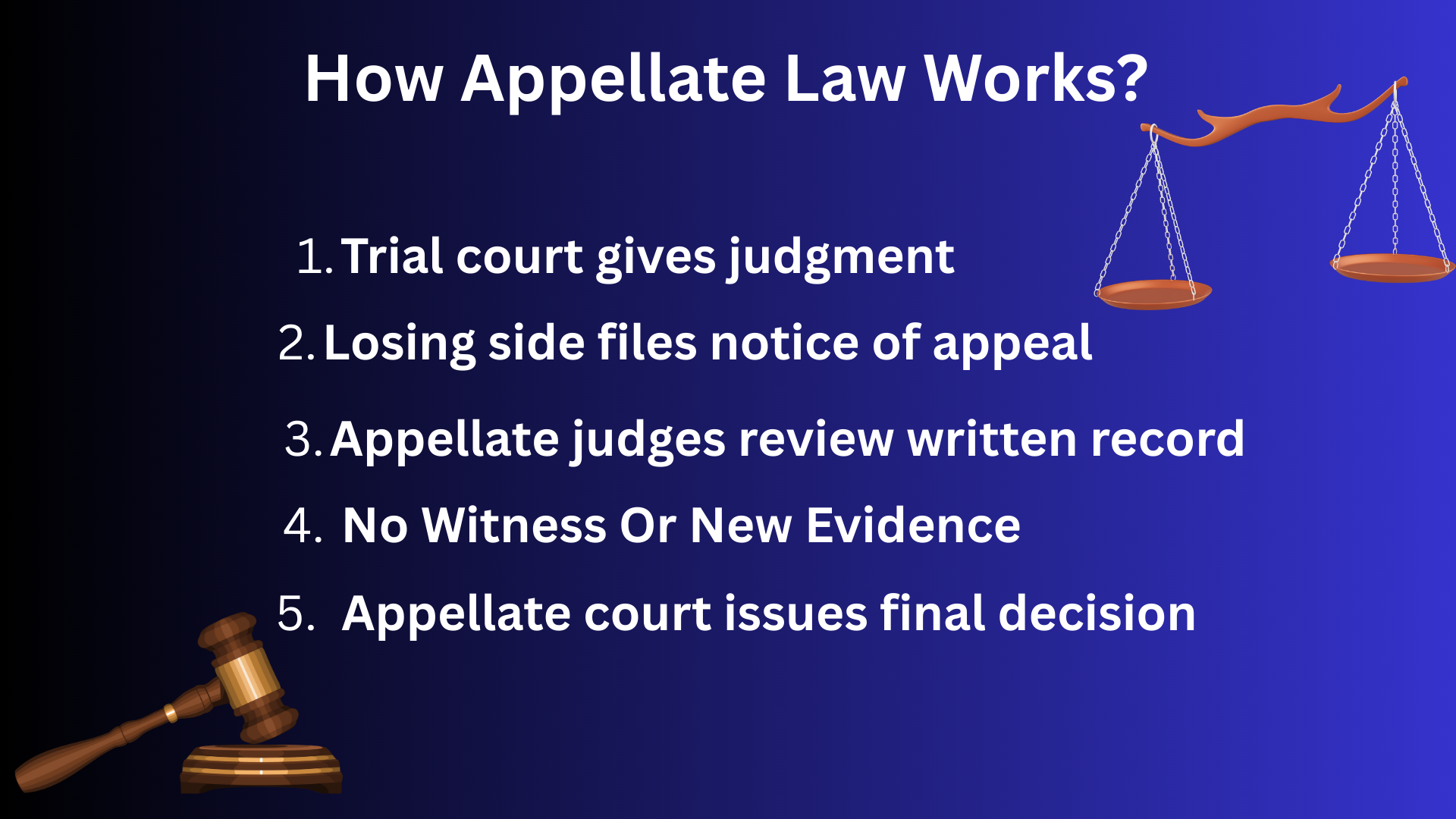
Filing A Notice Of Appeal:
The appellate process starts with filing a notice of appeal in the trial court within the deadline. This filing tells the system what you want reviewed; it does not explain your arguments yet.
Preparing The Record:
Next, the “record” from your case is put together: transcripts, exhibits, motions, and the judge’s orders. The appellate court will decide your case only from this record, not from new testimony or new evidence.
Writing And Filing The Briefs
Your appellate lawyer files an opening brief explaining the facts, the legal errors, and what result you are asking for. The other side files an answer brief defending the trial court’s ruling, and your lawyer may submit a short reply brief to answer those arguments.
Possible Oral Argument
In some cases, the appellate court decides everything on the written briefs.
In others, the court schedules an oral argument, where the lawyers appear before a panel of judges, answer questions, and highlight the key legal issues.
The Court’s Decision
After reviewing the record and the briefs (and any oral argument), the judges issue a written decision.
They may affirm the ruling (leave it in place), reverse it, modify it, or remand the case back to the trial court with instructions on what must happen next
Can An Appellate Court Take Additional Evidence?
In most appeals, No.
Appellate courts review the existing trial record to decide whether the law was applied correctly and the proceedings were fair.
If you believe new evidence changes everything, that may point to a different legal path (like a motion for a new trial or post-conviction relief) rather than a straight appeal.
A good appellate lawyer will tell you which route fits your situation, and which deadlines matter most.
Why Appeal Deadlines Matter (And How Fast You Must Act)
One of the most useful truths is that appeals run on strict clocks. In federal court, for example, the time to file a notice of appeal is commonly:
- Civil cases: typically 30 days after entry of judgment (often 60 days if the U.S. is a party)
- Criminal cases: a defendant typically has 14 days
Deadlines vary by jurisdiction and case type, but the takeaway is consistent:
If you’re even thinking about an appeal, it’s worth speaking to an appellate lawyer early (before time closes the door).
Are appeals usually successful? (A realistic, hopeful answer)
Many people feel discouraged because they hear “appeals rarely work.” The truth is more specific, and recent federal data shows why appeals still matter.
In New York’s appellate courts (2024), 75-81% of criminal appeals were affirmed, with reversals or modifications occurring in 19-25% of cases.
Michigan’s appellate data shows a similar pattern: 74% of criminal appeals were affirmed, with 18-26% receiving some form of relief.
These numbers might sound discouraging until you understand what they really mean. When a court “affirms,” it doesn’t mean your trial was fair or just, it means the appellate judge found no reversible legal error based on the written record from the trial court.
That 19-25% reversal rate, however, represents real people who won relief: cases remanded for new trials, convictions overturned, sentences reduced or modified.
The critical insight is this:
The difference between cases that fail and cases that succeed rarely comes down to luck. It comes down to identifying the legal issues that appellate judges actually care about and presenting those issues with disciplined, persuasive briefing.
That’s where an experienced appellate court attorney becomes invaluable, spotting the reversible errors that others miss and building arguments that judges find impossible to ignore.
What Do Appellate Lawyers Look For In The Record?
If you’re wondering, “Do I have grounds?” This is where an appellate lawyer earns their keep. They typically:
Order and review the record (transcripts, exhibits, motions, rulings)
Spot legal issues worth briefing
Check whether issues were preserved (raised properly at the right time)
Match issues to standards of review (some issues are easier to win than others)
Build a tight, persuasive written brief
Prepare for oral argument (if granted)
In the BJS state criminal appeals data, some of the most common issues courts addressed included sufficiency of the evidence (15%) and excessive/inconsistent sentencing (10%), exactly the kinds of issues that live in the record.
What Happens If The Appeal Is Denied?
If the appellate court denies relief (often called “affirming” the lower court), you may still have options depending on your case:
Rehearing/rehearing en banc (asking the same court to reconsider under strict rules)
Discretionary review by a higher court (like a state supreme court or the U.S. Supreme Court—rarely granted)
Post-conviction relief (in criminal cases, a different process than direct appeal)
This is another moment where a lawyer’s guidance matters: the next step is often deadline-driven and strategy-driven.
How Much Does An Appellate Lawyer Cost?
Costs vary widely because appeals vary widely. What usually drives price:
size of the record (one-day hearing vs multi-week trial transcript),
number/complexity of issues,
whether oral argument is likely,
the court and briefing requirements.
A trustworthy appellate lawyer will usually explain:
whether they offer flat fee vs hourly billing,
what’s included (record review, brief writing, oral argument),
and what a realistic budget range looks like after they evaluate your record.
An Appeal Is A Second Look, If You Act In Time
When life gets rearranged by one ruling, it’s normal to feel stuck between urgency and uncertainty. Appellate law exists to correct legal mistakes and keep the law applied fairly
If you’re even thinking about an appeal, the smartest early step is simple:
Sit down with an appellate lawyer
Bring the judgment or order
Ask for a focused review of the record, deadlines, and options.
A brief consultation with Brownstone Law can turn confusion into a concrete plan—because in appellate work, what matters most is catching the right issues, filing on time, and presenting them in clear, precise writing.