False and misleading statements can easily jeopardize years of hard work by a business. Looking for legal recourse is often the first response of a business. However, business defamation and business disparagement are two distinct legal concepts. You need the right strategy to protect your business. For that, you need to understand the core difference between defamation and disparagement.
- Business defamation is an attack on your identity as an entity (your character, integrity, and reputation).
- Business disparagement is an attack on what you sell (the quality, safety, or title of your goods and services).
Can a business sue for defamation, or should you pursue a disparagement claim? The devil is in the details.
What Is Business Defamation?
Business defamation is the legal claim you use when someone makes a false statement that directly attacks the honesty, integrity, or financial stability of your business entity or its leadership.
Can a company sue for defamation?
Under US law, yes. A corporation, LLC, or partnership has a business reputation to uphold, and the law allows businesses to protect that reputation from malicious lies. However, you must prove the following four elements in court:
- A False Statement of Fact
- Publication
- Fault (Negligence or Malice)
- Harm
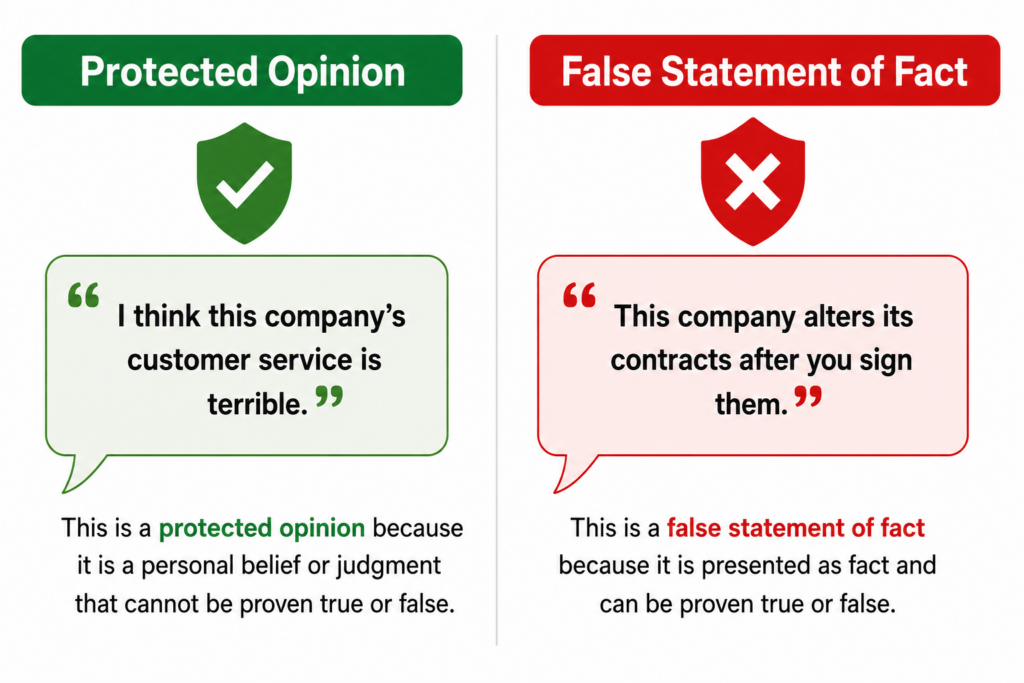
It must be a false statement presented as a factual claim, not an opinion.
The false statement must have been communicated to at least one third party, such as a Google review, a social media post, an email to a client, or a spoken conversation.
Negligence
You must prove that the person who made the statement did not exercise reasonable care to check the facts.
Malice
They knew they were lying and said it anyway.
The statement caused actual financial loss or damaged your reputation.
What Is Business Disparagement?
Business disparagement is the legal claim you use when someone makes a false statement that attacks the quality, safety, or value of your goods, services, or property title.
The Higher Legal Hurdle
The law treats economic interests differently from reputational integrity, which makes it much harder to prevail in a disparagement claim. You must meet the following strict requirements:
- Proving Actual Malice
- Proving “Special Damages” (The Forensic Financial Proof)
You must prove that the defendant published the lie with the specific, malicious intent to sabotage your sales and cause you financial harm. Either they knew that their statement was false, or they acted with reckless disregard for whether it was true or false.
The law does not presume damages in a disparagement case. You must present precise, quantifiable, and itemized financial proof to prove the direct link between the specific lie and a specific financial loss. This requires forensic accounting data to show:
Lost Specific Transactions
A client canceled a signed contract or backed out of a deal after reading or hearing the false statement.
An Identified Loss of Market
A measurable, sudden drop in specific product sales immediately following the false statement.
Core Differences
What Is Being Protected?
- Business defamation protects your reputation and integrity.
- Business disparagement protects the economic value, quality, safety, or title of your goods, services, or property.
What Did the Lie Attack?
- You file a business defamation claim when the false statement attacks who you are as a business.
- A business disparagement is filed when a false statement attacks what you sell as a business.
Burden of Proof on Intent
- In the case of business defamation, you only need to prove the speaker was careless and failed to check the facts.
- In the case of business disparagement, you must prove the speaker knew they were lying or utterly ignored the truth to intentionally hurt your sales.
Requirement of Financial Evidence
- In the case of business defamation, if the lie falls under defamation per se (like accusing you of a crime), the court presumes harm; you don’t need to prove a lost dollar to sue.
- In the case of business disparagement, you must provide itemized, forensic financial evidence of damages, such as specific lost contracts or lost revenue.
Primary Legal Objective
- Business defamation aims to restore the company’s name and seek compensation for general reputational harm.
- Business disparagement aims to recover specific, quantifiable financial losses directly caused by the economic sabotage.
Real-World Battlegrounds: Social Media and Online Reviews
One viral TikTok post, a malicious post on X, or a coordinated 1-star review campaign on Google can decimate your revenue overnight. Whether you are defamed on social media or in traditional print media, courts apply the exact same legal standards. The person who posts a false statement of fact online may be legally liable for the resulting financial and reputational damages.
Opinion vs. Fact on Review Sites
Defendants use the First Amendment’s protection of free speech as a shield. You must understand the clear legal line between a protected consumer opinion and an actionable statement of fact.
Protected Opinion
People are legally allowed to leave bad, unfair reviews based on their personal experiences.
Example:
“The customer service at this store is absolutely terrible, the staff is rude, and this is the worst food I have ever had.”
Words like “terrible,” “rude,” and “worst” are subjective opinions. A judge will throw your lawsuit out.
Actionable Statement of Fact
You need to present a factual claim that can be objectively proven true or false.
Example
“This restaurant uses expired meat and has a cockroach infestation in the kitchen.”
Contracts and Non-Disparagement Clauses
The entire legal landscape shifts when a signed agreement is involved. Businesses often protect their interests by inserting non-disparagement clauses into contracts. When a dispute arises, you are enforcing a broken promise. You cannot sue for a standard business tort.
The legal strategy is changed in the following two ways:
- The “Truth Defense” Completely Disappears
- The Burden of Proof Drops Dramatically
The truth does not matter when there is a contractual non-disparagement clause. For example, if an employee signs an agreement not to disparage your company, they legally cannot make any negative statement about your business, even if the negative statement is 100% accurate. This is a breach of contract.
When someone breaks a signed contract, you don’t have to prove malicious intent and financial loss. You just have to prove the following two facts:
- There was a valid contract.
- They broke the promise.
Do You Need a Lawyer?
You must have a strong case before filing a lawsuit, as the defendant may file an Anti-SLAPP motion. If your case is dismissed under an Anti-SLAPP motion, the court will likely order your business to pay 100% of the defendant’s legal fees.
You need an experienced business defamation lawyer to ensure that your case is legally sound and can survive an early motion to dismiss.
Brownstone Appellate Law Firm is a team of trusted lawyers who handle litigation and appeals. Schedule a free consultation today!
Frequently Asked Questions
Can a customer be sued for leaving a bad online review?
Yes, but only when the review contains a false statement of fact. You cannot sue them for expressing a negative opinion.
How long do I have to file a business defamation or disparagement lawsuit before the deadline expires?
Depending on the state, it can be between one and two years from the date the statement was first published or spoken.
Can an anonymous online reviewer actually be identified and sued?
Yes, your attorney can use court subpoenas to compel the platform to provide the IP address, account data, and other details about an anonymous online reviewer.
Is it legal to put a non-disparagement clause in my customer contracts to prevent negative reviews?
Under the federal Consumer Review Fairness Act (CRFA), it is illegal to include such clauses in customer contracts or online terms of service to penalize or prevent honest consumer reviews.