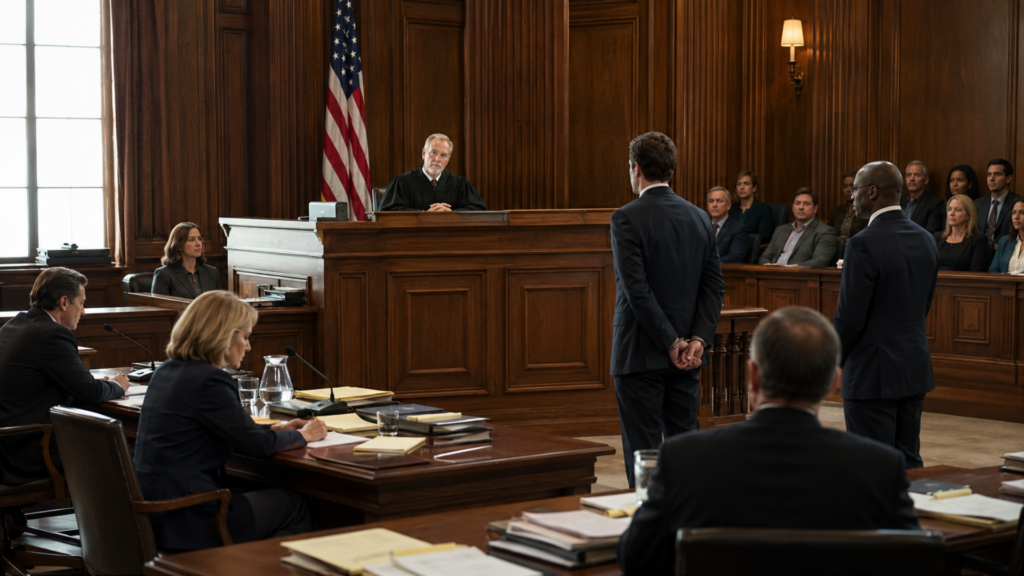
Key Takeaways –
- A preliminary hearing determines probable cause, not guilt or innocence.
- Prosecutors generally present enough evidence to show that a crime was committed and that the defendant probably committed it.
- Defense attorneys may cross-examine prosecution witnesses and challenge whether the evidence satisfies the applicable standard.
At a preliminary hearing, prosecutors present evidence to show that there is probable cause to believe a crime was committed and that the defendant was involved. The defense may cross-examine witnesses, challenge the prosecution’s evidence, and argue that one or more charges should not move forward. The judge then decides whether there is enough evidence for the case to continue toward trial.
If the judge finds probable cause, the case generally proceeds to the next stage of the criminal process. If the prosecution fails to meet that standard, the judge may dismiss some or all charges, although the effect of dismissal and whether charges can later be refiled depends on the jurisdiction.
A preliminary hearing is not a trial and does not determine guilt or innocence. The prosecution’s burden is much lower than the “beyond a reasonable doubt” standard required for a criminal conviction.
In a typical felony preliminary hearing, the process may include:
- prosecutors calling witnesses and presenting evidence;
- defense attorneys cross-examining those witnesses;
- arguments over whether the evidence supports each charge;
- consideration of aggravating allegations or enhancements where applicable;
- a judge determining whether probable cause exists; and
- a ruling on whether the case should continue.
The exact procedure varies by state and between state and federal courts. Some felony cases also proceed through a grand jury indictment and may not require a preliminary hearing at all.
This guide explains what happens at a preliminary hearing, what prosecutors must prove, what questions may be addressed, whether charges can be dropped, whether a defendant can remain in jail, what it means to waive the hearing, and more.
What Happens at a Preliminary Hearing?
At a preliminary hearing, the prosecution presents evidence to convince a judge that there is probable cause to continue the criminal prosecution. The defense then has an opportunity, subject to the jurisdiction’s rules, to challenge that evidence.
Although procedures differ, a preliminary hearing commonly involves the following steps.
1. The Court Identifies the Charges and Issues Before It
At the beginning of the hearing, the judge establishes which charges are being considered and confirms that the parties are ready to proceed.
A preliminary hearing should not be confused with an arraignment. An arraignment is generally the proceeding in which the defendant is formally advised of the charges and asked to enter a plea. Under federal Rule 10, for example, arraignment involves providing the defendant with the indictment or information, stating the substance of the charges, and asking for a plea.
The purpose of a preliminary hearing is different: it tests whether the prosecution has established probable cause.
2. Prosecutors Present Evidence
The prosecution normally goes first.
Depending on the case, prosecutors may rely on:
- testimony from investigating officers;
- eyewitness testimony;
- surveillance footage;
- photographs or recordings;
- forensic or laboratory evidence;
- documents or electronic communications; and
- other evidence connecting the defendant to the alleged offense.
The prosecutor does not ordinarily need to present the entire case that would later be presented at trial. The question is whether the available evidence reaches the probable-cause threshold necessary to continue the prosecution.
3. The Defense May Cross-Examine Witnesses
A preliminary hearing is not simply an uncontested presentation by prosecutors.
Defense counsel may be able to cross-examine witnesses, expose inconsistencies, challenge the connection between the defendant and the alleged crime, and argue that the government’s evidence does not establish probable cause.
In federal proceedings, Rule 5.1 expressly permits a defendant to cross-examine adverse witnesses and introduce evidence.
The defense does not necessarily have to prove innocence. Its immediate objective may instead be to demonstrate that the prosecution has failed to meet the much narrower burden required at this stage.
4. The Parties Argue Whether Probable Cause Exists
After evidence is presented, attorneys may argue about what the evidence establishes.
Questions can include:
- Is there sufficient evidence that the alleged crime occurred?
- Is there sufficient evidence connecting this defendant to it?
- Does the evidence support every charge currently filed?
- Does an enhancement or aggravating allegation have sufficient support?
- Should a particular charge be dismissed or reduced?
The precise legal test varies by jurisdiction, but the preliminary hearing is fundamentally a screening proceeding rather than a full determination of criminal responsibility.
5. The Judge Makes a Probable-Cause Decision
The judge then decides whether the prosecution has met the applicable standard.
If probable cause exists, the defendant is generally required to appear for further proceedings and the prosecution continues.
If probable cause is lacking, the judge may dismiss the complaint or affected charges under the rules governing that jurisdiction.
In a federal preliminary hearing, Rule 5.1 requires the magistrate judge to move the defendant forward for additional proceedings when probable cause is found. If probable cause is not found, the complaint must be dismissed and the defendant discharged from that complaint, although the rule expressly provides that this does not prevent the government from later prosecuting the same offense.
What Happens at a Preliminary Hearing for a Felony?
At a felony preliminary hearing, the judge determines whether prosecutors have presented enough evidence to establish probable cause for one or more felony charges to continue. The basic process is similar to other preliminary hearings:
- prosecutors may call witnesses and introduce evidence;
- the defense may cross-examine witnesses and challenge the prosecution’s case; and
- the judge decides whether the required probable-cause standard has been met.
Because felony charges carry more serious potential penalties, the hearing may involve closer examination of the specific elements of each felony charge, aggravating circumstances, sentencing enhancements, or evidence supporting particularly serious allegations.
Possible outcomes include:
- all felony charges moving forward;
- some charges moving forward while others are dismissed or reduced;
- an aggravating allegation or enhancement being allowed to continue or rejected;
- dismissal of charges for which probable cause has not been established; or
- further proceedings being scheduled after the judge finds probable cause.
A felony preliminary hearing still does not determine guilt or innocence. Even when the judge allows every felony charge to proceed, prosecutors must later prove the defendant’s guilt under the much higher standard required at trial.
Is a Felony Preliminary Hearing Different From a Regular Preliminary Hearing?
The core purpose is generally the same: determining whether probable cause exists for the criminal case to continue. A felony preliminary hearing is not a completely separate type of proceeding simply because the charges are felonies.
The main difference is the nature and seriousness of the charges being examined.
In a felony case, the court may have to consider:
- whether evidence supports each element of a felony offense;
- whether multiple felony counts can proceed;
- whether aggravating circumstances or sentence enhancements are supported;
- whether the evidence supports a more serious or lesser charge; and
- other issues specific to the felony allegations.
NOTE: The exact procedure varies by jurisdiction. In addition, not every criminal case receives a preliminary hearing. For example, some felony cases may proceed through a grand jury indictment instead.
What Evidence Is Presented at a Preliminary Hearing?
At a preliminary hearing, prosecutors typically present enough evidence to establish probable cause that a crime was committed and that the defendant was involved. The evidence varies depending on the charges and the facts of the case.
Common evidence presented at a preliminary hearing may include:
- testimony from police officers, investigators, victims, or eyewitnesses;
- surveillance video, photographs, or body-camera footage;
- physical evidence allegedly connecting the defendant to the offense;
- forensic evidence, such as fingerprints, DNA testing, or ballistics;
- medical records or reports in assault or violent-crime cases;
- bank records, transaction histories, or financial documents in fraud and financial-crime cases;
- text messages, emails, social media communications, or other electronic records; and
- statements allegedly made by the defendant or other witnesses.
For example, in a violent-crime case, the prosecution may rely on eyewitness testimony, investigative findings, video footage, forensic testing, or evidence connecting a weapon to the defendant. In a financial-crime case, prosecutors may present bank records, electronic communications, transaction data, and investigator testimony.
Because a preliminary hearing is designed to determine probable cause rather than guilt beyond a reasonable doubt, the evidence presented does not necessarily have to be introduced in the same manner required at trial. The evidentiary rules that apply also vary by jurisdiction.
Evidence considered at the preliminary hearing may later be challenged through motions to suppress, constitutional objections, evidentiary motions, or other pretrial proceedings. Therefore, evidence presented at a preliminary hearing is not automatically guaranteed to be admissible at trial.
What Questions Does a Judge Ask During a Preliminary Hearing?
A judge may ask questions during a preliminary hearing to determine whether the prosecution has presented enough evidence to establish probable cause for the charges to continue. However, there is no standard list of questions that judges ask in every preliminary hearing.
Unlike a guilty-plea hearing, a preliminary hearing is usually focused on the prosecution’s evidence rather than an extended question-and-answer session with the defendant.
Depending on the case and jurisdiction, a judge may ask questions such as:
- What evidence supports each criminal charge?
- How does a witness know or remember a particular fact?
- What evidence connects the defendant to the alleged offense?
- Has the prosecution presented evidence supporting each required element of the charge?
- Is additional testimony, evidence, or legal argument necessary?
- Do the parties agree on any procedural or evidentiary issues?
The judge may also ask questions about witness availability, representation by counsel, scheduling, pending charges, or other procedural matters.
In many cases, most questioning of witnesses is conducted by the prosecutor and defense attorney. The judge may step in to clarify testimony, address legal issues, or determine whether the evidence is sufficient to support probable cause.
A defendant therefore should not expect every preliminary hearing to follow the same set of questions. The judge’s questions will depend on the charges, the evidence presented, disputed legal issues, and the criminal procedure rules of the jurisdiction.
What Happens if the Judge Finds Probable Cause?
If the judge finds probable cause, the criminal case continues toward the next stage rather than ending at the preliminary hearing.
Depending on the jurisdiction and procedural posture, the next steps may include:
- formal arraignment or further arraignment proceedings;
- entry of a plea;
- discovery;
- additional pretrial motions;
- motions involving the admissibility or suppression of evidence;
- plea negotiations;
- status or pretrial conferences;
- trial scheduling; and
- eventually, trial if the case is not otherwise resolved.
A probable-cause finding does not require the defendant to change a not-guilty position, nor does it establish the truth of every allegation.
It simply means the case has passed that particular procedural screening stage.
What Happens if Probable Cause Is Not Found?
If a judge determines that prosecutors have not established probable cause, the judge may dismiss the complaint or unsupported charges according to the applicable rules.
That can be an important result for the defendant, but its long-term effect depends on the jurisdiction.
The government may in some circumstances be permitted to:
- refile charges;
- seek an indictment;
- present additional evidence; or
- pursue another legally available charging procedure.
A preliminary-hearing dismissal therefore should not automatically be described as an acquittal.
An acquittal generally follows a determination of guilt or innocence under circumstances carrying substantially different constitutional consequences.
Can You Go to Jail at a Preliminary Hearing?
A defendant can remain in custody after a preliminary hearing, but the preliminary hearing itself is not a sentencing proceeding.
Whether a defendant is detained or released is generally governed by separate bail, bond, detention, and release rules.
A person who was already detained before the preliminary hearing may remain in custody after the judge finds probable cause. A person who had been released subject to conditions may continue under those conditions unless the court changes them under applicable law.
The preliminary hearing is therefore not normally the proceeding in which someone is “sent to jail” as punishment for the charged offense.
Punishment follows only after a legally sufficient conviction or guilty plea and sentencing.
Is a Preliminary Hearing the Same as a Pretrial Hearing?
No. A preliminary hearing and a pretrial hearing are generally different stages of a criminal case, although terminology and procedure can vary by jurisdiction.
A preliminary hearing usually asks whether the prosecution has presented enough evidence to establish probable cause for the criminal charges to continue.
A pretrial hearing or pretrial conference usually addresses issues that must be resolved before trial, rather than deciding whether probable cause exists.
The key difference is that a preliminary hearing focuses primarily on whether there is enough evidence for the prosecution to move forward, while a pretrial hearing generally focuses on resolving legal, evidentiary, and procedural issues before trial.
For more information about what can happen during the broader pretrial stage, see Brownstone Law’s guide, Can a Case Be Dismissed at the Pretrial Hearing?
Is a Preliminary Hearing the Same as an Arraignment?
No. An arraignment formally addresses the charges and the defendant’s plea, while a preliminary hearing generally determines whether probable cause exists for the prosecution to continue.
Under the Federal Rules of Criminal Procedure, an arraignment includes ensuring the defendant has the indictment or information, communicating the substance of the charges, and asking the defendant to enter a plea.
A preliminary hearing serves a different purpose.
The exact order of proceedings can differ among jurisdictions, which is why a defendant may encounter terms such as:
- initial appearance;
- arraignment;
- preliminary hearing;
- preliminary examination;
- probable-cause hearing;
- status conference; and
- pretrial conference.
They should not automatically be treated as names for the same event.
How Soon Does a Preliminary Hearing Take Place?
A preliminary hearing may take place within days or a few weeks after the defendant’s initial court appearance, but the exact deadline depends on the jurisdiction, the charges, and whether the defendant is in custody.
There is no single nationwide deadline for preliminary hearings in state criminal cases. Each state sets its own rules governing when the hearing must occur, whether the defendant may waive it, and when the court may grant a delay or continuance.
In federal criminal cases, Federal Rule of Criminal Procedure 5.1 generally requires a preliminary hearing, when one is required, within:
- 14 days after the initial appearance if the defendant is in custody; or
- 21 days after the initial appearance if the defendant is not in custody.
Those deadlines may be extended in circumstances permitted by the federal rules.
The federal 14-day and 21-day deadlines do not automatically apply to state felony cases. State preliminary-hearing deadlines can be shorter or longer and may depend on factors such as detention status, waiver by the defendant, continuances, indictment, and state-specific criminal procedure.
Therefore, anyone trying to determine how long after an arrest or initial appearance a preliminary hearing will occur should check the rules of the specific court and jurisdiction handling the case.
What Happens When a Criminal Case Goes to Trial After the Preliminary Hearing?
If a criminal case proceeds to trial after a preliminary hearing, the prosecution must prove the defendant’s guilt under a much higher legal standard.
At the preliminary hearing, the question is generally whether there is probable cause to allow the charges to continue. At trial, the prosecution must prove every required element of the charged offense beyond a reasonable doubt.
During a criminal trial:
- the prosecution presents witnesses and other admissible evidence;
- the defense may cross-examine prosecution witnesses;
- the defense may present its own witnesses or evidence, but generally is not required to do so;
- the judge rules on evidentiary and legal issues;
- both sides may make opening statements and closing arguments; and
- the factfinder—usually a jury in a jury trial or a judge in a bench trial—determines whether the prosecution has met its burden.
The key difference is:
- Preliminary hearing: Is there probable cause for the criminal charge to move forward?
- Criminal trial: Has the prosecution proven the defendant guilty beyond a reasonable doubt?
If the prosecution proves the required elements beyond a reasonable doubt, the factfinder may return a guilty verdict. If the prosecution fails to meet that burden, the defendant should be found not guilty of the charge at issue.
Therefore, a judge’s decision after a preliminary hearing that there is enough evidence for a defendant to stand trial does not mean the defendant has been found guilty. It is a procedural determination that the prosecution has met the lower probable-cause threshold necessary for the case to continue.
Conclusion: What a Preliminary Hearing Means for the Rest of the Case
A preliminary hearing can determine whether a criminal case moves forward, but it does not determine whether the defendant is guilty. The judge is deciding whether the prosecution has presented sufficient evidence to satisfy the probable-cause standard, not whether the government has proven the charges beyond a reasonable doubt.
If probable cause is found, the case may continue through additional pretrial proceedings, evidentiary motions, plea negotiations, and ultimately trial. If probable cause is not established, the court may dismiss unsupported charges, although the prosecution may still have additional options depending on the jurisdiction and procedural posture.
The most important point is that a preliminary hearing is only one stage of a larger criminal process. A defendant who is ordered to stand trial has not been convicted, and the prosecution must still satisfy the much higher burden required for a criminal conviction.
Speak With Brownstone Law About a Criminal Appeal
If a criminal case later results in a conviction, sentence, or other appealable ruling, Brownstone Law can review the record for potential appellate issues, including constitutional errors, evidentiary rulings, sentencing issues, and other legal errors that may support appellate review.
Brownstone Law represents clients in state and federal criminal appeals. Learn more about the firm’s criminal appeal lawyers or contact Brownstone Law for a no-cost appeal evaluation to discuss potential grounds for appeal and applicable filing deadlines.
Frequently Asked Questions (FAQs)
Q1. What Does the Prosecutor Have to Prove at a Preliminary Hearing?
At a preliminary hearing, the prosecutor generally must establish probable cause to believe that a criminal offense was committed and that the defendant was involved in committing it.
This is a significantly lower burden than the standard required for a criminal conviction at trial.
Probable Cause vs. Beyond a Reasonable Doubt
At the preliminary-hearing stage, the court is not deciding whether the defendant is guilty. The judge is determining whether the prosecution has presented sufficient evidence for the criminal charges to continue.
By contrast, at trial, the prosecution must prove every required element of the charged offense beyond a reasonable doubt.
In practical terms:
A finding of probable cause means:
There is sufficient evidence for the case to proceed to the next stage.
A finding of probable cause does not mean:
The defendant has been proven guilty of the charged offense.
This distinction is important because a defendant may be ordered to stand trial after a preliminary hearing and later be acquitted if the prosecution cannot meet the much higher burden required at trial.
For the same reason, reports that a defendant has been “ordered to stand trial” should not be interpreted as meaning that the defendant has been convicted. It reflects only that the court found sufficient evidence for the prosecution to continue.
Q2. Can Charges Be Dropped at a Preliminary Hearing?
Yes, charges can sometimes be dismissed at a preliminary hearing if the prosecution fails to establish the required probable cause. Prosecutors may also independently decide not to continue pursuing a charge.
However, “charges being dropped” and “charges being dismissed by the judge” are not always the same thing.
A prosecutor may voluntarily withdraw or dismiss charges according to applicable law and court rules.
A judge, on the other hand, may determine that the prosecution’s evidence does not support a particular charge at the preliminary-hearing stage.
For example, if several charges are filed but evidence establishes probable cause for only some of them, the outcome may differ from a situation in which the prosecution fails to establish probable cause for the case altogether.
Q3. Can Charges Be Dropped at the Preliminary Hearing Permanently?
Not necessarily. A preliminary-hearing dismissal does not automatically mean prosecutors can never pursue the allegation again.
Federal Rule 5.1 expressly states that when a federal complaint is dismissed for lack of probable cause at a preliminary hearing, the discharge does not prevent the government from later prosecuting the defendant for the same offense.
State rules vary, so whether and how a charge can be refiled depends on the jurisdiction, the reason for dismissal, statutes of limitation, constitutional protections, and other procedural rules.
Q4. What Does Waiving a Preliminary Hearing Mean?
Waiving a preliminary hearing means the defendant gives up the right to require the prosecution to establish probable cause at that particular hearing. It does not ordinarily mean the defendant is pleading guilty.
A defendant may waive the hearing for strategic, procedural, or case-specific reasons.
For example, attorneys may consider how holding the hearing could:
- reveal defense strategy;
- affect negotiations;
- preserve or expose witness testimony;
- affect scheduling;
- interact with an indictment; or
- influence other aspects of the defense.
Whether waiver is beneficial is highly case-specific and should not be treated as a routine decision.
In the federal system, a defendant’s waiver is one of the circumstances under which Rule 5.1 does not require a preliminary hearing. A federal preliminary hearing also generally becomes unnecessary when the defendant has already been indicted.
Most importantly, waiving the preliminary hearing is not itself an admission that the prosecution’s allegations are true.
Q5. Do All Felony Cases Have a Preliminary Hearing?
No. Not every felony prosecution includes a preliminary hearing. One important reason is the use of a grand-jury indictment.
In federal court, Rule 5.1 provides several circumstances in which a preliminary hearing is unnecessary, including when:
- the defendant waives it;
- a grand jury has indicted the defendant; or
- certain qualifying informations have been filed.
States use different charging systems. Some rely heavily on preliminary hearings, some on grand juries, and some permit prosecutors to proceed through different mechanisms depending on the case. Therefore, the absence of a preliminary hearing does not by itself indicate that something improper happened.