
| Key Takeaways
|
When an appellate court reviews a lower court’s decision, it may affirm, reverse, vacate, or remand the case, sometimes using two or more of these terms together. Although reverse, vacate, and remand are often found in the same appellate judgment, they describe different actions and have different legal consequences.
In general, reverse means the appellate court overturns the lower court’s ruling because the decision cannot stand. Vacate means the appellate court sets aside the lower court’s judgment, order, conviction, sentence, or other ruling, removing that decision as the operative judgment. Remand means the appellate court sends the case, or a particular issue, back to the lower court for further proceedings consistent with the appellate court’s instructions. Affirm, by contrast, means the appellate court leaves the challenged ruling in place.
For example, an appellate court may reverse and remand, meaning it overturns the lower court’s decision and sends the case back for further proceedings. It may also vacate and remand, meaning it sets aside the existing decision and returns the matter to the lower court for additional action.
The exact effect depends on the language of the appellate court’s judgment and opinion, the issues decided on appeal, and the instructions given to the lower court. In federal cases, 28 U.S.C. § 2106 expressly authorizes appellate courts to affirm, modify, vacate, set aside, or reverse judgments, decrees, or orders and to remand cases for further proceedings.
Reverse vs. Vacate vs. Remand: Quick Comparison
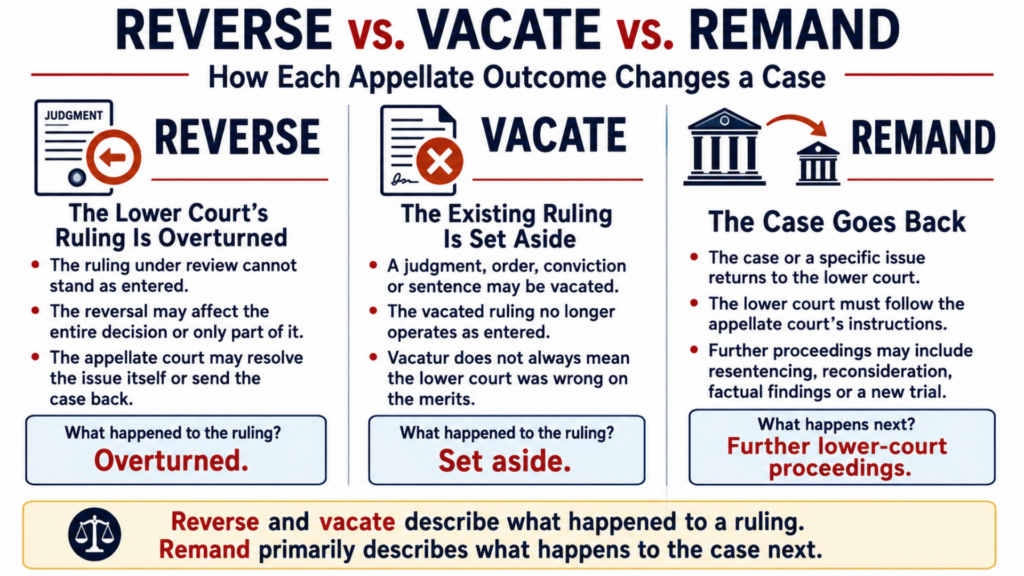
| Appellate Term | Basic Meaning | What Happens to the Existing Decision? | What May Happen Next? |
|---|---|---|---|
| Reverse | The appellate court overturns the lower court’s ruling or judgment under review. | The reversed ruling cannot stand as entered. | The appellate court may direct a particular result or remand the case for further proceedings. |
| Vacate | The appellate court sets aside a judgment, order, conviction, sentence, or other ruling. | The vacated decision is no longer operative as entered. | The matter may be reconsidered or otherwise addressed as directed by the appellate court. |
| Remand | The appellate court sends the case or a particular issue back to the lower court. | Remand itself does not necessarily overturn the existing decision. | The lower court takes the further action required by the appellate court’s judgment or mandate. |
| Affirm | The appellate court upholds the lower court’s ruling. | The challenged ruling remains in effect. | The affirmed issues generally remain resolved, subject to any further review that may be available. |
Now, let’s examine each of these appellate outcomes in detail, including what they mean, when they are used, and what happens to the case afterward.
What Does It Mean When a Case Is Reversed?
When a case is reversed on appeal, it means the appellate court has determined that the lower court made a legal or other reversible error and overturns the decision, judgment, or ruling being reviewed. The reversed decision cannot stand as entered to the extent of the reversal.
A reversal does not necessarily mean that the entire case is over or that the opposing party automatically wins everything. The effect of the reversal depends on what part of the lower court’s decision was reversed, the reason for the reversal, and what the appellate court directs the lower court to do next.
A court may reverse a decision because the lower court applied the wrong law, made a significant procedural or evidentiary error, reached a legally incorrect conclusion, or committed another error that affected the outcome. The appellate court’s opinion explains the basis for the reversal, and its judgment or mandate determines the resulting action.
Simple Example of a Reversal
Suppose a defendant is convicted after a trial. The defendant appeals, arguing that the trial court made a significant legal error.
If the appellate court agrees that the error requires the conviction to be overturned, it may state:
“The conviction is reversed.”
This means the conviction under review has been overturned. However, the word “reversed” alone does not necessarily determine what happens to the case next.
Depending on the circumstances, the appellate court may:
- remand the case for a new trial;
- direct the lower court to enter a different judgment;
- order further proceedings;
- reverse only a particular conviction, count, claim, or ruling; or
- provide specific instructions governing what the lower court must do.
For this reason, a reversal should always be read together with the appellate court’s reasoning, judgment, and instructions. Two cases may both be “reversed” but have very different outcomes depending on the error identified and the relief ordered.
Can an Appellate Court Reverse Only Part of a Decision?
Yes. An appellate court can reverse only part of a lower court’s decision while leaving other portions intact.
For example, an appellate judgment may state:
“Affirmed in part, reversed in part, and remanded.”
This means the appellate court has upheld some portions of the lower court’s decision, overturned other portions, and sent the case or particular issues back to the lower court for further proceedings.
A partial reversal is therefore different from a complete reversal. The appellate court may leave certain claims, counts, findings, or portions of a judgment undisturbed while changing others. To determine the precise effect, it is necessary to examine what the appellate court reversed and what instructions it gave for the remaining issues.
What Happens After a Case Is Reversed?
What happens after a reversal depends on the appellate court’s decision and the nature of the error. The appellate court may resolve the issue itself, direct the entry of a particular judgment, or remand the case to the lower court for additional proceedings.
For example, a case that is “reversed and remanded” has been overturned in the relevant respect and returned to the lower court for further action. By contrast, a reversal may sometimes resolve the issue without requiring a remand. The appellate court’s judgment and mandate determine the scope of the lower court’s authority after the appeal.
What Does Vacate Mean in Court?
When a court vacates a judgment or order, it means the court sets aside or annuls that decision, so that it no longer stands as the operative ruling. In an appellate case, vacatur may apply to a lower court’s judgment, order, conviction, sentence, or a particular portion of a decision.
In simple terms, vacate means to set aside a decision. It does not necessarily mean that the appellate court has ruled that the lower court reached the wrong result on the underlying merits. The reason for the vacatur and the appellate court’s instructions determine what happens next.
An appellate court may vacate:
- a judgment;
- an order;
- a conviction;
- a sentence;
- part of a judgment; or
- another ruling properly before the court on appeal.
For example, a sentence is vacated.
Suppose a defendant is convicted after a trial, but the appellate court determines that the sentencing court applied an incorrect legal rule when imposing the sentence.
The appellate court may state:
“The sentence is vacated, and the case is remanded for resentencing.”
This means the existing sentence has been set aside, but it does not necessarily mean that the underlying conviction has been overturned.
In this example:
- the conviction may remain in place;
- the existing sentence is vacated; and
- the lower court must conduct further sentencing proceedings consistent with the appellate court’s decision.
NOTE – This distinction is particularly important in criminal appeals because vacating a sentence is not the same as vacating a conviction. The appellate court may set aside only the sentence while leaving the underlying conviction undisturbed.
What Is the Legal Difference Between Reverse and Vacate?
Reverse and vacate are related but are not interchangeable terms in appellate decisions.
A reversal generally means that the appellate court has determined that the lower court’s ruling under review was legally incorrect and overturns that ruling.
A vacatur, by contrast, means that the appellate court sets aside the existing judgment, order, or other ruling. Vacatur can occur without the appellate court deciding that the lower court’s ultimate merits determination was wrong.
This distinction matters because a court may vacate a decision for reasons that do not amount to a ruling that the lower court reached the wrong result on the merits. For example, a case may become moot while it is on appeal. In certain circumstances, the Supreme Court may vacate the lower court’s judgment and remand the case with instructions to dismiss as moot. Federal law and Supreme Court precedent recognize vacatur as one possible disposition in such circumstances.
A recent example illustrates this distinction.
On January 20, 2026, the U.S. Supreme Court granted the petition in Tennessee v. Kennedy, vacated the judgment below, and remanded the case to the U.S. Court of Appeals for the Sixth Circuit with instructions to dismiss the case as moot. The disposition therefore did not represent a determination that the lower court’s merits decision was necessarily incorrect. Instead, the Court set aside the judgment as part of its disposition of a case that had become moot.
What Does Remand Mean in Law?
When an appellate court remands a case, it means the court sends the case, or a particular issue in the case, back to the lower court, agency, or tribunal for further proceedings or action. A remand does not, by itself, determine whether the lower court’s original decision was correct or incorrect.
In appellate litigation, a remand generally means that the appellate court has completed its review of the issue before it and is directing the lower court to take the next step required by the appellate decision. The appellate court may provide specific instructions that the lower court must follow.
Depending on the case, a remand may require the lower court to:
- conduct a new trial;
- resentence a defendant;
- reconsider a particular legal issue;
- make additional factual findings;
- apply the correct legal standard;
- hold another hearing;
- enter a specified judgment; or
- take another action directed by the appellate court.
NOTE – The scope of a remand depends on the appellate court’s judgment, opinion, and mandate. A court may remand the entire case or only a particular claim, issue, or portion of the proceedings.
Does Remand Mean the Appellate Court Agreed With the Trial Court?
No. A remand does not, by itself, mean that the appellate court agreed with the trial court’s decision.
Remand describes what happens to the case next, not necessarily whether the lower court’s ruling was right or wrong. An appellate court may remand after reversing a decision, vacating a judgment or sentence, or resolving an appeal in another manner that requires additional proceedings.
For example:
- “Reversed and remanded” generally means the appellate court overturned the lower court’s ruling and sent the case back for further proceedings.
- “Vacated and remanded” generally means the appellate court set aside the existing ruling and returned the matter to the lower court for further action.
- A case may also be remanded with specific instructions, requiring the lower court to address a particular issue or take a particular action.
NOTE – The word “remanded” should not be interpreted in isolation. To understand the legal effect of a remand, it is necessary to read the appellate court’s judgment and opinion to determine what was decided, what was changed, and what the lower court has been instructed to do next.
What Is the Difference Between Reverse and Remand?
Reverse and remand describe different aspects of an appellate court’s decision. A reversal changes the status of the lower court’s ruling by overturning the decision, in whole or in part. A remand, by contrast, sends the case or a particular issue back to the lower court for further proceedings or action.
In other words, reverse answers what happened to the lower court’s decision, while remand answers what happens to the case next.
The two actions can occur together, but they do not mean the same thing. For example, an appellate court may determine that a trial court applied the wrong legal standard. It can reverse the resulting judgment because the ruling cannot stand and then remand the case so the lower court can reconsider the matter under the correct legal standard.
The distinction can be understood this way:
- Reverse: The appellate court overturns the lower court’s ruling or a specified portion of it.
- Remand: The appellate court returns the case or a particular issue to the lower court for additional proceedings.
- Reverse and remand: The appellate court overturns the challenged ruling and sends the matter back for further action consistent with its decision.
A remand does not necessarily mean that the lower court’s decision was reversed. An appellate court may remand an issue for additional factual findings, clarification, application of the correct legal standard, or another specified purpose without completely overturning the underlying judgment. Conversely, a reversal does not always require a remand if the appellate court can resolve the issue itself or direct the appropriate final result.
What Does “Reversed and Remanded” Mean?
When an appellate court states that a case is “reversed and remanded,” it generally means that the appellate court has overturned the challenged decision, or a particular part of it, and returned the case to the lower court for further proceedings consistent with the appellate court’s opinion and judgment.
For example, if a defendant’s conviction is reversed because of a reversible trial error, the appellate court may remand the case for a new trial. In another case, the appellate court might reverse a judgment and remand for the lower court to reconsider a particular issue, make additional findings, or apply the correct legal standard.
The exact meaning of “reversed and remanded” depends on the appellate court’s instructions. The phrase tells you that the lower court’s ruling has been overturned and that the case is being returned, but the appellate opinion and judgment explain what the lower court must do next.
Thus, reversal and remand are related but distinct appellate actions: reversal concerns the validity or status of the ruling under review, while remand concerns the further proceedings that follow the appellate court’s decision.
Does “Reversed and Remanded” Always Mean a New Trial?
No. “Reversed and remanded” does not automatically mean that a new trial will take place.
A new trial is one possible outcome, but what happens after remand depends on the reason for the reversal, the issues decided on appeal, and the specific instructions in the appellate court’s judgment and opinion.
Depending on the case, the lower court may instead be required to:
- reconsider a particular motion or legal issue;
- conduct a limited hearing;
- correct a legal or sentencing calculation;
- resentence a defendant;
- make additional factual findings;
- enter a particular judgment; or
- take another action specified by the appellate court.
Therefore, “reversed and remanded” should not be understood as meaning that the entire case starts over from the beginning. The scope of the proceedings on remand is determined by the appellate court’s decision and instructions.
What Does “Vacated and Remanded” Mean?
When an appellate court says “vacated and remanded,” it generally means that the court has set aside the judgment, order, sentence, conviction, or other ruling under review and returned the case to the lower court for further proceedings.
For example, an appellate judgment may state:
“Sentence vacated and remanded for resentencing.”
In that situation, the existing sentence has been set aside, but the underlying conviction may remain in place. The lower court must conduct further sentencing proceedings consistent with the appellate court’s ruling.
The same phrase can have a different effect depending on what was vacated. If an appellate court vacates a sentence, the conviction may remain undisturbed. If it vacates a conviction or an entire judgment, the consequences can be substantially broader.
This is why “vacated and remanded” must be read together with the appellate court’s opinion and judgment. The phrase identifies the appellate disposition, but the court’s instructions determine what the lower court must do next.
What Is the Difference Between “Reversed and Remanded” and “Vacated and Remanded”?
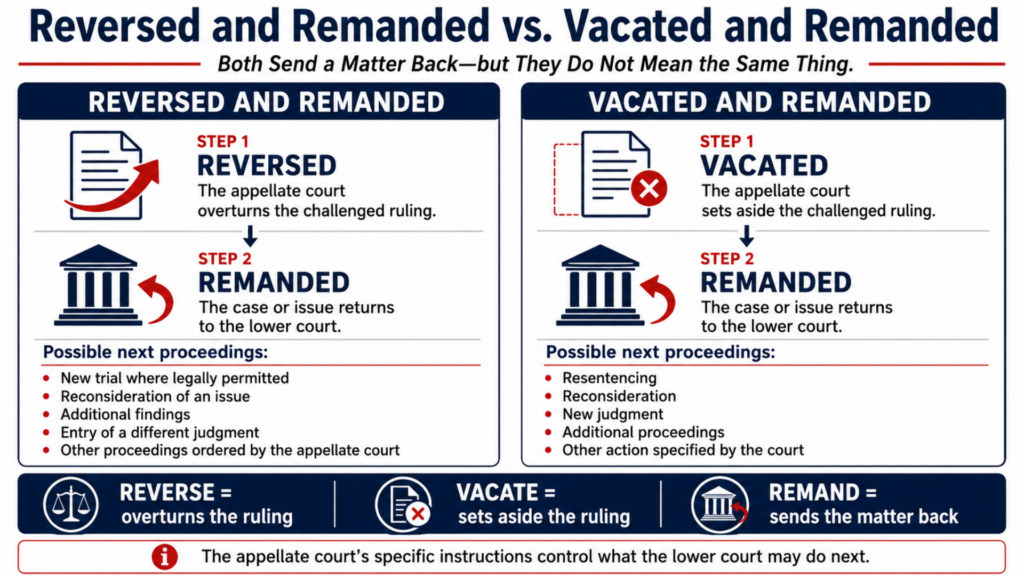
Both dispositions can result in the case returning to the lower court, but the key distinction is what the appellate court did to the decision under review.
- Reversed and remanded: The appellate court overturned the challenged ruling and returned the case for further proceedings.
- Vacated and remanded: The appellate court set aside the challenged ruling and returned the case for further proceedings.
NOTE – The distinction can matter significantly in practice. A reversal generally reflects an appellate determination that the ruling under review cannot stand because of an error requiring reversal. Vacatur, however, can occur in circumstances where the appellate court is setting aside the existing judgment without necessarily deciding that the lower court reached the wrong result on the merits. In either situation, the appellate court’s specific instructions control what happens after remand.
To better understand the difference between reverse, vacate, and remand, consider a practical example involving a criminal appeal and see how each appellate outcome can affect the conviction, sentence, and proceedings that follow.
Reverse vs. Vacate vs. Remand in a Criminal Appeal
The distinctions between reverse, vacate, and remand can have very different consequences in a criminal appeal. The key question is not simply which word appears in the appellate judgment, but what part of the criminal case was affected and what the appellate court ordered next.
Consider a defendant who has been convicted and sentenced to eight years in prison.
Scenario 1: The Conviction Is Reversed
If the appellate court determines that a reversible error affected the conviction, it may reverse the conviction.
That does not automatically mean the defendant is immediately released or that the prosecution is permanently barred from taking further action. The result depends on the reason for the reversal and the appellate court’s instructions.
For example, the case may be remanded for a new trial or for another proceeding. Whether the government may retry the defendant can depend on the nature of the error and constitutional protections, including the Double Jeopardy Clause.
What Does the Double Jeopardy Clause Mean?
The Double Jeopardy Clause, found in the Fifth Amendment to the U.S. Constitution, generally protects a person from being prosecuted or punished twice for the same offense. In criminal appeals, however, its application can depend on why a conviction was reversed and what happened during the original trial. A reversal based on certain trial errors may permit a retrial, while a reversal based on insufficient evidence generally prevents the government from retrying the defendant for the same offense.
Scenario 2: The Sentence Is Vacated
If the appellate court determines that the sentencing court applied an incorrect legal rule or otherwise imposed an unlawful sentence, it may vacate the sentence without disturbing the underlying conviction.
In that situation:
- the conviction remains in place;
- the existing sentence is set aside; and
- the case may return to the lower court for resentencing.
This is why vacating a sentence is not the same as reversing a conviction. The defendant’s criminal judgment may remain valid even though the original sentence no longer stands.
Scenario 3: The Sentence Is Vacated, and the Case Is Remanded
An appellate court may state that the sentence is vacated and the case is remanded for resentencing.
Here, the appellate court has set aside the existing sentence and returned the matter to the lower court. The lower court must then conduct the required sentencing proceedings and follow any legal instructions provided by the appellate court.
The conviction itself may remain unaffected.
Scenario 4: The Conviction Is Reversed, and the Case Is Remanded
If the appellate court reverses the conviction and remands the case, the lower court must proceed in accordance with the appellate court’s judgment.
Depending on the reason for reversal, the remand may involve a new trial or another specified proceeding. However, a reversal does not automatically authorize a retrial in every criminal case.
The Double Jeopardy Clause can limit when the government may retry a defendant after a conviction has been reversed. The availability of a retrial can depend on whether the reversal resulted from trial error, insufficient evidence, or another circumstance recognized by constitutional law.
Why the Distinction Matters?
These scenarios show why the words reverse, vacate, and remand cannot be interpreted in isolation.
A reversed conviction can affect the validity of the conviction itself. A vacated sentence may leave the conviction intact while requiring resentencing. A remand identifies the further proceedings the lower court must undertake, but the scope of those proceedings depends on the appellate court’s judgment and instructions.
Can the Government Retry a Defendant After a Conviction Is Reversed?
Sometimes. A reversal of a criminal conviction does not automatically prevent the government from retrying the defendant. Whether a retrial is constitutionally permitted generally depends on why the conviction was reversed.
When a conviction is reversed because of trial error, such as an erroneous jury instruction, improper admission or exclusion of evidence, or another error that affected the trial, a new trial may generally be permitted. In these circumstances, the reversal does not necessarily mean that the prosecution’s evidence was legally insufficient to establish the defendant’s guilt.
The result is different when an appellate court determines that the evidence presented at trial was legally insufficient to support the conviction.
In Burks v. United States, the U.S. Supreme Court held that the Double Jeopardy Clause bars the government from retrying a defendant after an appellate determination that the evidence was insufficient to support the conviction.
The distinction can be summarised as follows:
| Reason the Conviction Was Reversed | Can the Defendant Generally Be Retried? |
|---|---|
| Reversible trial error | Often yes. A new trial may generally be permitted because the reversal resulted from an error in the original proceedings rather than a determination that the evidence was insufficient. |
| Legally insufficient evidence | Generally no. The Double Jeopardy Clause bars a second trial for the same offense after an appellate finding of insufficient evidence. |
Therefore, “conviction reversed” does not, by itself, answer whether the defendant will face another trial. The appellate court’s reasoning, the nature of the error, and constitutional protections governing retrial must all be considered.
What Happens When a Judgment Is Vacated?
When a judgment is vacated, the next step depends on what was vacated, why it was vacated, and what the appellate court directs the lower court to do. Vacatur sets aside the existing judgment, but it does not automatically determine the final outcome of the case.
Depending on the circumstances, the lower court may be required to:
- enter a new judgment;
- conduct a new trial;
- resentence a defendant;
- reconsider a particular legal issue;
- dismiss the case;
- make additional factual findings; or
- conduct another proceeding specified by the appellate court.
A vacated judgment therefore does not automatically mean that:
- the entire lawsuit or prosecution is over;
- the defendant has been acquitted;
- a new trial must take place; or
- the party who obtained the vacatur has prevailed on every issue.
For example, if an appellate court vacates a sentence and remands for resentencing, the underlying conviction may remain in place while the lower court determines a new sentence. If an appellate court vacates an entire judgment and provides different instructions, the consequences may be broader.
Is an Appellate Court Vacating a Judgment the Same as Filing a Motion to Vacate?
No. An appellate court vacating a judgment and a party filing a motion to vacate are different legal procedures, even though both use the term “vacate.”
In an appellate disposition, the appellate court itself sets aside a judgment, order, sentence, conviction, or other ruling as part of its review of the case.
A motion to vacate, by contrast, is a request made by a party asking a court to set aside an existing judgment, sentence, or order. The procedure, legal grounds, and court involved depend on the type of motion being filed.
For example, 28 U.S.C. § 2255 allows a federal prisoner, under specified circumstances, to move the sentencing court to vacate, set aside, or correct the sentence. A § 2255 proceeding is a form of federal post-conviction relief and is procedurally distinct from a direct appeal.
Therefore, searches such as:
- “motion to vacate sentence”;
- “2255 motion to vacate”; and
- “how to vacate a judgment”
may refer to procedures that are different from an appellate court’s decision to vacate a judgment during direct appellate review.
The important distinction is who is taking the action and through what procedure: an appellate court may vacate a lower court’s ruling as part of its appellate disposition, while a motion to vacate is a request by a party asking a court to set aside an existing ruling.
Can a Judgment Be Vacated Without Being Reversed?
Yes. A judgment can be vacated without the appellate court describing the disposition as a reversal.
“Vacate” and “reverse” are distinct appellate actions. Federal law expressly gives appellate courts authority to affirm, modify, vacate, set aside, or reverse judgments, decrees, or orders. The appropriate disposition depends on the circumstances of the case and the relief the appellate court determines is appropriate.
Vacatur can occur without a determination that the lower court’s substantive reasoning was incorrect. For example, in certain circumstances involving mootness, an appellate court may vacate the judgment below and remand the matter without reaching the underlying merits.
Accordingly, it is inaccurate to treat:
“Vacated” = “Reversed.”
The appellate opinion and judgment must be examined to determine why the court vacated the ruling and what legal effect the vacatur has.
Can a Case Be Remanded Without Being Reversed?
Yes. A case can be remanded without being reversed or vacated.
Although remand frequently accompanies reversal or vacatur, the concepts are not legally interchangeable. A remand means that the appellate court is returning the case or a particular issue to the lower court for further proceedings or action. The appellate court may do so for a purpose that does not require reversing the underlying decision.
For example, Federal Rule of Appellate Procedure 12.1 provides a procedure for an indicative ruling when an appeal is pending. If a district court states that it would grant a motion or that the motion raises a substantial issue, the court of appeals may remand for that purpose while retaining jurisdiction under the rule’s procedures.
The broader principle is that remand describes what happens to the case next, while reversal or vacatur describes what the appellate court has done to the ruling under review.
Therefore, when reading an appellate judgment, the terms should be considered together with the court’s opinion and instructions. A case may be reversed and remanded, vacated and remanded, or remanded for a specified purpose without either reversal or vacatur.
Conclusion
Understanding the difference between reverse, vacate, and remand is important when reading an appellate judgment because each term describes a different aspect of what the appellate court has decided.
A reversal generally means the appellate court has overturned the lower court’s ruling, while vacatur means the existing judgment, order, sentence, conviction, or other ruling has been set aside. A remand means the case or a particular issue is being returned to the lower court for further proceedings or action. These terms may appear together, but their combined effect depends on the appellate court’s judgment, opinion, and instructions.
The practical consequences can vary significantly. A reversed conviction may lead to further proceedings or, in some circumstances, a new trial. A vacated sentence may require resentencing without disturbing the underlying conviction. A remand may require the lower court to reconsider an issue, make additional findings, apply a different legal standard, or take another action specified by the appellate court.
For that reason, the words “reversed,” “vacated,” or “remanded” should not be interpreted in isolation. The appellate court’s reasoning and specific instructions determine what the decision means for the case and what happens next.
Need Help Understanding an Appellate Decision?
If you are dealing with an appeal and need help determining what an appellate court’s decision means or what options may remain, Brownstone Law can help you understand the appellate process and evaluate the issues involved in your case.
Contact Brownstone Law to discuss your appellate matter with an experienced appellate attorney.
Frequently Asked Questions (FAQs)
Q1. Does a remand give the trial court complete freedom to decide the case again?
No. A remand does not give the trial court unlimited authority to reconsider the case. The lower court must follow the appellate court’s mandate and the instructions in its opinion.
The scope of a remand can vary. An appellate court may return the entire matter for substantial further proceedings, or it may limit the lower court’s authority to a specific issue or task.
For example, an appellate court may remand a case:
- solely for resentencing;
- to calculate damages under the correct legal standard;
- to make additional factual findings;
- to reconsider a motion under specific legal instructions; or
- for a new trial.
When implementing the appellate mandate, the lower court generally must follow both the letter and spirit of the appellate court’s decision and may not reconsider issues that the appellate court has already conclusively decided.
Therefore, a remand does not necessarily mean that the trial court gets to decide the case from scratch. The appellate judgment, opinion, and mandate determine the scope of the lower court’s authority on remand.
Q2. Does a remand mean the original verdict was wrong?
Not necessarily. A remand by itself does not mean that the appellate court determined the original verdict or judgment was wrong. “Remand” primarily describes what happens to the case after the appellate court’s decision: the case, or a particular issue, is returned to the lower court for further proceedings.
The appellate court may remand a case for different reasons. For example, it may require the lower court to:
- reconsider an issue under the correct legal standard;
- make additional factual findings;
- correct a sentencing calculation;
- conduct a new hearing;
- determine damages;
- enter a judgment consistent with the appellate decision; or
- conduct a new trial when the appellate court has determined that one is required.
The effect on the original judgment depends on the other language used in the appellate disposition.
For example:
- “Affirmed and remanded” generally means the appellate court has left the challenged ruling in place while returning the matter for a specified additional proceeding.
- “Reversed and remanded” generally means the appellate court has overturned the challenged ruling and returned the case for further action.
- “Vacated and remanded” generally means the appellate court has set aside the challenged ruling and returned the matter to the lower court.
A remand can therefore occur with or without a reversal or vacatur. The word “remanded” alone does not tell you whether the lower court’s original decision was upheld, overturned, set aside, or modified.
To determine what the appellate court actually decided, you should read the appellate judgment and opinion together, including any specific instructions governing proceedings on remand.
Q3. Can a Plea Deal Be Reversed?
Yes, a plea agreement or guilty plea can sometimes be undone, but whether it can be “reversed” depends on what is being challenged and when the challenge is made. In legal practice, the remedy may involve withdrawing the guilty plea, challenging the plea agreement, vacating the resulting conviction, or setting aside the sentence, rather than simply “reversing” the plea deal.
In federal court, Federal Rule of Criminal Procedure 11 governs guilty pleas and provides different standards depending on when the defendant seeks to withdraw the plea. Before the court accepts a guilty plea, a defendant may withdraw it for any reason or no reason. After the court accepts the plea but before sentencing, the defendant may withdraw it in certain circumstances by showing a fair and just reason. After sentencing, the defendant generally cannot simply withdraw the plea and must instead challenge the plea through direct appeal or collateral attack.
A defendant may have grounds to challenge a plea when, for example, the plea was not knowing or voluntary, resulted from improper coercion, involved ineffective assistance of counsel, or was accepted without compliance with applicable procedural requirements. The available remedy depends on the specific circumstances and the stage of the case.
For example, if a court rejects a qualifying plea agreement under Rule 11, the rule may require the court to give the defendant an opportunity to withdraw the guilty plea.
After sentencing, however, the defendant generally cannot simply ask to “take back” the plea. The challenge must proceed through the applicable appellate or post-conviction procedure, and the defendant must establish a legally recognized basis for relief.
In short, a plea deal can sometimes be undone, but the legal process is different from reversing an appellate judgment. Whether relief is available depends on the terms of the plea agreement, the validity of the guilty plea, when the challenge is made, and the specific error or legal ground being asserted.
Q4. What Percentage of Cases Does the Sixth Circuit Reverse?
The Sixth Circuit reverses roughly 10% of appeals overall, but the reversal rate varies significantly by case type and year. Recent statistics indicate that the Sixth Circuit’s reversal rate in civil cases was under 11%, while its reversal rate in criminal appeals was about 5%. Historically, the Sixth Circuit’s civil reversal rate has generally been higher, typically ranging from about 13% to 16%.
The reversal rate also varies depending on the type of appeal. For example, private civil appeals have historically had a higher reversal rate than criminal appeals, while prisoner and habeas appeals generally have lower rates. In a 2023 statistical analysis, the Sixth Circuit Appellate Blog reported reversal rates of approximately 13.4% for private civil cases, 12.5% for bankruptcy appeals, and 5% for criminal appeals.
These figures should not be interpreted as an individual’s probability of winning an appeal. A reversal rate is a historical statistical measure across a particular category of cases; the likelihood of reversal in an individual appeal depends on the specific legal issue, standard of review, factual record, procedural history, and alleged error.
For criminal appeals specifically, the most recent reported Sixth Circuit figure is approximately 5%.
Q5. Can a Judge Reverse His or Her Own Decision?
Yes, in some circumstances, a judge can change, reconsider, modify, or set aside an earlier decision, but the judge cannot freely “reverse” any ruling at any time. The court’s authority depends on the type of decision, whether it is final, when the change is requested, and the applicable procedural rules.
In federal civil cases:
- A non-final or interlocutory order: A district court generally has authority to revise an order that does not end the entire case before final judgment, subject to the applicable rules and circumstances. Federal Rule of Civil Procedure 54(b) addresses revision of such orders.
- A final judgment: A judge’s ability to change a final judgment is more limited. Federal Rules of Civil Procedure 59 and 60 provide specific procedures and grounds for altering, amending, or obtaining relief from a final judgment or order.
- A decision after an appeal has been filed: The trial court’s authority to change the ruling may be affected by the pending appeal and applicable jurisdictional rules. A court cannot simply disregard the appellate process and freely alter a decision that is already under appellate review.
The terminology also matters. When a trial judge changes the judge’s own earlier ruling, the court will generally describe the action as reconsidering, modifying, altering, or vacating the decision. The term “reverse” is more commonly used when an appellate court overturns a lower court’s ruling.
Therefore, a judge can sometimes change his or her own decision, but whether that is permitted depends on the procedural status of the case and the legal authority for making the change. A final judgment generally requires a different and more limited procedure than an earlier, non-final ruling.
Q6. What Are the Legal Grounds to Vacate a Subpoena?
A subpoena may generally be challenged when there is a legal defect in the subpoena, the requested information is protected, compliance would be unduly burdensome, or the subpoena exceeds the court’s permitted discovery authority. In federal civil cases, Rule 45 refers to the remedy as quashing or modifying a subpoena.
The main grounds include:
- Insufficient time to comply: The subpoena does not provide a reasonable time for the recipient to comply.
- Improper geographic scope: The subpoena requires compliance at a location outside the geographic limits permitted by Federal Rule of Civil Procedure 45.
- Privileged or protected information: The subpoena requires disclosure of information protected by attorney-client privilege, work-product protection, or another applicable privilege.
- Undue burden: Complying with the subpoena would impose an undue burden on the person or entity receiving it.
- Protected confidential information: The subpoena seeks certain protected trade secrets or confidential research, development, or commercial information.
- Discovery beyond permissible limits: The subpoena seeks information that falls outside the scope of permissible discovery, including information that is not relevant or proportional to the needs of the case.
Under Federal Rule of Civil Procedure 45(d)(3), a federal court must quash or modify a subpoena in specified circumstances, including when it fails to allow reasonable time for compliance, exceeds applicable geographic limits, requires disclosure of privileged or protected matter, or subjects a person to undue burden.
Q7. What Is a Motion to Vacate?
A motion to vacate is a formal request asking a court to set aside or cancel an existing judgment, order, or sentence. The person filing the motion must generally identify a legally recognized reason why the court should grant relief from the existing ruling.
A motion to vacate may seek to have a court:
- set aside a judgment or order;
- vacate a criminal sentence;
- reopen a case;
- correct a legal or procedural error; or
- provide another form of relief permitted by the applicable law or court rules.
The legal grounds for a motion to vacate depend on the type of case and the specific ruling being challenged. For example, federal civil cases may involve Federal Rule of Civil Procedure 60, while a person challenging a federal sentence after conviction may proceed under 28 U.S.C. § 2255, when its requirements are met.
A motion to vacate is therefore different from an appeal. An appeal asks a higher court to review a lower court’s decision, while a motion to vacate asks the court with the appropriate authority to set aside an existing ruling under a specific legal procedure.
Appellate Disposition – An appellate disposition is the formal outcome of an appeal. It states what the appellate court has decided to do with the lower court’s ruling, such as affirming, reversing, vacating, modifying, or remanding the decision.
Interlocutory Order – An interlocutory order is a court order issued during an ongoing case that does not finally resolve the entire case. Unlike a final judgment, an interlocutory order generally addresses an issue before the litigation is completely concluded and may be subject to different rules governing reconsideration or appellate review.
Collateral Attack – A collateral attack is a legal challenge to an existing judgment, conviction, or sentence brought through a proceeding other than the ordinary direct appeal. In criminal cases, certain post-conviction proceedings can provide a way to challenge a conviction or sentence through collateral review.
Mootness – Mootness occurs when a dispute no longer presents a live controversy that a court can meaningfully resolve. When an appellate case becomes moot, the court may be unable to decide the underlying dispute on the merits, and in some circumstances a judgment below may be vacated as part of the disposition.
Indicative Ruling – An indicative ruling is a ruling or statement by a district court about how it would address a matter while an appeal is pending, when the district court ordinarily lacks authority to decide the matter because jurisdiction over the case has shifted to the appellate court.
Post-Conviction Relief – Post-conviction relief refers to legal procedures through which a person who has been convicted of a crime seeks to challenge the conviction or sentence after the ordinary trial and direct-appeal process. Depending on the jurisdiction and applicable law, post-conviction proceedings may seek to vacate, set aside, correct, or otherwise provide relief from a conviction or sentence.
Plea Agreement – A plea agreement is an agreement between the prosecution and a criminal defendant concerning how criminal charges will be resolved, typically through a guilty plea in exchange for specified concessions, recommendations, or other terms. A plea agreement is different from an appellate disposition. A court’s decision to reverse or vacate a conviction or sentence can affect the consequences of a plea, but whether a plea agreement or guilty plea can be withdrawn or challenged depends on the applicable law and procedural circumstances.