Key Takeaways
|
The deadline to file an appeal depends on the court, type of case, and judgment or order being challenged. In federal court, a criminal defendant generally has 14 days to file a notice of appeal. Most federal civil appeals generally must be filed within 30 days after entry of the judgment or order, while a 60-day deadline generally applies when the United States or certain specified federal parties are involved. State appeal deadlines vary by jurisdiction, case type, and the type of appellate review available.
The appellate filing period is generally calculated from the entry of the judgment or order, rather than simply from the date the judge announces the decision. Certain timely post-judgment motions can affect when the appeal period begins or expires, and some rules permit limited extensions or reopening of the filing period.
Because appellate deadlines can be strictly enforced, determining the correct deadline requires identifying the court, the type of case, the judgment or order being challenged, and the rule governing the appeal. In other words, determining an appeal deadline requires more than simply counting 14, 30, or 60 days from the date a judge announces a decision.
Common Appeal Deadlines in Selected U.S. Courts
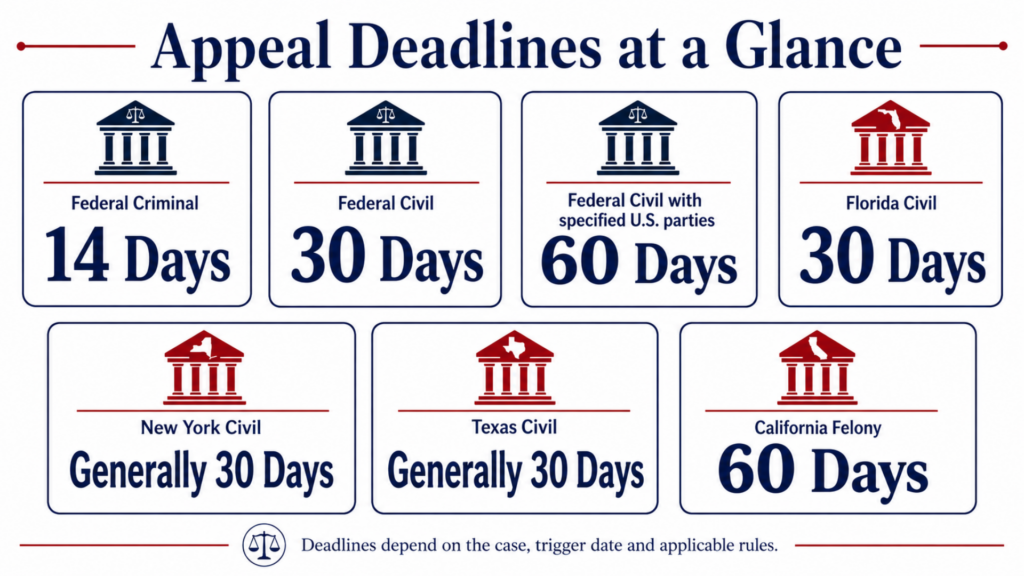
| Jurisdiction | Case Type | Standard Deadline | When the Deadline Generally Starts | Extensions / Special Rules | Rule |
|---|---|---|---|---|---|
| Federal Court | Criminal — Defendant | 14 days | Entry of the judgment or order being appealed, or the later filing of the government’s notice of appeal. | District court may extend the deadline by up to 30 days beyond the prescribed period for excusable neglect or good cause. Certain timely post-trial motions can also affect when the 14-day period runs. | Fed. R. App. P. 4(b) |
| Federal Court | Criminal — Government | 30 days | The later of entry of the judgment or order, or filing of the defendant’s notice of appeal. | Special rules apply to government appeals under Rule 4(b). | Fed. R. App. P. 4(b) |
| Federal Court | Civil | 30 days | Entry of the judgment or order appealed from. | A district court may extend the deadline for excusable neglect or good cause if the requirements of Rule 4(a)(5) are met. Certain timely post-judgment motions can restart the appeal period. | Fed. R. App. P. 4(a) |
| Federal Court | Civil — United States or specified federal parties | 60 days | Entry of the judgment or order appealed from. | The extension and reopening provisions of Rule 4(a) may apply. | Fed. R. App. P. 4(a)(1)(B) |
| California | Unlimited Civil | 60 days or 180 days | Generally 60 days after qualifying service of a Notice of Entry or filed-endorsed judgment; otherwise 180 days after entry of judgment. | Certain qualifying post-judgment motions can extend the time to appeal under Rule 8.108. | Cal. Rules of Court, Rules 8.104, 8.108 |
| California | Limited Civil | Generally 30 days or 90 days | Generally 30 days after qualifying service of the notice of entry; otherwise 90 days after entry of judgment. | Separate limited-civil appellate rules apply. | Cal. Rules of Court, Rules 8.822–8.823 |
| California | Felony | 60 days | Rendition of the judgment or making of the order being appealed. | Generally no extension of the notice-of-appeal deadline is permitted, except as otherwise provided by law, such as Rule 8.66. | Cal. Rules of Court, Rule 8.308 |
| California | Misdemeanor | 30 days | Rendition of the judgment or making of the order being appealed. | Limited special rules apply; the appellate division generally cannot extend the ordinary filing deadline. | Cal. Rules of Court, Rule 8.853 |
| Florida | Civil — Final Order | 30 days | Rendition of the order being reviewed. | Certain timely post-judgment motions can affect when the order is considered rendered for appellate purposes. | Fla. R. App. P. 9.110 |
| Florida | Criminal — Defendant | Generally 30 days | Rendition of the final judgment or other appealable order, subject to the specific provisions of Rule 9.140. | Criminal appeals have special timing rules under Rule 9.140; the precise trigger depends on the type of appeal. | Fla. R. App. P. 9.140 |
| New York | Civil — Appeal as of Right | Generally 30 days | Service of the judgment or order with written notice of entry. | Service by mail generally adds 5 days, making the period 35 days. Different rules can apply to particular proceedings. | N.Y. CPLR § 5513 |
| Texas | Civil | 30 days | Date the judgment is signed. | The period generally becomes 90 days when a party timely files specified post-judgment motions or a qualifying request for findings. Accelerated appeals generally have a 20-day deadline, while restricted appeals generally have a 6-month deadline. | Tex. R. App. P. 26.1 |
| Texas | Criminal — Defendant | 30 days | Date sentence is imposed or suspended in open court, or date the trial court enters the appealable order. | The deadline becomes 90 days when the defendant timely files a motion for new trial. | Tex. R. App. P. 26.2 |
| Texas | Criminal — State | 20 days | Date the trial court enters the order, ruling, or sentence being appealed. | Rule 26.3 provides a limited extension mechanism when its requirements are met. | Tex. R. App. P. 26.2–26.3 |
NOTE – These are general appellate deadlines. Special proceedings, interlocutory appeals, administrative appeals, juvenile cases, bankruptcy matters, and other categories can have different filing periods.
Federal Criminal Appeals: The 14-Day Rule Under FRAP 4(b)
In federal criminal cases, the deadline to file a lawsuit is 14 calendar days from the date of judgment entry. This is one of the shortest timelines in the legal system. Importantly, the countdown begins when the judgment is entered on the docket—not on the day of sentencing.
Where Do You File a Federal Notice of Appeal?
A federal notice of appeal from a district court judgment or order is filed with the clerk of the federal district court that entered the judgment or order. For an appeal as of right, Federal Rule of Appellate Procedure 3 requires the notice of appeal to be filed with the district clerk within the time prescribed by Rule 4. The notice identifies the party taking the appeal, the judgment or order being appealed, and the court of appeals to which the appeal is taken.
NOTE – The notice of appeal is filed in the district court, not initially with the court of appeals. After the notice is filed, the district clerk serves notice of the filing on the other parties and promptly sends a copy of the notice and the docket entries to the clerk of the designated court of appeals.
The appellate brief is filed later in the court of appeals. Filing the brief does not replace the requirement to timely file the notice of appeal with the district clerk. Rule 3 specifically provides that an appeal as of right is taken by filing the notice of appeal, while the briefing and other appellate steps occur afterward.
What To File – A timely Notice of Appeal is the document used to initiate a federal criminal appeal as of right. Under Federal Rule of Appellate Procedure 3, the notice must identify the appealing party, designate the judgment or order being appealed, and name the court of appeals to which the appeal is taken. The notice is filed with the district court clerk; the detailed appellate arguments are presented later in the appellate briefs.
Critical Distinction: The date of sentencing is not necessarily the date the appeal deadline begins. For a federal criminal defendant, the 14-day period generally runs from the entry of the judgment or order being appealed. Federal Rule of Appellate Procedure 4(b) defines entry by reference to the criminal docket. A timely qualifying post-trial motion can also affect when the 14-day appeal period runs.
Example:
- Sentencing: March 1
- Judgment entered on the criminal docket: March 10
- 14-day notice-of-appeal deadline: March 24
- Notice filed on March 25: Generally untimely, assuming no qualifying motion or other rule changes the deadline
The key point is that the appeal period does not necessarily begin on the day the judge announces the sentence. In a straightforward federal criminal case, the relevant date is the entry of the judgment or order on the docket. A defendant can also file a notice of appeal after the court announces the sentence but before the judgment is entered; under Rule 4(b)(2), that notice is treated as filed on the date of and after entry.
NOTE – To verify the relevant date, check the official federal docket through PACER or the district court clerk’s office. PACER provides access to federal district-court docket information and case documents.
Federal Civil Appeals: 30 Days or 60 Days
In most federal civil cases, a notice of appeal must generally be filed within 30 days after entry of the judgment or order being appealed. The deadline generally becomes 60 days when the United States, a United States agency, a United States officer or employee covered by Rule 4(a)(1)(B), or another specified federal party is involved in the case.
The applicable deadline therefore depends on –
- who the parties are,
- what judgment or order is being appealed, and
- whether any rule or qualifying post-judgment motion affects the appeal period.
A federal civil appeal does not automatically have the same filing deadline in every case.
What Happens If Another Party Files an Appeal First?
If one party files a notice of appeal in a federal civil case, another party may generally have an additional 14 days to file its own notice of appeal. Federal Rule of Appellate Procedure 4(a)(3) provides that the second party may file its notice of appeal within 14 days after the first notice of appeal is filed or within the time otherwise prescribed by Rule 4(a), whichever ends later.
This rule allows another party to file a separate appeal even after the first party has already filed a notice of appeal. It is particularly important when both parties want to challenge different parts of the same judgment or order.
For example, if the first party files a notice of appeal on May 10, the other party generally has 14 days from that filing date to file its own notice of appeal, unless its ordinary Rule 4(a) deadline expires later. The exact deadline should be calculated based on the date the judgment was entered, any applicable 60-day period, qualifying post-judgment motions, and any other Rule 4 provisions that apply to the case.
Can a Post-Judgment Motion Change the Federal Appeal Deadline?
Yes. Certain timely post-judgment motions can affect the deadline for filing a federal civil appeal. Under Federal Rule of Appellate Procedure 4(a)(4), when a party timely files one of the specified post-judgment motions, the time to appeal generally runs from the entry of the order disposing of the last such remaining motion.
Qualifying motions under Rule 4(a)(4) include a motion for judgment under Federal Rule of Civil Procedure 50(b), a motion to amend or make additional factual findings under Rule 52(b), a motion for a new trial under Rule 59, and a motion to alter or amend the judgment under Rule 59. Certain motions under Rule 60 can also affect the appeal period when they are filed within the time specified by Rule 4(a)(4).
This means that a party cannot always determine the federal appeal deadline by simply counting 30 or 60 days from the original judgment. The court must determine whether a qualifying post-judgment motion was filed on time and whether that motion affects the appeal period under Rule 4(a)(4).
What Starts the Appeal Deadline?
The event that starts an appeal deadline depends on the court, jurisdiction, and type of case. In many courts, the filing period begins when the judgment or order is formally entered, but some jurisdictions calculate the deadline from service of the judgment, rendition of the order, sentencing, or another specified event. Qualifying post-judgment motions can also affect when the appeal period begins or runs.
| Court / Case Type | Common Trigger for the Appeal Period |
|---|---|
| Federal civil | Entry of the judgment or order being appealed, subject to the special rules in Federal Rule of Appellate Procedure 4(a) and qualifying post-judgment motions under Rule 4(a)(4). |
| Federal criminal | Entry of the judgment or order on the criminal docket, subject to the alternative timing provisions and qualifying motions under Rule 4(b). |
| California — Unlimited civil | Generally 60 days after qualifying service of the notice of entry or a filed-endorsed judgment, or 180 days after entry of judgment if the applicable service-based deadline has not occurred. |
| California — Felony | Rendition of the judgment or making of the order being appealed, generally resulting in a 60-day filing period. |
| California — Misdemeanor | Rendition of the judgment or making of the order being appealed, generally resulting in a 30-day filing period. |
| Florida — Civil | Rendition of the order being reviewed. Under Florida Rule of Appellate Procedure 9.020, rendition generally occurs when a signed, written order is filed with the clerk of the lower tribunal. |
| Florida — Criminal | Rendition of the final judgment or other appealable order, subject to the specific timing provisions of Rule 9.140. |
| New York — Civil | Generally service of the judgment or order with written notice of entry. |
| Texas — Civil | Generally the date the judgment is signed, subject to different deadlines for accelerated, restricted, and other types of appeals. |
| Texas — Criminal | Generally the date sentence is imposed or suspended in open court, or the date the appealable order is entered, depending on the type of appeal. |
How Do You Calculate a Federal Appeal Deadline?
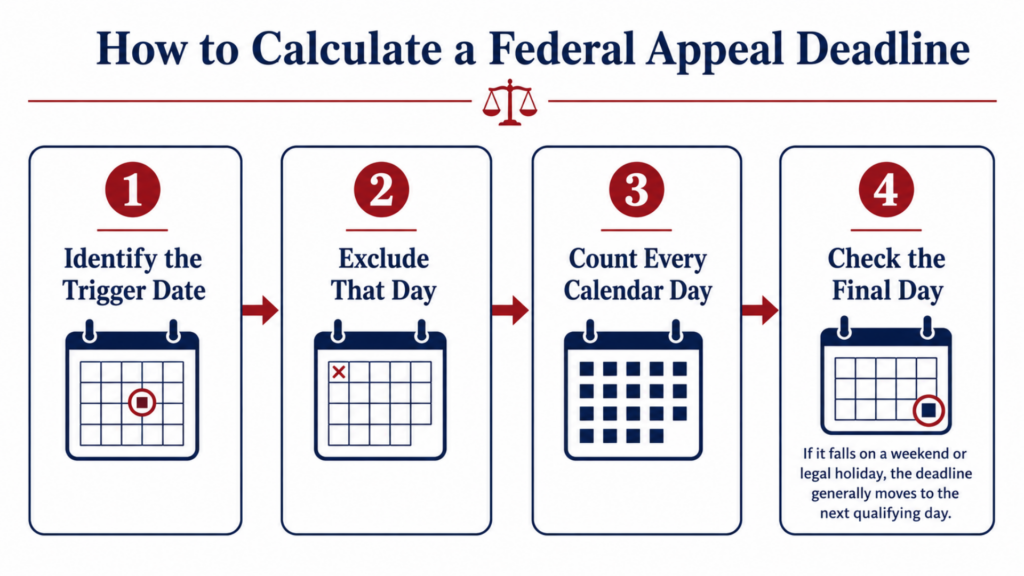
Federal appeal deadlines are calculated under Federal Rule of Appellate Procedure 26.
For a period stated in days,
- the day of the event that triggers the deadline is excluded,
- every subsequent calendar day is counted,
- and the final day is included.
Saturdays, Sundays, and legal holidays are counted as intermediate days. If the final day falls on a Saturday, Sunday, or legal holiday, the filing period generally continues until the next day that is not a Saturday, Sunday, or legal holiday.
This means that a 14-day federal appeal deadline generally means 14 calendar days, not 14 business days. The calculation begins with identifying the correct triggering event, for example, entry of the judgment or order, and then applying Rule 26 to that date.
For example, if a federal criminal defendant’s 14-day appeal period begins after entry of judgment on March 10, March 10 is excluded and March 11 is counted as Day 1. The 14-day period ordinarily ends on March 24, unless the final day falls on a Saturday, Sunday, or legal holiday or another rule changes the calculation.
State appellate courts use their own rules for computing filing periods. A federal Rule 26 calculation should therefore not automatically be applied to a state appeal. The applicable state rule must be checked separately.
State Appeal Deadlines: California, Florida, New York, and Texas
State appeal deadlines vary by jurisdiction, case type, and the type of judgment or order being appealed. A federal appeal deadline should not be applied to a state-court appeal, and one state’s deadline should not be assumed to apply in another state.
California Civil Appeals
In a California unlimited civil case, the notice of appeal generally must be filed by the earliest applicable deadline under California Rule of Court 8.104.
- 60 days after qualifying service: The deadline is generally 60 days after the superior court clerk serves a document entitled Notice of Entry of Judgment or a filed-endorsed copy of the judgment showing the date it was entered.
- 60 days after qualifying service by a party: The same 60-day period generally applies when a party serves a qualifying Notice of Entry or filed-endorsed copy of the judgment.
- 180-day outside deadline: If neither of those qualifying service events occurs, the notice of appeal generally must be filed within 180 days after entry of judgment.
- Post-judgment motions: Certain timely post-judgment motions can extend the time to appeal under California Rule of Court 8.108.
- Late filing: A court generally cannot simply extend the ordinary Rule 8.104 deadline after it has expired. The applicable rules governing extensions, relief, and qualifying post-judgment motions must be followed.
The important point is that California’s civil appeal deadline is not simply “60 days from the judgment.” The applicable service event and the 180-day outside period must be considered.
California Criminal Appeals
California uses different appeal deadlines for felony and misdemeanor cases.
- Felony: A notice of appeal generally must be filed within 60 days after rendition of the judgment or making of the appealable order. See California Rule of Court 8.308.
- Misdemeanor: A notice of appeal generally must be filed within 30 days after rendition of the judgment or making of the appealable order. See California Rule of Court 8.853.
- Extensions: The ordinary notice-of-appeal deadline generally cannot simply be extended by the court, although specific rules may provide limited relief in particular circumstances.
Therefore, a person cannot determine a California criminal appeal deadline without first identifying whether the case is a felony or misdemeanor and determining the judgment or order being appealed.
Florida Civil Appeals
In a Florida civil case, an appeal from a final order generally must be initiated by filing a notice of appeal with the clerk of the lower tribunal within 30 days after rendition of the order being reviewed. Fla. R. App. P. 9.110.
- 30-day civil deadline: Rule 9.110 generally requires a notice of appeal from a final order to be filed within 30 days after rendition.
- Meaning of rendition: Under Florida Rule of Appellate Procedure 9.020, an order is generally rendered when a signed, written order is filed with the clerk of the lower tribunal.
- Post-decision motions: Certain authorized and timely motions can toll rendition, meaning the 30-day appellate period does not begin until the motion is resolved and the resulting order is rendered.
- Practical effect: The date the judge announces a ruling is not necessarily the date the Florida appeal period begins.
Florida Criminal Appeals
For a Florida criminal defendant, the notice of appeal generally may be filed from rendition of the final judgment and, in sentencing appeals, no later than 30 days after rendition of the written order imposing sentence.
- A defendant may generally file the notice of appeal after rendition of the final judgment.
- In a sentencing appeal, the notice may generally be filed before the written sentencing order is rendered, but the 30-day period following rendition of the written sentencing order controls the outer deadline under Rule 9.140(b)(3).
- The specific timing rule depends on the type of criminal order or judgment being appealed.
Florida’s appellate rules have also been amended in 2026. Because the rules governing appellate procedure can change, the current versions of Rule 9.020, Rule 9.110, and Rule 9.140 should be checked when calculating a Florida appeal deadline. When the applicable deadline or appellate procedure is unclear, a Florida appeal lawyer can review the judgment, applicable rule, and relevant filing dates to determine the deadline.
New York Civil Appeals
In many New York civil cases, the time to appeal generally runs from service of the judgment or order with written notice of entry, rather than simply from the date the judge issues the decision.
- 30-day period: Under N.Y. CPLR § 5513, an appeal as of right generally must be taken within 30 days after service of the judgment or order with written notice of entry.
- Service by mail: When the triggering service is made by mail, additional time is generally added under the applicable service rules, making the practical period 35 days.
- Different proceedings: Special rules can apply to particular courts, proceedings, and types of appellate review.
- Key distinction: The date on which the judge signs or issues a decision does not necessarily begin the appeal period.
New York’s service-based rule is therefore different from the federal rule, which generally measures the civil appeal period from entry of the judgment or order.
Texas Civil Appeals
Texas does not have one universal appeal deadline. The applicable deadline depends on whether the appeal is an ordinary civil appeal, an accelerated appeal, a restricted appeal, or a criminal appeal.
Under Texas Rule of Appellate Procedure 26.1, an ordinary civil notice of appeal generally must be filed within 30 days after the judgment is signed.
- Ordinary civil appeal: Generally 30 days after the judgment is signed.
- 90-day period: The deadline generally becomes 90 days when a party timely files a qualifying motion for new trial, motion to modify the judgment, motion to reinstate under the applicable rule, or certain requests for findings of fact and conclusions of law.
- Accelerated appeal: Generally 20 days after the judgment or order is signed.
- Restricted appeal: Generally six months after the judgment or order is signed.
- Special rules: Other types of appeals can have different deadlines under the Texas Rules of Appellate Procedure.
The type of Texas civil appeal must therefore be identified before calculating the deadline.
Texas Criminal Appeals
For a Texas criminal defendant, the notice of appeal generally must be filed within 30 days after the day the sentence is imposed or suspended in open court, or within the applicable period following entry of the appealable order.
- Ordinary deadline: Generally 30 days.
- Timely motion for new trial: The deadline generally becomes 90 days when the defendant timely files a motion for new trial.
- Other criminal appeals: Different deadlines and procedures can apply depending on what is being appealed and who is taking the appeal.
- State appeals: The State’s right to appeal is governed by separate provisions and should not be treated as having the same deadline as a defendant’s appeal.
Texas appeal deadlines therefore depend on both the type of case and the type of appellate proceeding involved. If the applicable deadline or filing requirements are unclear, Texas appeal lawyers can review the judgment, applicable appellate rule, and relevant filing dates to help determine the correct deadline.
Not Every Federal Appeal Uses a 14, 30, or 60-Day Deadline
The 14, 30, or 60-Day deadlines under Federal Rule of Appellate Procedure 4 apply primarily to ordinary appeals as of right from federal district court judgments and orders. Other federal appellate proceedings have their own filing deadlines and procedures.
| Proceeding | General Deadline |
|---|---|
| Interlocutory appeal by permission under 28 U.S.C. § 1292(b) | 10 days after entry of the order containing the required certification |
| Petition for permission to appeal a class-certification order under Rule 23(f) | 14 days after the order is entered |
| Appeal from a U.S. Tax Court decision under Federal Rule of Appellate Procedure 13 | Generally 90 days after the decision is entered |
| Petition for a writ of certiorari to the U.S. Supreme Court | Generally 90 days after entry of the judgment |
Why Are These Federal Deadlines Different?
A specialized federal appellate proceeding may have a different deadline because it is governed by a different statute or appellate rule. For example, an interlocutory appeal under 28 U.S.C. § 1292(b) requires permission to appeal and has a 10-day petition period. A petition for permission to appeal a class-certification order under Federal Rule of Civil Procedure 23(f) generally must be filed within 14 days after the order is entered. Appeals from U.S. Tax Court decisions are governed by Federal Rule of Appellate Procedure 13, while petitions for Supreme Court review are governed by Supreme Court Rule 13.
The 90-day Supreme Court period is a deadline for filing a petition for a writ of certiorari, not an ordinary appeal from a federal district court. Supreme Court Rule 13 generally requires the petition to be filed within 90 days after entry of the judgment, although the rule contains specific provisions concerning timely rehearing petitions and extensions in appropriate circumstances.
Therefore, the correct federal appeal deadline depends first on the type of appellate proceeding involved. A person should not assume that the ordinary 14, 30, or 60-day Rule 4 deadline applies to every federal appeal or petition for appellate review.
What Happens If You Miss the Appeal Deadline?
Missing an appeal deadline can result in the loss of the right to pursue ordinary appellate review. The consequences of a late filing depend on the jurisdiction, type of case, applicable appellate rule, and whether a rule provides a procedure for an extension, reopening, or other form of relief.
- Federal civil appeals: Federal Rule of Appellate Procedure 4(a) provides limited procedures for extending the time to appeal for excusable neglect or good cause and, under specific circumstances, reopening the time to appeal when a party did not receive timely notice of the judgment.
- Federal criminal appeals: Federal Rule of Appellate Procedure 4(b) permits a district court to extend a defendant’s notice-of-appeal period for a limited time upon a finding of excusable neglect or good cause, subject to the rule’s requirements.
- State appeals: California, Florida, New York, Texas, and other states have their own rules governing late notices of appeal, extensions, and other forms of relief. A federal rule should not be assumed to apply to a state appeal.
- If no relief is available: When the applicable deadline has expired, and no extension, reopening provision, or other authorized remedy applies, the court may dismiss the appeal or otherwise refuse to permit the late appeal to proceed.
The practical consequence can be significant: if a late filing cannot be excused or otherwise permitted under the applicable rules, the original judgment may remain in effect without ordinary appellate review. Other legal remedies may exist in limited circumstances, but they are not substitutes for a timely notice of appeal.
Because appeal deadlines can be strictly enforced, a person who believes the deadline has been missed should determine immediately whether an extension, reopening provision, or other form of relief is available under the applicable appellate rules.
Conclusion
There is no single appeal deadline that applies to every court or every type of case. Federal criminal defendants generally have 14 days to file a notice of appeal, most federal civil appeals generally have a 30-day deadline, and certain civil cases involving specified federal government parties generally have 60 days. State appeal deadlines vary based on the jurisdiction, case type, judgment or order being appealed, and applicable appellate rules.
The key to calculating an appeal deadline is identifying the correct judgment or order, determining whether it is appealable, identifying the event that starts the appellate clock, and checking whether a timely post-judgment motion or special appellate rule affects the filing period. Counting the correct number of days from the wrong triggering event can still result in an incorrect deadline.
If you are considering an appeal, do not wait until the deadline is approaching to determine whether you have time to file. Brownstone Law‘s appellate attorneys handle state and federal appeals and can evaluate your judgment or order, applicable appellate deadlines, and potential appellate options. Contact Brownstone Law to discuss your case and determine the appropriate next steps.
Frequently Asked Questions (FAQs)
Q1. What Information Should Be Checked Before Filing a Notice of Appeal?
Before filing a notice of appeal, verify the exact judgment or order being challenged, whether that judgment or order is appealable, the date it was entered or rendered, and the appellate rule that establishes the filing deadline. The following information should also be checked:
- Judgment or order: Identify the exact judgment, order, or decision being appealed.
- Appealability: Confirm that the judgment or order is immediately appealable or determine whether permission to appeal is required.
- Triggering date: Determine the date the judgment or order was formally entered, rendered, or otherwise became effective for purposes of the appeal deadline.
- Service or notice: Check whether the jurisdiction requires service of a Notice of Entry, filed-endorsed judgment, or another document to start the appeal period.
- Post-judgment motions: Determine whether a timely qualifying motion was filed and whether it affects or tolls the appeal deadline.
- Filing location: Confirm the correct court clerk or tribunal with which the notice of appeal must be filed.
- Applicable rules: Check the governing appellate rules, statutes, and any applicable local rules for the court.
- Deadline calculation: Calculate the filing deadline using the specific rule that applies to the case rather than relying on a general 14-, 30-, or 60-day period.
In a federal appeal as of right from a district court, the notice of appeal is filed with the district clerk under Federal Rule of Appellate Procedure 3. Timely filing of the notice of appeal is the act that initiates the appeal; the appellate brief is filed later according to the schedule established by the court of appeals.
The notice of appeal should therefore be addressed before preparing the appellate brief. A party should first confirm where the notice must be filed, what judgment or order is being appealed, and the exact deadline for filing it.
Q2. Can You File an Appeal After 30 Days?
Sometimes, but not automatically. Whether you can file an appeal after 30 days depends on the type of case and whether a specific rule allows an extension or reopening of the appeal period.
- Federal civil appeals: Under Federal Rule of Appellate Procedure 4(a)(5), a district court may extend the time to file a notice of appeal for excusable neglect or good cause if the motion for an extension is filed within 30 days after the original appeal deadline expires. Rule 4(a)(6) also allows the appeal period to be reopened in limited circumstances when the party did not receive timely notice of the judgment, subject to strict requirements, including a 180-day limit from entry of judgment or a 14-day period from receipt of notice, whichever is earlier.
- Federal criminal appeals: Under Rule 4(b)(4), a district court may extend a defendant’s time to file a notice of appeal by up to 30 days after the original 14-day period expires when the defendant demonstrates excusable neglect or good cause.
- State appeals: Deadlines and late-filing rules vary by state. Some jurisdictions provide limited extensions or other relief, while others generally do not permit the ordinary notice-of-appeal period to be extended.
Therefore, a 30-day deadline is not an automatic cutoff in every case, but a late appeal should not be assumed to be permitted. The specific appellate rule, the original deadline, the reason for the delay, and any available extension or reopening procedure must be checked immediately.
Q3. What Happens If the Supreme Court Rejects Your Case?
If the U.S. Supreme Court denies a petition for a writ of certiorari, the lower court’s judgment remains in effect. A denial of certiorari means the Supreme Court has declined to review the case; it does not mean that the Court has agreed with or endorsed the lower court’s decision.
The Supreme Court grants review in only a small percentage of cases. The Court generally selects cases involving important federal questions, conflicts among lower courts, significant constitutional issues, or other matters that warrant review.
A denial of certiorari ordinarily ends the direct appellate review process in the Supreme Court. There generally is no further appeal to another federal court from a Supreme Court denial of certiorari. However, depending on the circumstances, other limited legal remedies or proceedings may remain available, and a certiorari denial itself does not prevent the Supreme Court from considering a different case presenting the same legal issue.
Q4. What are the odds of winning a federal appeal?
Federal appeals are difficult to win, and appellate courts affirm a substantial majority of lower-court decisions. However, the likelihood of success varies significantly by the type of case, the issue being appealed, and the applicable standard of review.
An appeal is more likely to succeed when the record shows a reversible legal error, such as an incorrect interpretation or application of the law, and less likely to succeed when the appellant is primarily asking the court to reweigh evidence or second-guess factual or discretionary decisions. Federal appellate courts generally review legal questions de novo, factual findings for clear error, and discretionary decisions for abuse of discretion.
The outcome also depends on whether the alleged error was preserved for appeal and whether it affected the judgment. The court of appeals generally reviews the existing record rather than conducting a new trial or considering evidence that was not presented to the lower court.
For that reason, a general federal appeal success rate should not be used to predict the outcome of an individual case. The strongest indicator is whether the appellate record supports a preserved, reversible error under the standard of review that applies to the issue.
Q5. When Should an Appeal Be Taken?
An appeal should generally be taken as soon as the party decides to challenge an appealable judgment or order and before the applicable appellate deadline expires. The deadline is determined by the jurisdiction, type of case, judgment or order being challenged, and the rule governing the appeal.
Do not wait until the deadline is close to begin the appellate process. Before filing, the party should confirm that the judgment or order is appealable, identify the event that starts the appeal period, calculate the exact filing deadline, and determine whether any timely post-judgment motion affects that deadline.
In most appeals, the first critical filing is the notice of appeal—not the appellate brief. The notice must be filed in the court and within the time required by the applicable appellate rules. The appellate briefing and other steps generally occur after the appeal has been initiated.
If you are considering an appeal, the safest approach is to determine the applicable deadline immediately after the judgment or order is entered and take the necessary steps before that deadline expires.
GLOSSARY
Rendition – Rendition is the point at which a court’s decision becomes formally effective for purposes of appellate review. In Florida, an order is generally rendered when a signed, written order is filed with the clerk of the lower tribunal.
Interlocutory Appeal – An interlocutory appeal is an appeal from a ruling or order issued before the trial court has completely resolved the case.
Filed-Endorsed Copy – A filed-endorsed copy is a copy of a court document that shows it has been officially filed with the court, generally including the date of filing.
Excusable Neglect – Excusable neglect is a legally recognized reason for failing to meet a deadline that may allow a court to grant limited relief when the applicable appellate rule permits it.
Appeal as of Right – An appeal as of right is an appeal that a party is entitled to take without first obtaining permission from the appellate court, provided the applicable requirements and deadline are met.
Entry of Judgment – Entry of judgment is the formal recording of a court’s judgment or order in the court’s official docket. In many federal appeals, the appeal deadline begins from the date the judgment is entered.
Appellate Brief – An appellate brief is a written legal document that presents a party’s arguments on appeal and explains the legal authority supporting those arguments.