
A federal criminal conviction does not necessarily mark the end of the legal process. Whether the conviction resulted from a guilty verdict at trial or a guilty plea, the defendant may still have several legal options. The available remedies depend on the stage of the case and the specific circumstances involved.
These may include filing post-trial motions where permitted, objecting to the Presentence Investigation Report (PSR), seeking a more favorable sentence at sentencing, filing a direct appeal, requesting release pending appeal, pursuing rehearing or Supreme Court review, seeking post-conviction relief under 28 U.S.C. § 2255, requesting a legally authorized sentence reduction, or applying for executive clemency.
Not every option is available in every case. The appropriate course of action depends on several factors, including:
- whether the conviction resulted from a trial or a guilty plea;
- whether the defendant signed an appellate waiver;
- which legal issues or objections were preserved during the proceedings;
- whether judgment has been entered;
- the procedural stage of the case; and
- whether the applicable filing deadlines remain open.
The timing of these options is just as important as the options themselves. Some remedies are available before sentencing, others after the judgment is entered, while certain forms of relief can only be pursued after the direct appeal has concluded.
Because each stage of a federal criminal case is governed by different legal standards, procedural rules and filing deadlines, understanding when a particular remedy becomes available is essential to protecting the defendant’s rights.
What Legal Options Are Available After a Federal Criminal Conviction?
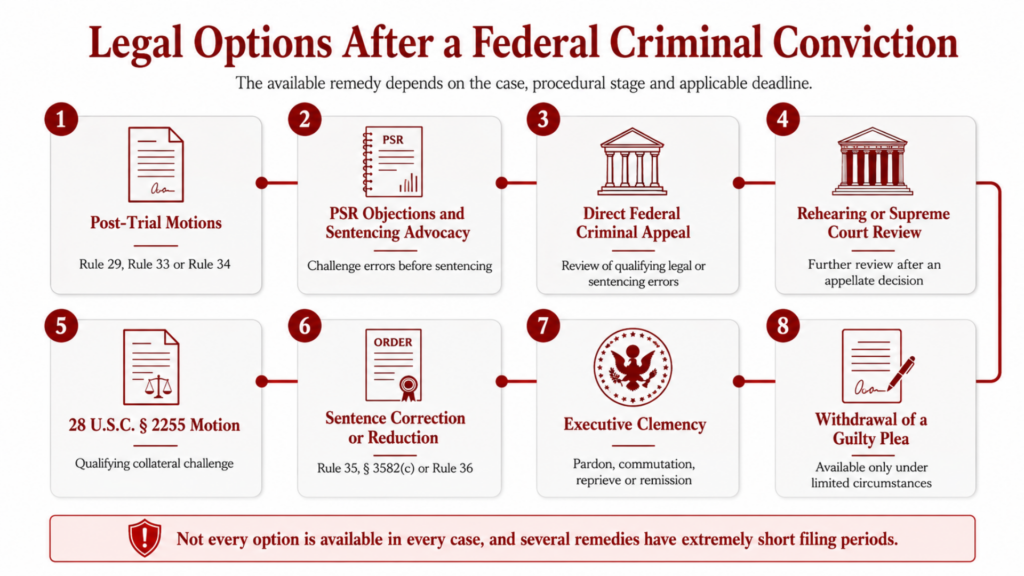
The defendant’s principal options may include the following:
| Legal Option | When It May Apply | Main Purpose | Where It Is Decided |
|---|---|---|---|
| Rule 29 Motion for Judgment of Acquittal | Following a guilty verdict at a jury trial, generally within 14 days after the verdict or jury discharge. | Argues that the evidence presented at trial was legally insufficient to support the conviction. | U.S. District Court |
| Rule 33 Motion for a New Trial | Following a jury or bench-trial conviction; deadlines depend on the asserted ground. | Seeks a new trial when the interests of justice require it, including qualifying error or newly discovered evidence. | U.S. District Court |
| Rule 34 Motion to Arrest Judgment | Following a verdict or finding of guilt, or acceptance of a guilty or no-contest plea, generally within 14 days. | Raises the narrow claim that the district court lacked jurisdiction over the charged offense. | U.S. District Court |
| Withdrawal of a Guilty or No-Contest Plea Under Rule 11 | Before sentencing, after the court has accepted the plea, when the defendant can establish a “fair and just reason” or another applicable ground under Rule 11. | Seeks permission to withdraw the plea and restore the case to its pre-plea position. | U.S. District Court |
| PSR Objections and Sentencing Advocacy | After conviction but before sentence is imposed. | Challenges factual or guideline errors and presents mitigating information and sentencing arguments. | U.S. District Court |
| Direct Federal Criminal Appeal | Generally after entry of the final judgment; the defendant’s notice is ordinarily due within 14 days. | Challenges appealable legal, constitutional, procedural, or sentencing errors. | U.S. Court of Appeals |
| Release Pending Appeal | After sentencing and the filing of an appeal or certiorari petition, subject to strict statutory requirements. | Requests release while appellate review remains pending. | U.S. District Court initially, with review by the Court of Appeals |
| Panel Rehearing or Rehearing En Banc | Following an unfavorable appellate decision, usually within 14 days in a criminal case. | Requests reconsideration based on overlooked matters, decisional conflicts, or exceptionally important questions. | U.S. Court of Appeals |
| Petition for Writ of Certiorari | After the Court of Appeals enters judgment or denies rehearing. | Asks the Supreme Court to exercise discretionary review. | U.S. Supreme Court |
| Motion Under 28 U.S.C. § 2255 | Commonly after direct review ends and generally within the applicable one-year limitation period. | Seeks to vacate, set aside, or correct a sentence on qualifying constitutional, federal-law, jurisdictional, or collateral grounds. | Sentencing U.S. District Court |
| Rule 35 or 18 U.S.C. § 3582(c) Sentence Relief | After sentencing, but only under specifically authorized and often tightly limited circumstances. | Seeks correction or reduction of a sentence under the applicable rule or statute. | U.S. District Court |
| Correction of a Clerical Error Under Rule 36 | At any time after a clerical mistake, oversight, or omission is identified in a judgment, order, or other part of the court record. | Corrects the written record so that it accurately reflects the court’s actual decision; it generally cannot be used to make a substantive change to the conviction or sentence. | U.S. District Court |
| Executive Clemency | During or after the sentence, depending on the form of clemency requested. | Requests a pardon, commutation, reprieve, or other form of executive clemency for a federal offense. | President of the United States |
IMPORTANT NOTE: Withdrawal of a guilty plea is generally available only before sentencing; after sentencing, the plea may ordinarily be challenged only through direct appeal or an authorized collateral proceeding. Rule 36 is limited to clerical or recordkeeping mistakes and cannot ordinarily be used to reconsider the merits of a conviction or alter a sentence substantively. Many post-conviction remedies have strict and sometimes jurisdictional filing requirements, so the defendant should obtain advice from qualified federal criminal counsel without delay.
What Happens Immediately After a Federal Conviction?
What happens next after a federal conviction depends partly on whether the defendant was convicted following a jury or bench trial or pleaded guilty or no contest.
After a trial conviction, defense counsel may evaluate any available post-trial motions while the case proceeds toward sentencing. After the court accepts a guilty or no-contest plea, the case normally proceeds into the presentence investigation and sentencing stages. Withdrawal of the plea or other plea-related challenges may remain available only in limited circumstances. Before sentencing, an accepted plea may generally be withdrawn when the defendant establishes a fair and just reason or another ground recognized under Rule 11.
The period following conviction may involve:
- A determination of whether the defendant will be detained or permitted to remain released pending sentencing
- Preparation of the Presentence Investigation Report
- Review of the advisory Federal Sentencing Guidelines calculation
- Written objections to the PSR
- Defense and government sentencing submissions
- The sentencing hearing
- Entry of the written judgment
- Calculation of the direct-appeal deadline
- If imprisonment is imposed, designation to a Bureau of Prisons facility
A presentence investigation and report are ordinarily prepared before sentencing, although Rule 32 permits limited exceptions when a statute provides otherwise or the court finds that the existing record contains sufficient information to exercise its sentencing authority meaningfully. The PSR normally identifies the applicable Sentencing Guidelines, calculates the offense level and criminal-history category, and states the resulting advisory sentencing range. The parties ordinarily have 14 days after receiving the PSR to submit written objections.
A finding of guilt does not automatically mean that a defendant who was previously released will remain free until sentencing. Under 18 U.S.C. § 3143(a), post-conviction detention is generally presumed when imprisonment is anticipated unless the applicable statutory requirements for release are satisfied. Certain categories of offenses are subject to stricter mandatory-detention provisions.
Option 1: File a Post-Trial Motion
A defendant convicted after a trial may have a limited opportunity to ask the U.S. District Court to set aside the verdict, order a new trial or arrest the judgment before the case proceeds through the direct-appeal process.
The three principal post-trial motions are:
- A Rule 29 motion for judgment of acquittal
- A Rule 33 motion for a new trial
- A Rule 34 motion to arrest judgment
Each motion serves a different legal purpose and is subject to its own standards and filing deadlines.
Rule 29 Motion for Judgment of Acquittal
A Rule 29 motion challenges whether the prosecution presented legally sufficient evidence to support the conviction.
What a Rule 29 motion argues
The defendant may argue that:
- The prosecution failed to prove one or more essential elements of the charged offense.
- The evidence was insufficient for a rational factfinder to return a guilty verdict.
- Even when the evidence is viewed in the light most favorable to the prosecution, it does not legally support the conviction.
What a Rule 29 motion does not do
A Rule 29 motion does not ordinarily ask the judge to:
- Reweigh the evidence.
- Replace the jury’s credibility determinations with the judge’s own view.
- Decide which witness was more believable.
- Grant an acquittal merely because the judge might have reached a different factual conclusion.
The central question is whether the evidence was legally sufficient to permit the conviction, not whether the judge personally agrees with the verdict.
Rule 29 filing deadline
Following a jury trial:
- A defendant may file or renew a Rule 29 motion after a guilty verdict.
- The motion generally must be filed within 14 days after the guilty verdict or the jury’s discharge, whichever occurs later.
- A motion made during the trial may be renewed after the jury returns a guilty verdict.
Possible result
If the court grants the Rule 29 motion:
- The court may set aside the guilty verdict.
- The court may enter a judgment of acquittal.
- The conviction on the affected count or counts may no longer stand, subject to any available government appeal.
Rule 33 Motion for a New Trial
A Rule 33 motion asks the district court to vacate the judgment and grant a new trial when the interest of justice requires it.
Unlike a Rule 29 motion, which challenges the legal sufficiency of the evidence, a Rule 33 motion may address qualifying problems affecting the fairness or reliability of the trial.
Potential grounds for a Rule 33 motion
Depending on the circumstances and the law of the applicable federal circuit, possible grounds may include:
- Serious trial errors.
- Improperly admitted or excluded evidence.
- Prosecutorial misconduct.
- Juror misconduct.
- Undisclosed juror bias.
- Improper outside influence on the jury.
- Serious problems with jury instructions.
- Newly discovered evidence.
- Other qualifying errors that may have affected the fairness of the trial.
The existence of an error does not automatically require a new trial. The defendant must satisfy the applicable legal standard and show that the issue is sufficiently serious to justify relief.
Motion based on grounds other than newly discovered evidence
For most Rule 33 motions:
- The motion generally must be filed within 14 days after the verdict or finding of guilt.
- This deadline may apply to claims involving trial errors, juror problems, or other matters already known or reasonably discoverable at the time of trial.
- The defendant must explain why the identified issue justifies setting aside the result and conducting a new trial.
Motion based on newly discovered evidence
When the motion is based on newly discovered evidence:
- The motion generally must be filed within three years after the verdict or finding of guilt.
- The evidence must ordinarily have been discovered after the trial.
- The defendant may need to show that the evidence could not have been discovered earlier through reasonable diligence.
- The evidence generally must be material rather than merely cumulative or useful only for impeachment.
- The evidence must satisfy the legal test applied by the relevant federal circuit.
The discovery of additional information does not automatically entitle the defendant to a new trial.
Rule 33 motion during a pending appeal
If a direct appeal is already pending:
- The defendant may still present a Rule 33 motion in appropriate circumstances.
- The district court may consider the motion.
- However, the district court generally may not grant the motion while the appeal remains pending unless the Court of Appeals remands the case.
Possible result
If the Rule 33 motion is granted:
- The judgment may be vacated.
- A new trial may be ordered.
- The defendant is not necessarily acquitted.
- The prosecution may ordinarily retry the affected charge unless another legal rule prevents it.
In a case tried without a jury, the district court may take additional testimony and enter a new judgment when permitted under Rule 33.
Rule 34 Motion to Arrest Judgment
A Rule 34 motion provides a much narrower form of relief than Rule 29 or Rule 33. Under the current rule, it allows the defendant to argue that the district court lacked jurisdiction over the charged offense.
What a Rule 34 motion may address
A Rule 34 motion may raise the narrow claim that the federal district court lacked jurisdiction over the charged offense.
What a Rule 34 motion does not ordinarily address
Rule 34 is not a general method for challenging:
- The sufficiency of the prosecution’s evidence.
- The weight of the evidence.
- Witness credibility.
- Ordinary trial errors.
- The fairness of the sentence.
- Disagreement with the jury’s verdict.
- Claims that are properly raised through Rule 29, Rule 33, direct appeal, or another procedure.
Rule 34 filing deadline
A Rule 34 motion generally must be filed:
- Within 14 days after the court accepts a verdict or finding of guilt.
- Within 14 days after a guilty plea or no-contest plea when the motion arises following such a plea.
Unlike Rule 29, Rule 34 is not limited exclusively to a conviction following a jury trial.
Possible result
If a Rule 34 motion is granted:
- The court may arrest the judgment.
- The judgment cannot proceed on the affected charge because of the identified jurisdictional defect.
- The precise consequences may depend on the nature of the defect and the procedural circumstances of the case.
Key Differences Between Rules 29, 33 and 34
- Rule 29: Challenges whether the prosecution presented legally sufficient evidence to sustain the conviction.
- Rule 33: Requests a new trial because qualifying errors, juror problems, newly discovered evidence, or other serious circumstances affected the interests of justice.
- Rule 34: Raises the narrow claim that the district court lacked jurisdiction over the charged offense.
These motions should not be grouped under a generic description such as a “motion to overturn the conviction.” Each motion addresses a distinct legal issue and provides a different type of potential relief.
Effect on the Direct-Appeal Deadline
A timely post-trial motion may affect when the deadline for filing a direct federal criminal appeal begins.
Under Federal Rule of Appellate Procedure 4(b)(3):
- A qualifying and timely Rule 29, Rule 33, or Rule 34 motion may postpone the running of the direct-appeal period.
- The notice of appeal is generally due within 14 days after the district court disposes of the last qualifying motion.
- Alternatively, the deadline may run from the entry of the judgment of conviction if that produces a later deadline.
- A notice of appeal filed before the district court decides a qualifying motion generally becomes effective when the court disposes of the final qualifying motion.
A Rule 33 motion based on newly discovered evidence receives special treatment:
- Although the Rule 33 motion itself may generally be filed within three years after the verdict or finding of guilt, it affects the direct-appeal deadline under Rule 4(b)(3) only when it is filed within 14 days after entry of judgment.
- A newly discovered-evidence motion filed later in the three-year period does not ordinarily restart or postpone an already expired direct-appeal deadline.
Important Filing Considerations
A defendant and defense counsel should consider the following points immediately after a trial conviction:
- The filing periods for Rules 29, 33 and 34 are extremely short.
- The relevant deadline may begin from the verdict, finding of guilt, jury discharge, plea or entry of judgment, depending on the rule involved.
- A defendant should not assume that the court will grant additional time.
- Rule 45 may permit limited relief in certain circumstances involving excusable neglect, but an extension is not automatic.
- Filing the wrong type of motion may fail to preserve the intended issue.
- A post-trial motion does not automatically prevent sentencing from proceeding.
- A post-trial motion does not automatically result in the defendant’s release from custody.
- Issues raised in post-trial motions may also affect the scope and timing of a later direct appeal.
- The availability of each motion depends on whether the conviction followed a jury trial, bench trial, guilty plea, or no-contest plea.
- The applicable standards may vary based on the facts, procedural history and controlling law of the federal circuit.
Option 2: Challenge the PSR and Advocate at Sentencing
When sentencing has not yet occurred, one of the defendant’s most important options is to challenge mistakes in the Presentence Investigation Report and present a persuasive sentencing case.
| What Is the Presentence Investigation Report?The Presentence Investigation Report, commonly called the PSR, is usually prepared by a federal probation officer after a guilty plea or trial conviction.The probation officer may investigate:The offense and relevant conduct.The defendant’s criminal history.Financial circumstances.Employment and education.Physical and mental health.Family and personal background.Substance-use or treatment needs.Victim losses and restitution. |
The PSR is normally prepared by a federal probation officer. It can contain:
- A description of the offense
- Relevant-conduct allegations
- The defendant’s criminal history
- The proposed offense level
- Sentencing enhancements or reductions
- The advisory guideline range
- Statutory minimum and maximum penalties
- Victim and restitution information
- The defendant’s health, education, employment and family history
- Information relevant to treatment, supervision and imprisonment
The probation officer generally must provide the PSR to the defendant, defense counsel and the government at least 35 days before sentencing unless the defendant waives that period. The parties generally have 14 days after receiving the report to make written objections.
Why PSR Objections Matter?
A factual or legal error in the PSR can affect:
- The advisory guideline range
- Criminal-history scoring
- Sentencing enhancements
- Restitution
- Conditions of supervised release
- Bureau of Prisons classification
- Facility designation
- Eligibility for certain programs
- Later appellate or post-conviction arguments
At sentencing, the defense may also submit a memorandum addressing disputed guideline questions, mitigating evidence and the factors listed in 18 U.S.C. §3553(a). The judge must allow defense counsel and the defendant to speak before sentence is imposed. The defendant’s personal statement to the court is commonly known as allocution.
The defendant should not assume that sentencing is merely an administrative step. It may be the final opportunity to correct factual errors, preserve sentencing objections, and build a record for a possible appeal.
What Can the Federal Sentence Include?
A federal sentence may include one or more of the following:
- Imprisonment
- Probation
- Supervised release
- Restitution
- Criminal fines
- Forfeiture
- Special assessments
- Treatment or monitoring conditions
- Restrictions imposed during supervision
The court considers the governing criminal statute, applicable mandatory minimum or maximum, advisory Federal Sentencing Guidelines, and the statutory sentencing factors. The written judgment entered after sentencing normally becomes the central order for purposes of a direct criminal appeal.
Does the Defendant Go to Prison Immediately?
Not necessarily.
A defendant who was detained before trial may remain in custody through sentencing. A defendant who was released may be taken into custody after conviction or sentencing, or the court may permit voluntary surrender.
When voluntary surrender is permitted, the U.S. Marshals Service generally informs the defendant of the surrender date, and either identifies the designated institution or directs the defendant to report to the Marshals Service. The Bureau of Prisons makes the final institutional designation based on sentencing documents, security requirements, program needs, and other considerations.
Filing an appeal does not automatically postpone imprisonment.
Option 3: File a Direct Federal Criminal Appeal
A direct federal criminal appeal asks the appropriate U.S. Court of Appeals to review the conviction, sentence or both for qualifying legal, constitutional, procedural or sentencing errors.
A direct appeal may challenge issues such as:
- Incorrect legal rulings.
- Constitutional violations.
- Improperly admitted or excluded evidence.
- Incorrect jury instructions.
- Insufficient evidence to support the conviction.
- Procedural errors at trial or sentencing.
- Incorrect Sentencing Guidelines calculations.
- A procedurally or substantively unreasonable sentence.
The issues available on appeal depend on how the conviction occurred, whether objections were preserved, the terms of any plea agreement, and the record developed in the district court.
What Does the Court of Appeals Review?
The Court of Appeals does not conduct another trial.
Appellate judges generally:
- Do not hear witnesses again.
- Do not receive new evidence.
- Do not reconsider the entire case from the beginning.
- Do not simply decide whether they would have reached the same verdict or sentence.
Instead, the court reviews the district-court record under the applicable standard of review. The record generally includes the papers and exhibits filed in the district court, relevant transcripts and the district-court docket entries.
The amount of deference given to the district court depends on the issue. Legal questions may receive fresh review, while factual findings and discretionary decisions are ordinarily reviewed under more deferential standards.
How Long Does a Defendant Have to File an Appeal?
A federal criminal defendant generally must file a notice of appeal within 14 days after the later of:
- Entry of the judgment or order being appealed; or
- Filing of the government’s notice of appeal.
For this purpose, a judgment or order is entered when it is entered on the district court’s criminal docket.
The appeal deadline commonly begins after entry of the written judgment, not merely when the judge orally announces the sentence.
Effect of Post-Trial Motions
Certain timely post-trial motions may affect when the 14-day appeal period begins, including:
- A Rule 29 motion for judgment of acquittal.
- A Rule 33 motion for a new trial.
- A Rule 34 motion to arrest judgment.
When a qualifying motion is timely filed, the appeal period generally runs from the later of:
- Entry of the order resolving the last qualifying motion; or
- Entry of the judgment of conviction.
A Rule 33 motion based on newly discovered evidence affects the appeal deadline under this rule only when it is filed no later than 14 days after entry of judgment. A Rule 35(a) motion to correct a sentence does not suspend the time for filing the notice of appeal.
Can the Appeal Deadline Be Extended?
The district court may extend the filing period upon a finding of:
- Excusable neglect; or
- Good cause.
However:
- The extension is not automatic.
- It may not exceed 30 days from the expiration of the original appeal period.
- The defendant should never assume that additional time will be granted.
How Is a Federal Criminal Appeal Filed?
The appeal begins by filing a notice of appeal with the clerk of the U.S. District Court that entered the judgment.
The notice is not initially filed directly with the Court of Appeals. After it is filed, the district-court clerk sends the required information to the appropriate appellate court.
A notice of appeal generally must:
- Identify the defendant or defendants taking the appeal.
- Designate the judgment or appealable order being challenged.
- Name the U.S. Court of Appeals to which the appeal is taken.
If a notice is mistakenly filed directly with the Court of Appeals, the appellate clerk must send it to the district-court clerk, and it is generally treated as filed in the district court on the date the appellate court received it.
Filing by an Incarcerated Defendant
An incarcerated defendant may receive the benefit of the prison-mailbox rule.
The notice may be considered timely when:
- It is deposited in the institution’s internal mail system by the filing deadline.
- The defendant uses the institution’s legal-mail system when one is available.
- The filing is accompanied by the required declaration, notarised statement or other evidence showing the date of deposit and prepayment of postage.
What Does the Notice of Appeal Contain?
The notice of appeal is usually a short document. It does not contain the defendant’s complete appellate arguments.
Its immediate purpose is to begin the appellate proceeding and identify the judgment or order being challenged.
After the appeal begins, the parties generally:
- Arrange for any necessary transcripts.
- Review the district-court record.
- Identify the appealable issues.
- Prepare an opening appellate brief.
- File response and, when permitted, reply briefs.
- Participate in oral argument if the Court of Appeals orders or permits it.
The detailed legal and factual arguments are presented later in the appellate briefs, with citations to the existing record.
Important Appeal Considerations
The defendant and defense counsel should remember that:
- The 14-day filing period is extremely short.
- The notice is generally filed in the district court, not directly in the Court of Appeals.
- Filing an appeal does not automatically postpone imprisonment.
- New evidence generally cannot be introduced during the direct appeal.
- Issues not properly preserved in the district court may be subject to a more restrictive standard of review.
- A guilty plea may limit the issues that can be appealed.
- An appeal waiver in a plea agreement may restrict—but does not necessarily eliminate—the available appellate claims.
- The notice of appeal should be filed promptly even if counsel has not completed transcript review or identified every
What Are the Steps to Appeal a Federal Criminal Conviction?
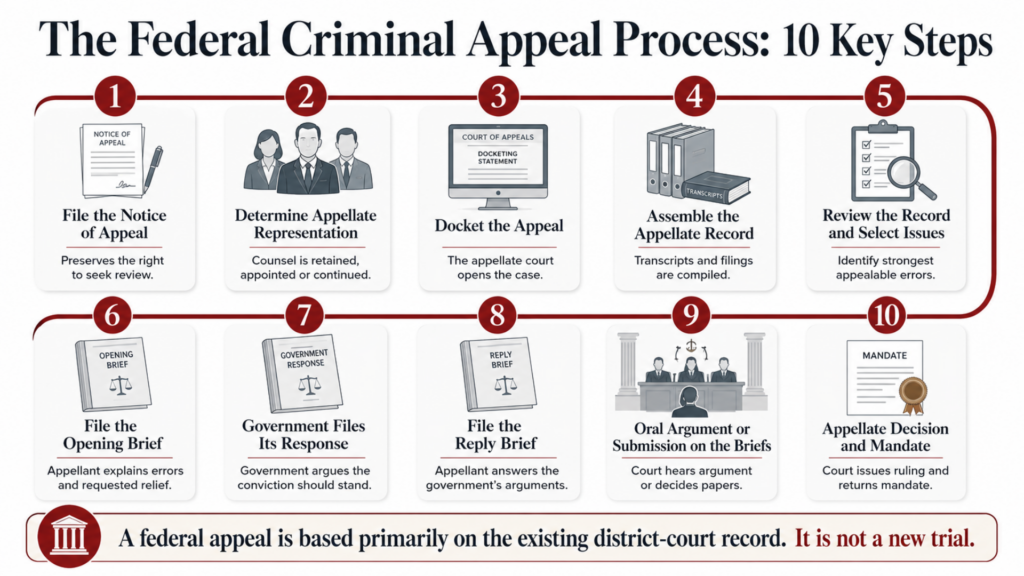
(Alt Text – 10 Steps to appeal a federal criminal conviction)
The federal criminal conviction appeal process generally involves the following stages.
1. File the Notice of Appeal
The defendant generally must file the notice of appeal in the U.S. District Court within the applicable 14-day period.
Protecting this deadline should not be delayed while counsel:
- Investigates every possible appellate issue.
- Orders and reviews transcripts.
- Researches the controlling law.
- Prepares the detailed appellate arguments.
The notice of appeal begins the appellate proceeding. The detailed legal arguments are presented later in the appellate briefs.
2. Determine Who Will Handle the Appeal
The defendant may continue with trial counsel, retain a new private appellate lawyer or receive appointed appellate counsel if financially eligible.
In many circuits, trial counsel remains responsible for the case on appeal unless the Court of Appeals permits withdrawal or substitution. The precise procedure depends on the circuit’s local rules and Criminal Justice Act plan.
Trial and appellate advocacy require different skills:
- Trial counsel presents evidence, examines witnesses, and makes arguments to the jury or trial judge.
- Appellate counsel studies the completed record, researches controlling law and prepares written legal arguments for appellate judges.
3. Docket the Appeal
After the notice is filed, the district-court clerk sends a copy of the notice and docket entries to the appropriate regional Court of Appeals.
The circuit clerk then formally dockets the appeal. Counsel may also need to file:
- A notice of appearance.
- A representation statement.
- A disclosure statement, when required.
- A docketing or case-information statement.
- A transcript order or certificate.
- Other circuit-specific documents.
Under Rule 12, the attorney who filed the notice ordinarily must file a representation statement within 14 days unless the appellate court sets another time.
4. Assemble the Appellate Record
Federal Rule of Appellate Procedure 10 defines the record on appeal as including:
- The original papers and exhibits filed in the district court.
- The transcript of proceedings, if any.
- A certified copy of the district-court docket entries.
Depending on what was filed and considered below, the record may contain:
- Motions and court orders.
- Hearing and trial transcripts.
- Admitted exhibits.
- Jury instructions and the verdict.
- The PSR and sentencing materials, subject to applicable confidentiality rules.
- The sentencing transcript.
- The written judgment.
The appeal is generally limited to this existing record. New evidence ordinarily cannot be added merely because a party believes it would strengthen the appeal.
5. Review the Record and Identify Appealable Issues
Appellate counsel reviews the record to identify qualifying legal, constitutional, procedural, and sentencing errors.
Counsel considers:
- Whether the issue was properly preserved.
- Which standard of review applies.
- Whether a guilty plea limits the issue.
- Whether an appeal waiver applies.
- Whether the error was harmless.
- Whether an unpreserved error satisfies plain-error review.
- Whether the error affected the defendant’s substantial rights.
- What relief the Court of Appeals could provide.
A strong appeal does not necessarily raise every possible complaint. Effective appellate advocacy generally requires selecting the issues with the strongest legal support and greatest potential effect.
6. File the Opening Brief
The defendant, now called the appellant, files an opening brief.
The brief generally:
- Explains the Court of Appeals’ jurisdiction.
- Identifies the issues presented for review.
- Describes the relevant facts and procedural history.
- States the applicable standards of review.
- Presents legal arguments supported by authority.
- Cites the relevant parts of the appellate record.
- Identifies the precise relief requested.
The requested relief may include reversal, a new trial, resentencing, modification of the judgment or another legally available remedy.
7. Government Response
The government, generally acting as the appellee, files a response or answering brief.
The government may argue that:
- The district court ruled correctly.
- The issue was waived or forfeited.
- The defendant failed to preserve the objection.
- The appeal waiver covers the claim.
- No legal error occurred.
- Any error was harmless.
- The conviction or sentence should be affirmed.
8. File a Reply Brief
The appellant may file a reply brief addressing the government’s response.
The reply brief may:
- Answer the government’s legal arguments.
- Correct mischaracterizations of the record.
- Explain why the government’s authorities do not control.
- Reinforce the relief requested in the opening brief.
A reply brief should ordinarily respond to the government’s arguments rather than introduce an entirely new appellate claim that was omitted from the opening brief.
9. Oral Argument or Submission on the Briefs
Some appeals are scheduled for oral argument, usually before a three-judge panel. During oral argument, the judges may question counsel about the law, the record, the standard of review, and the requested relief.
Oral argument is not guaranteed. A three-judge panel may unanimously determine that it is unnecessary when:
- The appeal is frivolous.
- The controlling issues have already been authoritatively decided.
- The briefs and record adequately present the issues, and oral argument would not significantly assist the court.
In those circumstances, the appeal may be decided entirely on the written briefs and record.
10. Appellate Decision and Mandate
The Court of Appeals enters its judgment and may issue a written opinion or decide the case without a published opinion.
The court may:
- Affirm the conviction and sentence.
- Reverse the conviction.
- Vacate the conviction or sentence.
- Remand the case for a new trial or resentencing.
- Modify part of the judgment.
- Dismiss the appeal.
After the decision, the parties may have a limited opportunity to seek panel rehearing, rehearing en banc or Supreme Court review.
The Court of Appeals later issues its mandate, which ordinarily consists of a certified copy of the judgment, any opinion and directions concerning costs. Unless the court changes the schedule or stays the mandate, it generally issues seven days after the rehearing period expires or seven days after the denial of a timely rehearing petition or motion to stay the mandate, whichever is later.
The mandate becomes effective when issued and formally returns authority over any required further proceedings to the district court.
Can a Defendant Appeal After Pleading Guilty?
A guilty plea may limit appellate rights, but it does not necessarily eliminate every possible appeal.
The available issues may depend on:
- Whether the plea was conditional
- Whether the government and court approved the conditional plea
- Which issue was expressly preserved
- Whether the plea agreement contains an appeal waiver
- The wording and scope of the waiver
- Whether the plea was knowing and voluntary
- Whether the government complied with the agreement
- Whether the sentence was lawful
- The precedent of the applicable circuit
A conditional plea can preserve a specified pretrial ruling for appeal. Rule 11 also requires the court to address applicable appeal or collateral-review waivers during the plea proceeding.
A defendant should not assume that an appeal is impossible merely because a guilty plea was entered. The plea agreement, plea transcript, sentencing record, and circuit law must be reviewed together.
Can the Defendant Remain Free During the Appeal?
Release pending appeal is possible in limited cases, but filing an appeal does not automatically keep the defendant out of prison.
Under 18 U.S.C. §3143(b), a defendant sentenced to imprisonment must be detained unless the court finds:
- Clear and convincing evidence that the defendant is not likely to flee.
- Clear and convincing evidence that the defendant does not pose a danger.
- The appeal is not being pursued merely for delay.
- The appeal raises a substantial question of law or fact.
- A favorable ruling would likely result in reversal, a new trial, a sentence without imprisonment or a reduced sentence shorter than the time already served plus the expected duration of the appeal.
Certain offenses are subject to stricter mandatory-detention rules.
A release request is separate from the appeal itself. It is presented first to the district court, with appellate review available under Federal Rule of Appellate Procedure 9.
How Long Does It Take to Appeal a Federal Criminal Conviction?
There is no fixed timeline for a federal criminal appeal.
The total time required depends on several factors, including:
- The U.S. Court of Appeals hearing the case
- Preparation of the trial transcripts
- The size and complexity of the trial record
- The number and complexity of the legal issues raised
- Extensions of briefing deadlines
- Whether the case involves multiple defendants
- Supplemental briefing ordered by the court
- Whether oral argument is scheduled
- The court’s overall caseload
- Whether further review is sought through rehearing or a petition for a writ of certiorari to the U.S. Supreme Court
According to the Judicial Business of the United States Courts 2025 Annual Report, for criminal appeals terminated on the merits during the 12-month period ending September 30, 2025, the national median time from filing the notice of appeal to the final appellate opinion or order was 11 months. Median disposition times varied by federal circuit, reflecting differences in caseloads and court procedures.
It is important to understand that this statistic measures only the time required for the direct appeal in the U.S. Court of Appeals. It does not include additional proceedings that may follow, such as petitions for panel rehearing or rehearing en banc, petitions for a writ of certiorari to the U.S. Supreme Court, remand proceedings, resentencing, or post-conviction motions under 28 U.S.C. § 2255.
Option 4: Seek Rehearing or U.S. Supreme Court Review
An unfavorable Court of Appeals decision may not end direct review.
Panel Rehearing
A petition for panel rehearing asks the judges who decided the appeal to reconsider a point of law or fact the panel overlooked or misunderstood.
It should not merely repeat arguments already considered.
Rehearing En Banc
A petition for rehearing en banc asks the en banc court to reconsider the panel decision.
En banc review is not favored. It is ordinarily associated with:
- A conflict within the circuit.
- A conflict with Supreme Court authority.
- A conflict involving another Court of Appeals.
- A question of exceptional importance.
A rehearing petition must generally be filed within 14 days after judgment or an amended decision, unless an order or local rule changes the deadline. Panel and en banc requests generally must be submitted together unless local rules provide otherwise.
Petition for Writ of Certiorari
A petition for a writ of certiorari asks the U.S. Supreme Court to review the Court of Appeals’ judgment.
Supreme Court review is discretionary. The Court generally focuses on important federal questions, conflicts among courts, and issues requiring national resolution.
Under Supreme Court Rule 13, a petition is generally due within 90 days after entry of judgment, not issuance of the mandate. A timely rehearing petition makes the period run from denial of rehearing or the later judgment entered after rehearing. The current Supreme Court Rules took effect March 16, 2026.
Option 5: File a Motion Under 28 U.S.C. § 2255
A motion under 28 U.S.C. § 2255 allows a person in federal custody to ask the sentencing U.S. District Court to vacate, set aside, or correct a conviction or sentence on qualifying legal grounds.
A § 2255 motion may be based on claims that:
- The conviction or sentence violated the U.S. Constitution or federal law
- The sentencing court lacked jurisdiction
- The sentence exceeded the maximum authorized by law
- The conviction or sentence is otherwise subject to collateral attack
Unlike a direct appeal, a § 2255 motion is not a second appeal. It is a separate post-conviction proceeding filed in the sentencing court and is commonly used to raise claims that could not be fully resolved on the direct appeal record.
Common § 2255 Claims
Depending on the facts of the case, a § 2255 motion may involve:
- Ineffective assistance of counsel
- Failure to file a requested notice of appeal
- Prosecutorial misconduct or suppression of material favorable evidence
- Jurisdictional defects
- An unlawful sentence
- A newly recognized constitutional right made retroactively applicable
- Newly discovered evidence or other qualifying evidence outside the original trial record
What Is the Deadline?
In most cases, a § 2255 motion must be filed within one year of the latest statutory triggering event, which may include:
- The date the conviction becomes final
- Removal of an unlawful governmental impediment to filing
- Recognition of a qualifying new constitutional right made retroactively applicable by the Supreme Court
- Discovery of new facts through due diligence
Because the limitation period depends on the statute and the procedural history, it is not always one year from sentencing. Second or successive § 2255 motions are also subject to additional statutory restrictions.
Direct Appeal vs. § 2255 Motion
| Issue | Direct Federal Criminal Appeal | § 2255 Motion |
|---|---|---|
| Court | U.S. Court of Appeals | Sentencing U.S. District Court |
| Purpose | Reviews legal and procedural errors. | Challenges the conviction or sentence on qualifying collateral grounds. |
| Record | Existing trial record. | May include qualifying evidence outside the original record. |
| Common Claims | Trial errors, plea issues, sentencing errors. | Ineffective assistance, jurisdictional defects, constitutional violations. |
| Typical Deadline | Notice of appeal generally due within 14 days. | One year from the latest statutory triggering event. |
| Possible Relief | Reversal, remand, new trial, or resentencing. | Vacatur, correction of sentence, resentencing, or other appropriate relief. |
Option 6: Seek Correction or Reduction of the Federal Sentence
Once a federal sentence becomes final, it generally cannot be changed unless a federal statute or rule specifically authorizes the court to do so.
Rule 35 Sentence Relief
Federal Rule of Criminal Procedure 35 permits limited sentence relief in certain circumstances, including:
- Correction of a clear sentencing error within 14 days after sentencing.
- Reduction of a sentence upon the government’s motion based on the defendant’s substantial assistance, subject to Rule 35’s requirements.
A Rule 35 motion is available only in the limited situations authorized by the rule and generally does not extend the deadline for filing a direct appeal.
Sentence Modification Under 18 U.S.C. § 3582(c)
18 U.S.C. § 3582(c) permits a court to modify a sentence only when specifically authorized by law. Depending on the applicable provision, this may include:
- Compassionate release.
- Certain retroactive amendments to the U.S. Sentencing Guidelines.
- Sentence modifications expressly authorized by another federal statute.
- Relief available under Rule 35.
Eligibility depends on the statutory requirements and the facts of the case. A motion under § 3582(c) is not a substitute for a timely direct appeal or a motion under 28 U.S.C. § 2255.
Correction of Clerical Errors
Federal Rule of Criminal Procedure 36 allows a court to correct clerical mistakes or errors arising from oversight or omission in a judgment or other part of the record. It cannot be used to make a substantive change to a conviction or sentence.
Option 7: Apply for Executive Clemency
Executive clemency is an act of presidential mercy rather than judicial review. It does not function as an appeal or require a court to find legal error in the conviction or sentence.
Forms of federal executive clemency include:
- Commutation: Reduces all or part of a federal sentence without overturning the conviction.
- Pardon: A formal act of forgiveness for a federal offense that does not erase or reverse the conviction.
- Reprieve: Temporarily postpones the execution or enforcement of a sentence.
- Remission of a fine or forfeiture: Relieves qualifying financial penalties in appropriate cases.
Applications for federal clemency are submitted through the U.S. Department of Justice’s Office of the Pardon Attorney. Still, the authority to grant clemency rests solely with the President of the United States. Executive clemency is separate from direct appeals and post-conviction remedies and does not replace applicable filing deadlines.
Option 8: Attempt to Withdraw a Guilty Plea
A defendant who entered a guilty plea may ask whether the plea can be withdrawn. The answer depends primarily on when the request is made, why the defendant wants to withdraw the plea, and what occurred during the plea proceeding.
Withdrawing a guilty plea is not automatic. The court may consider the defendant’s sworn statements during the plea hearing, the terms of the plea agreement, the advice provided by counsel, the timing of the request, and any prejudice that withdrawal may cause to the government.
Before the Court Accepts the Guilty Plea
Before the court formally accepts a guilty plea, the defendant may be permitted to withdraw it under the provisions of Federal Rule of Criminal Procedure 11.
The precise procedure depends on whether the court has accepted the plea and whether it has accepted or deferred consideration of the plea agreement.
After Acceptance but Before Sentencing
After the court accepts the guilty plea but before sentencing, the defendant generally must establish a “fair and just reason” for withdrawing it.
Possible grounds may include:
- The defendant did not understand the nature of the charge.
- The defendant did not understand the rights being waived.
- The defendant did not understand the possible sentencing consequences.
- The plea was entered because of coercion, threats, or improper pressure.
- Counsel provided materially deficient advice regarding the plea.
- The defendant received incorrect information about the plea agreement or expected sentence.
- The government breached a material term of the plea agreement.
- The Rule 11 proceeding failed to address a legally required matter.
- The defendant has a credible claim of legal innocence supported by the circumstances.
- The plea was not entered knowingly, voluntarily, and intelligently.
A defendant’s later regret, dissatisfaction with the likely sentence, or simple change of mind is generally not enough by itself to justify withdrawal.
What Documents Should the Defendant or Family Collect?
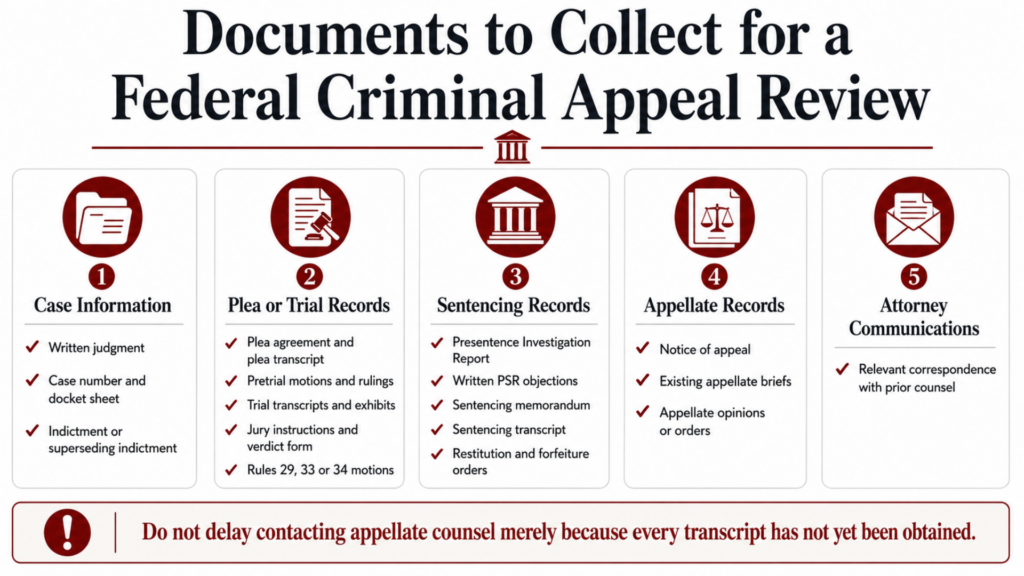
A federal appellate lawyer may request:
- Written judgment
- Docket sheet
- Indictment or superseding indictment
- Plea agreement
- Plea-hearing transcript
- Suppression motions and orders
- Other pretrial motions
- Trial transcripts
- Exhibits
- Rule 29, Rule 33 or Rule 34 motions
- Jury instructions
- Verdict form
- Presentence Investigation Report
- Written PSR objections
- Sentencing memorandum
- Sentencing transcript
- Restitution and forfeiture orders
- Notice of appeal
- Existing appellate briefs
- Appellate decisions
- Relevant correspondence with previous counsel
The family should not delay contacting appellate counsel simply because every transcript has not yet been obtained. The case number, court, judgment, sentencing date, plea agreement, and docket can help counsel begin identifying deadlines and record requirements.
Speak With a Federal Criminal Appeals Lawyer
A federal criminal conviction does not necessarily end the legal process, but many post-conviction remedies are subject to strict procedural rules and filing deadlines. Identifying the correct legal option and pursuing it within the applicable time limits can be critical to preserving your rights.
Whether you are considering a direct appeal, a motion under 28 U.S.C. § 2255, a sentence modification, or another post-conviction remedy, an experienced federal appellate attorney can evaluate the record and determine which options may be available under the law.
Brownstone Law represents clients in federal criminal appeals and post-conviction proceedings nationwide. Contact our team today to discuss your case and learn whether you may have grounds to challenge your conviction or sentence before important deadlines expire.
Frequently Asked Questions (FAQs)
Q1. What is the cost of appealing a federal criminal conviction?
The total cost of appealing a federal criminal conviction may range from approximately $20,000 to $50,000 or more. Complex appeals involving lengthy trials, extensive transcripts, multiple defendants, numerous legal issues, or complicated white-collar charges may cost substantially more.
The total expense may include:
- Appellate attorney fees
- The federal appeal filing fee
- Trial and sentencing transcripts
- Record and appendix preparation
- Legal research
- Oral-argument preparation
- Rehearing or Supreme Court proceedings, when required
The actual cost depends on the size of the record, complexity of the legal issues, billing arrangement, and scope of representation. A reliable estimate usually requires an initial review of the judgment, docket, plea agreement, sentencing record, and potential appellate issues.
Q2. How to file a federal criminal appeal?
Filing a federal criminal appeal generally involves the following steps:
- File a Notice of Appeal
- File a Notice of Appeal in the U.S. District Court that entered the judgment.
- In most criminal cases, the defendant’s notice of appeal is generally due within 14 days after entry of the judgment or the order being appealed, unless a rule or court order provides otherwise.
- Prepare the Appellate Record
- The district court compiles the record, including relevant pleadings, orders, exhibits and trial transcripts, and transmits it to the U.S. Court of Appeals.
- Submit Appellate Briefs
- The appellant files an opening brief explaining the alleged legal, constitutional, procedural, or sentencing errors.
- The government files a response brief, and the appellant may submit a reply brief.
- Participate in Oral Argument (If Scheduled)
- Some appeals include oral argument before a panel of appellate judges. Others are decided based solely on the written briefs and record.
- Receive the Court’s Decision
- The Court of Appeals may affirm, reverse, vacate, remand for further proceedings, order a new trial, or direct resentencing, depending on the issues presented.
A federal criminal appeal is not a new trial. The appellate court reviews the district court proceedings for legal error based on the existing record rather than hearing new evidence or witness testimony.
Q3. What are the top reasons for federal criminal conviction appeals?
A federal criminal conviction may be appealed if the defendant believes the district court made a reviewable legal, constitutional, procedural, or sentencing error that affected the outcome of the case. Every appeal depends on the facts and the trial record, but the most common grounds include:
- Insufficient Evidence
The defendant argues that the evidence presented at trial was legally insufficient to prove one or more elements of the offense beyond a reasonable doubt.
- Improper Admission or Exclusion of Evidence
The appeal challenges evidentiary rulings involving hearsay, expert testimony, prior bad acts, authentication, privilege, or unfair prejudice.
- Unlawful Searches, Seizures, or Statements
The defendant argues that evidence or statements were obtained in violation of the Fourth or Fifth Amendments and should have been suppressed.
- Incorrect Jury Instructions
The appeal argues that the jury received incorrect or misleading instructions about the law, the burden of proof, or the elements of the offense.
- Prosecutorial Misconduct
The defendant alleges misconduct such as improper closing arguments, suppression of material exculpatory evidence, use of false testimony, or other actions that affected the fairness of the proceedings.
- Judicial Error
The appeal challenges incorrect legal rulings, improper evidentiary decisions, denial of motions, or other qualifying abuses of discretion by the trial judge.
- Plea-Related Errors
The defendant argues that the guilty plea was not entered knowingly and voluntarily, that Rule 11 procedures were not followed, or that the plea agreement was incorrectly interpreted.
- Sentencing Errors
Common sentencing issues include:
- Incorrect Sentencing Guidelines calculations
- Incorrect criminal history scoring
- Reliance on clearly erroneous facts
- Failure to address material sentencing arguments
- An unlawful statutory sentence
- Incorrect restitution orders
- A procedurally or substantively unreasonable sentence
- Ineffective Assistance of Counsel
The defendant claims that defense counsel’s performance violated the Sixth Amendment. These claims are often raised in a motion under 28 U.S.C. § 2255 when they depend on evidence outside the trial record.
Q4. What happens after a federal criminal conviction appeal is denied?
If the U.S. Court of Appeals denies a federal criminal appeal by affirming the conviction or sentence, the defendant may still have limited legal options. The appropriate next step depends on the reason for seeking further review and the applicable filing deadlines.
Common options include:
- File a Petition for Panel Rehearing
Ask the same panel of appellate judges to reconsider the decision because it overlooked or misunderstood a material point of law or fact.
In most federal criminal cases, a petition for panel rehearing is generally due within 14 days after entry of judgment, unless another deadline applies.
- Request Rehearing En Banc
Ask all eligible active judges of the U.S. Court of Appeals to review the panel’s decision.
En banc review is granted only in limited circumstances, such as conflicts within circuit precedent or questions of exceptional importance.
- File a Petition for a Writ of Certiorari
Ask the U.S. Supreme Court to review the Court of Appeals’ decision.
Supreme Court review is discretionary, meaning the Court chooses which cases to hear.
A petition for certiorari is generally due within 90 days after the appellate judgment or, if a timely rehearing petition is filed, after rehearing is denied or a later judgment is entered.
- File a Motion Under 28 U.S.C. § 2255
Seek post-conviction relief in the sentencing U.S. District Court by challenging the conviction or sentence on qualifying constitutional, federal-law, jurisdictional, or other collateral grounds.
A § 2255 motion cannot be used simply to reargue issues that were rejected on direct appeal.
- Seek Other Available Relief
Depending on the circumstances, the defendant may qualify for:
- A sentence reduction under Rule 35 or 18 U.S.C. § 3582(c).
- Executive clemency, such as a commutation or pardon.
Because each remedy has different eligibility requirements and filing deadlines, pursuing the wrong procedure or missing a deadline may limit or prevent further review. An experienced federal criminal appeals attorney can help determine which option, if any, is available after an appeal is denied.
Q5. Can a federal criminal conviction be overturned?
Yes. A federal criminal conviction can be overturned if a court finds a qualifying legal basis to reverse or vacate the conviction or sentence. However, a successful appeal does not automatically end the prosecution. Depending on the appellate court’s decision, it may:
- Affirm the conviction or sentence.
- Reverse all or part of the district court’s decision.
- Vacate the conviction, sentence, or order.
- Remand the case for further proceedings.
- Order resentencing.
- Order a new trial.
- Dismiss the appeal.
- Grant partial relief on specific issues.
The outcome depends on the legal error identified and the remedy ordered by the appellate court.
Q6. How to choose a federal criminal appeal lawyer?
Choosing a federal criminal appeal lawyer involves more than searching for the “best” attorney or the closest law firm. A federal appeal focuses on identifying legal errors in the trial court record, so experience with appellate practice is critical.
When evaluating a lawyer, consider the following factors:
- Appellate experience: Determine whether the lawyer regularly handles federal criminal appeals rather than primarily trial-level criminal defense.
- Federal court experience: Ask about the lawyer’s experience before the U.S. Court of Appeals that will hear your case and familiarity with its rules and procedures.
- Record review: A thorough appellate review should include transcripts, motions, plea agreements, jury instructions, Presentence Investigation Report (PSR) objections, sentencing materials and other parts of the district court record.
- Legal writing: Federal appeals are decided largely on written briefs. Ask how the lawyer researches legal issues, develops arguments and prioritizes the strongest grounds for appeal.
- Fee transparency: Understand the scope of representation, billing structure, anticipated costs and whether services such as rehearing or Supreme Court review are included.
- Communication: Confirm how updates will be provided and who will serve as your primary point of contact.
Client reviews, published appellate decisions and prior case results may help evaluate a lawyer’s experience, but they do not guarantee a similar outcome in another case. Ultimately, the most suitable lawyer is one with relevant federal appellate experience, a thorough review process and clear communication about the available legal options.
Q7. How to prepare for a federal criminal appeal hearing?
Preparing for a federal criminal appeal hearing is different from preparing for a trial because the appellate court reviews the existing record rather than hearing new evidence or witness testimony. To prepare, the appellant and appellate counsel should review the district court record, including trial transcripts, motions, exhibits, jury instructions, plea documents, sentencing materials, and relevant rulings. Counsel should identify the strongest legal issues, research the applicable statutes and precedents, and ensure the appellate briefs clearly explain why the district court committed reversible error. If the U.S. Court of Appeals schedules oral argument, counsel should be prepared to answer the judges’ questions about the record, the applicable law, and the requested relief. Defendants should also understand that oral argument is not held in every appeal, and the court may decide many cases based solely on the written briefs and record. Because appellate deadlines and procedural requirements are strict, it is important to work closely with experienced federal appellate counsel throughout the process.
| Glossary Term | Definition |
|---|---|
| Appellate Waiver | A provision in a plea agreement that limits the defendant’s right to appeal the conviction, sentence, or certain legal issues. |
| Collateral Attack | A separate challenge to a conviction or sentence outside the direct-appeal process, commonly through a § 2255 motion. |
| En Banc Rehearing | A request for a larger group of active judges from the same Court of Appeals to reconsider a panel’s decision. |
| Executive Clemency | Relief granted by the President, such as a pardon, commutation, reprieve, or remission of a financial penalty. |
| Mandate | The formal document issued by the Court of Appeals that completes the appeal and returns authority over the case to the District Court. |
| Motion to Arrest Judgment | A request asking the court to arrest judgment because the district court lacked jurisdiction over the charged offense. |
| Prison-Mailbox Rule | A rule that may treat an incarcerated defendant’s filing as timely when it is placed in the institution’s approved mail system before the deadline. |
| Remand | An appellate court’s decision to send a case back to the District Court for further action, such as a new trial or resentencing. |
| Writ of Certiorari | A petition asking the U.S. Supreme Court to review a decision made by a lower appellate court. |