
| Key Takeaways
|
Over the past several years, Andrew Tate and Tristan Tate have become the subject of multiple criminal investigations, formal charges, civil lawsuits, financial proceedings, and extradition actions across several countries. As their legal matters have evolved, public interest has grown alongside widespread confusion about what has actually happened, which allegations have resulted in formal charges, and where each case currently stands.
However, in July 2026, the Tate Brothers were not arrested because of a single incident or a single criminal case. Their legal situation involves separate investigations and court proceedings in the United Kingdom, Romania, and the United States, with each jurisdiction applying its own criminal laws, procedures, and legal standards. Some proceedings involve criminal allegations, others concern civil litigation or financial disputes, while certain matters relate to extradition and international judicial cooperation. Understanding the full picture requires looking at each case individually and placing every major development into its proper chronological context.
This detailed guide examines the legal proceedings involving Andrew and Tristan Tate, including the alleged criminal conduct underlying the criminal allegations, arrests, formal charges, extradition process, civil cases, and the current status of proceedings across multiple jurisdictions.
Along the way, it also explains important legal concepts so readers can better understand the facts behind one of the most closely followed international legal stories in recent years.
All criminal charges and unresolved claims discussed in this article are allegations unless and until proven in court. Andrew and Tristan Tate have denied wrongdoing. Brownstone Law does not represent either brother, and this article is an independent educational analysis based on publicly available information.
Quick Facts About Tate Brothers
| Topic | Andrew Tate | Tristan Tate |
|---|---|---|
| Full Name | Emory Andrew Tate III | Tristan Tate |
| Nationality | British-American | British-American |
| Former Profession | Four-time kickboxing world champion, entrepreneur, social media personality | Former kickboxer, entrepreneur, social media personality |
| Known For | Kickboxing career, online businesses, social media influence, The Real World, The War Room | Business ventures with Andrew Tate, kickboxing, online businesses, media appearances |
| Current Legal Status (As of July 2026) | Facing criminal proceedings in multiple jurisdictions while contesting the allegations. | Facing criminal proceedings in multiple jurisdictions while contesting the allegations. |
| Countries Involved | Romania, United Kingdom, United States | Romania, United Kingdom, United States |
| Main Criminal Allegations | Human trafficking, rape, organized crime, assault, trafficking-related offenses, and other allegations in separate proceedings. | Human trafficking, organized crime, assault, trafficking-related offenses, and other allegations in separate proceedings. |
| Current Court Proceedings (As of July 2026) | Romanian investigations remain active; UK criminal prosecution pending; U.S. extradition proceedings ongoing. | Romanian investigations remain active; UK criminal prosecution pending; U.S. extradition proceedings ongoing. |
| Extradition Status | Subject to U.S. extradition proceedings following a UK extradition request. | Subject to U.S. extradition proceedings following a UK extradition request. |
| Position on the Allegations | Denies the criminal allegations against him. | Denies the criminal allegations against him. |
NOTE: The allegations against Andrew and Tristan Tate arise from multiple legally separate proceedings involving different jurisdictions, investigating authorities, alleged victims, and legal issues. Not every allegation applies equally to both brothers, and the cases are being handled independently under the laws of the respective countries.
Why Were Andrew Tate and Tristan Tate Arrested in Miami?
The Tate Brothers were arrested by the U.S. Marshals Service in Miami on July 18, 2026, pursuant to a U.K. extradition request. The arrest did not mean that either brother had been convicted of any offense, nor did it indicate that U.S. prosecutors had filed new criminal charges against them.
The United Kingdom is seeking their return to face 21 alleged previously authorized charges, along with 38 additional charges announced by the Crown Prosecution Service on July 19, 2026, bringing the total to 59 charges. Following their initial appearance in federal court on July 20, 2026, the brothers remained in federal custody while the extradition proceedings continued. Their attorney stated that they intended to contest extradition.
Why Are Andrew and Tristan Tate Facing Legal Proceedings in Different Countries?
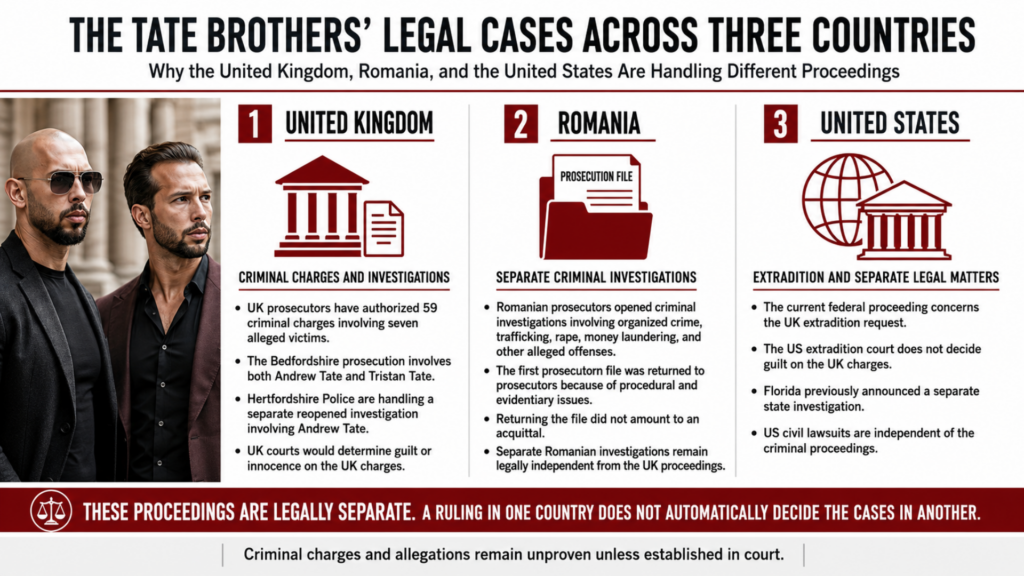
Andrew and Tristan Tate are facing legal proceedings in different countries because each case involves separate allegations, different investigating authorities, and independent legal systems. Romania is handling its own criminal investigations, the United Kingdom is pursuing separate criminal charges, the United States is overseeing extradition proceedings, and additional civil and financial cases are being heard independently.
Although these matters are often discussed together in news coverage, they are not part of a single international criminal case. Each jurisdiction applies its own criminal laws, rules of evidence, procedural requirements, and standards of proof. As a result, developments in one country do not automatically determine the outcome of proceedings in another.
Complete Andrew and Tristan Tate Legal Timeline
| Date | Country | Development | Why It Matters |
|---|---|---|---|
| 2014–2015 | United Kingdom | Women reported allegations involving Andrew Tate to Hertfordshire Police. | Marked the beginning of the earlier UK investigation that was later closed and subsequently reopened. |
| 2016 | United Kingdom | Andrew Tate appeared on the reality television program Big Brother. Reports later indicated that the show’s producers were informed of the police investigation. | The television appearance increased Tate’s public profile but was not itself a legal proceeding. |
| 2019 | United Kingdom | Hertfordshire Police closed the investigation without bringing charges. | A decision not to prosecute did not determine whether the allegations were true or false and did not prevent the investigation from being reopened in the future. |
| December 29, 2022 | Romania | Romanian anti-organized crime prosecutors (DIICOT) detained Andrew Tate, Tristan Tate, and two Romanian women. | Marked the beginning of the Romanian criminal investigation involving allegations of organized crime, human trafficking, rape, and related offenses. |
| January 2023 | Romania | Romanian authorities seized vehicles, luxury watches, cash, and other assets. | Asset seizures formed part of the criminal investigation and did not establish criminal liability. |
| March 31, 2023 | Romania | A Romanian court replaced police detention with house arrest. | Reduced the level of preventive detention while the criminal investigation continued. |
| June 20, 2023 | Romania | DIICOT formally indicted Andrew Tate, Tristan Tate, and two Romanian women and referred the first case for trial. | Marked the transition from investigation to prosecution. The indictment did not constitute a conviction. |
| August 2023 | Romania | House arrest ended and was replaced with judicial control measures. | The defendants remained subject to reporting obligations and other court-imposed conditions. |
| March 2024 | Romania / United Kingdom | Romanian authorities executed UK arrest warrants, and a Romanian court approved the brothers’ future surrender to the United Kingdom after the Romanian proceedings concluded. | Established that the UK extradition request could proceed only after the Romanian criminal proceedings permitted their transfer. |
| April 2024 | Romania | A Romanian court ruled that the first prosecution could proceed toward trial. | The decision allowed the case to move forward, although later appeals affected the proceedings. |
| August 2024 | Romania | Authorities conducted new searches and opened a second criminal investigation involving the Tate brothers and other suspects. | Created a separate criminal investigation involving additional allegations, including alleged organized crime, trafficking-related offenses, trafficking of minors, and money laundering. |
| December 18, 2024 | United Kingdom | A UK court authorized the forfeiture of approximately £2.7 million following civil tax proceedings. | The ruling concerned civil asset recovery under the civil standard of proof and was not a criminal conviction. |
| December 19, 2024 | Romania | The Bucharest Court of Appeal returned the first prosecution file to prosecutors because of procedural irregularities and excluded evidence. | The ruling did not acquit the defendants but required prosecutors to address procedural issues before continuing the case. |
| February 27, 2025 | Romania / United States | Romanian authorities permitted the brothers to leave the country, and they traveled to Florida. | Travel restrictions were relaxed, although the Romanian investigations and legal obligations remained in effect. |
| March 2025 | Florida (United States) | Florida Attorney General James Uthmeier announced a state criminal investigation involving search warrants and subpoenas. | Publicly confirmed a Florida investigation, although no criminal charges had been publicly announced at that stage. |
| March 21, 2025 | Romania | Andrew and Tristan Tate returned to Romania. | Demonstrated compliance with Romanian legal obligations while investigations remained ongoing. |
| May 2025 | United Kingdom | The Crown Prosecution Service publicly announced the previously authorized 21 criminal charges against Andrew and Tristan Tate. | Provided the first official public breakdown of the UK criminal prosecution. |
| March 2026 | United Kingdom | Hertfordshire Police reopened the earlier criminal investigation concerning allegations reported in 2014 and 2015. | Reopened a separate investigation that is legally distinct from the Bedfordshire prosecution. |
| April 6, 2026 | Romania | A Romanian court removed the remaining judicial control measures imposed on both brothers. | Ended preventive restrictions while allowing the underlying investigations to continue. |
| May 5, 2026 | United Kingdom | Andrew Tate’s civil trial involving claims brought by four women was adjourned. | The adjournment followed the reopening of the Hertfordshire criminal investigation and did not resolve the civil claims. |
| May 28, 2026 | Romania | Romanian prosecutors expanded one investigation involving Andrew Tate to include allegations of incitement to hatred and discrimination against women. | Broadened the scope of an existing Romanian criminal investigation. |
| June 26, 2026 | United Kingdom | The High Court rejected the brothers’ application for judicial review concerning disclosure of accusers’ identities. | A procedural ruling that did not determine criminal liability or the merits of the allegations. |
| July 18, 2026 | United States | The U.S. Marshals Service arrested Andrew and Tristan Tate in Miami pursuant to the United Kingdom’s extradition request. | Began the U.S. federal extradition proceedings. |
| July 19, 2026 | United Kingdom | The Crown Prosecution Service announced 38 additional criminal charges involving four additional alleged victims. | Increased the total number of authorized UK charges to 59, involving seven alleged victims. |
| July 20, 2026 | United States | Andrew and Tristan Tate appeared before a federal court in Miami and indicated through counsel that they intended to contest extradition. | Initiated the U.S. judicial process for determining whether the brothers should be extradited to the United Kingdom under the applicable treaty. |
Current Legal Status of Andrew and Tristan Tate (Through July 2026)
| Jurisdiction | Type of Proceeding | Current Reported Status | Conviction? |
|---|---|---|---|
| United States (Federal) | UK extradition proceeding | Andrew and Tristan Tate were arrested in Miami pursuant to the United Kingdom’s extradition request. They have appeared in federal court and are contesting extradition. The U.S. proceedings determine whether the legal requirements for extradition are met and do not determine guilt on the underlying U.K. charges. | No U.S. criminal conviction arising from the extradition case. |
| United Kingdom (Bedfordshire Police / Crown Prosecution Service) | Criminal prosecution | UK prosecutors have authorized 59 criminal charges against the brothers involving seven alleged victims. The charges include allegations such as rape, human trafficking, assault, and related offenses. The brothers deny the allegations. | No |
| United Kingdom (Hertfordshire Police) | Criminal investigation | Hertfordshire Police reopened an earlier investigation concerning allegations reported in 2014 and 2015 involving Andrew Tate. This investigation is separate from the Bedfordshire prosecution. | No |
| Romania (2022 case) | Criminal investigation after indictment was returned | In December 2024, a Romanian court returned the prosecution file because of procedural irregularities and excluded evidence. Prosecutors have continued the investigation while seeking to address those issues. | No |
| Romania (Separate Investigation) | Criminal investigation | Romanian authorities continue a separate investigation involving allegations including organized crime, human trafficking, trafficking of minors, sexual activity involving a minor, and money laundering. Public reporting also states that Andrew Tate’s investigation was expanded in 2026 to include allegations of incitement to hatred and discrimination against women. The brothers deny wrongdoing. | No |
| United Kingdom | Civil sexual abuse claims | Four women have brought civil claims against Andrew Tate. Those proceedings are separate from the criminal cases and have been affected by related criminal investigations. | Not a criminal case |
| United Kingdom | Civil tax and asset forfeiture proceedings | A UK court authorized the forfeiture of approximately £2.7 million under the civil standard of proof. This is a civil asset recovery matter and is not a criminal conviction. | Not a criminal conviction |
| Florida (State of Florida) | State criminal investigation | Florida’s Attorney General announced a state criminal investigation in 2025 involving search warrants and subpoenas. As of the time of publication, no Florida criminal charges arising from that investigation have been publicly announced. | No publicly announced conviction |
| United States | Civil litigation | Andrew Tate is involved in separate civil litigation, including defamation and other civil claims. These proceedings are independent of the criminal and extradition matters. | Not a criminal proceeding |
The United Kingdom Cases Explained
The legal proceedings involving Andrew and Tristan Tate in the United Kingdom consist of several separate matters that are often conflated in news reports and online discussions. They are more accurately understood as four distinct proceedings:
- the Bedfordshire criminal prosecution;
- the reopened Hertfordshire criminal investigation;
- civil claims brought by four women against Andrew Tate;
- and civil tax and asset-forfeiture proceedings.
Each matter follows different legal procedures, involves different parties or alleged victims, and serves a different purpose within the UK legal system.
Bedfordshire Criminal Charges
The Crown Prosecution Service (CPS) initially authorized 21 criminal charges following an investigation conducted by Bedfordshire Police. On July 19, 2026, the CPS announced that it had authorized 38 additional charges, bringing the combined total to 59 criminal charges involving seven alleged victims.
UK Criminal Charges Authorized by the Crown Prosecution Service
| Defendant | Previously Authorized Charges | Additional Charges Announced (July 2026) | Total Charges |
|---|---|---|---|
| Andrew Tate |
|
| 42 |
| Tristan Tate |
|
| 17 |
| Combined | 21 | 38 | 59 |
According to the CPS, the alleged conduct is said to have occurred between July 2010 and August 2017. The original charges relate to three alleged victims, while the additional charges announced in July 2026 concern four additional alleged victims.
These are criminal charges, not findings of guilt. The prosecution must still present admissible evidence in court and prove each alleged offense beyond a reasonable doubt.
Charges Relating to Indecent Images and Extreme Pornography
The July 2026 CPS announcement states that Andrew Tate faces 19 additional charges relating to alleged offenses involving indecent images of a child and extreme pornography. The official announcement does not reduce all 19 counts to a single offense or provide a complete public explanation of the evidence supporting each charge.
It would therefore be inaccurate to characterize all 19 counts as a single possession offense or assume they involve identical statutory allegations. The precise legal basis for each count, the applicable statutory provisions, and the supporting evidence will be examined during the UK court proceedings.
Why Are There Two Separate UK Criminal Cases Against Andrew and Tristan Tate?
The United Kingdom’s criminal proceedings involve two legally distinct matters that are frequently confused.
The Bedfordshire case is an active criminal prosecution in which the Crown Prosecution Service has authorized charges against Andrew and Tristan Tate following an investigation by Bedfordshire Police.
On the other hand, the Hertfordshire matter is a separate police investigation involving allegations reported in 2014 and 2015 concerning Andrew Tate. It involves different alleged victims, a different investigating police force, and a separate procedural history. As a result, developments in one matter do not determine the outcome of the other.
The Reopened Hertfordshire Investigation
A separate group of allegations involving Andrew Tate was reported to Hertfordshire Police in 2014 and 2015. The investigation continued for approximately four years before closing in 2019 without criminal charges being brought.
In March 2026, two significant developments occurred:
- The Independent Office for Police Conduct (IOPC) announced an investigation into how Hertfordshire Police handled reports made by three women;
- and Hertfordshire Police confirmed that they had reopened their criminal investigation into allegations of rape and sexual assault involving Andrew Tate.
This investigation is legally separate from the Bedfordshire prosecution involving both brothers. The two matters may involve different alleged victims, evidence, time periods, and potential criminal offenses.
NOTE
A previous decision not to prosecute does not establish that allegations were false. Likewise, reopening an investigation does not establish that a criminal offense occurred. It simply allows investigators to review existing evidence, consider new material, and determine whether the legal threshold for criminal charges has been met.
The UK Civil Claims Against Andrew Tate
Separate from the criminal proceedings, four women have brought civil claims against Andrew Tate alleging sexual and physical abuse. Tate has denied the allegations and has maintained that any sexual activity was consensual.
The civil trial was scheduled to proceed in 2026 but was later adjourned following the reopening of the Hertfordshire criminal investigation. The adjournment was intended to avoid potential conflicts involving evidence, witness testimony, and parallel criminal proceedings.
| Civil vs. Criminal Cases: What Is the Difference? | |
|---|---|
| Civil Proceedings | Criminal Proceedings |
| Usually brought by private claimants. | Brought by the state. |
| Usually seeks compensation or another civil remedy. | Seeks a criminal conviction and punishment. |
| Generally decided on the balance of probabilities in England and Wales. | Requires proof beyond a reasonable doubt. |
| Cannot itself result in a criminal prison sentence. | May result in imprisonment. |
| The claimant and defendant litigate the dispute. | Prosecutors control the case. |
| The same alleged conduct may give rise to both criminal and civil proceedings. However, the two processes remain legally independent and are governed by different legal standards, procedures, and burdens of proof. | |
The UK Tax and Asset-Forfeiture Proceedings
In December 2024, Westminster Magistrates’ Court authorized the forfeiture of approximately £2.7 million from accounts associated with Andrew Tate, Tristan Tate, and another individual.
The proceedings concerned funds held in accounts linked to businesses connected with the brothers. After considering evidence relating to approximately £21 million in income, the court concluded, applying the civil standard of proof, that the funds were recoverable under the Proceeds of Crime Act.
This decision is sometimes incorrectly described online as a criminal tax conviction. It was, however, a civil asset-forfeiture proceeding, not a criminal prosecution.
That distinction is important because:
- the court applied the civil balance-of-probabilities standard, not the criminal standard of proof;
- the proceedings concerned the recovery of funds and assets rather than criminal guilt;
- neither Andrew nor Tristan Tate was convicted of a criminal tax offense in these proceedings;
- and the financial ruling does not determine the outcome of any separate criminal allegations involving trafficking, sexual offenses, or other criminal conduct.
The Romanian Cases Explained
Romania has been the center of the Tate brothers’ most significant criminal proceedings since their detention in December 2022. However, public reporting often oversimplifies the status of the Romanian cases. Claims that the brothers have already “gone to trial,” that the case was “dismissed,” or that they were “cleared” do not accurately reflect the current procedural history. The Romanian proceedings involve multiple investigations, procedural rulings, preventive measures, and ongoing prosecutorial decisions. Understanding how those proceedings have developed requires distinguishing between the first prosecution file, later investigations, and the procedural rulings issued by the Romanian courts.
The Initial DIICOT Investigation
Romania’s Directorate for Investigating Organized Crime and Terrorism (DIICOT) detained Andrew Tate, Tristan Tate, and two Romanian women on December 29, 2022, as part of an investigation into allegations including organized crime, human trafficking, and rape.
DIICOT is Romania’s specialist prosecution agency responsible for investigating organized crime, terrorism, trafficking offenses, and other complex criminal matters.
Following their detention, the defendants were initially held in preventive police custody. On March 31, 2023, a Romanian court transferred them to house arrest, and several months later the court replaced house arrest with the less restrictive measure of judicial control, which required compliance with reporting obligations and certain travel restrictions.
Preventive detention and judicial-control measures are not criminal sentences. Romanian courts impose these measures to address issues such as the risk of flight, interference with witnesses, destruction of evidence, or the possibility of continued alleged criminal activity while investigations remain ongoing.
The 2023 Romanian Prosecution File
In June 2023, DIICOT formally indicted Andrew Tate, Tristan Tate, and two Romanian women and referred the first criminal case to court.
Prosecutors alleged that:
- the defendants formed an organized criminal group;
- women were allegedly recruited through deceptive personal or romantic relationships;
- the women were allegedly transported or housed for the purpose of sexual exploitation;
- online sexual content generated revenue for the alleged criminal enterprise; and
- violence or psychological pressure was allegedly used in certain circumstances.
Andrew Tate also faced a separate rape charge in the first Romanian indictment. All defendants denied the allegations.
Under Romanian criminal procedure, the case first entered a preliminary chamber, where judges review whether the indictment satisfies legal requirements and whether prosecutors obtained evidence lawfully. This stage does not determine guilt or innocence but decides whether a prosecution can proceed under Romanian procedural law.
What Does “Returned to Prosecutors” Mean?
One of the most misunderstood developments in the Romanian proceedings occurred when the prosecution file was returned to prosecutors.
When a Romanian court returns an indictment, it does not decide whether the defendants are guilty or innocent. Instead, the court concludes that procedural defects or evidentiary issues prevent the case from moving forward in its current form. Prosecutors may continue investigating, correct procedural deficiencies, obtain additional evidence where permitted, or make further procedural decisions under Romanian law.
For that reason, returning a prosecution file should not be confused with an acquittal, dismissal of the allegations, or a finding that the defendants were “cleared.”
Why Was the Romanian Case Against Andrew and Tristan Tate Returned to Prosecutors?
In April 2024, the Bucharest Tribunal ruled that the criminal case against Andrew Tate, Tristan Tate, and the two co-defendants could proceed toward trial. The defendants appealed that decision.
Later, the Bucharest Court of Appeal found procedural irregularities in the indictment prepared by DIICOT, Romania’s anti-organized crime prosecution agency. The court returned the case file to prosecutors after excluding certain evidence and identifying defects that needed to be addressed before the prosecution could continue.
The ruling did not mean that:
- Andrew Tate or Tristan Tate had been acquitted.
- A court had found the allegations to be false.
- Romanian prosecutors were permanently barred from continuing the investigation.
- All of the prosecution’s evidence had been excluded.
- The criminal case had been permanently dismissed.
Instead, the court’s decision required prosecutors to address the procedural deficiencies identified during judicial review before deciding how to proceed under Romanian law. Depending on the circumstances, prosecutors may revise the indictment, continue investigating where legally permitted, submit additional evidence if appropriate, or pursue other procedural steps available under the Romanian criminal justice system.
Why Were the Tate Brothers’ Assets Seized in Romania?
During the Romanian criminal investigations involving the Tate brothers and their co-defendants, Romanian authorities seized a range of assets, including luxury vehicles, real estate, luxury watches, cash, and other property believed to be relevant to the ongoing proceedings.
In criminal investigations, authorities may seize assets for several legitimate legal reasons, including:
- Preserving property that could later become subject to forfeiture if permitted by law.
- Securing assets that may be available for potential victim compensation or restitution.
- Preventing assets from being transferred, concealed, sold, or otherwise dissipated while legal proceedings are ongoing.
- Preserving property or financial records that may serve as evidence during the investigation or trial.
NOTE: The seizure of property does not, by itself, establish that every asset was acquired through criminal conduct. Romanian courts may later review whether individual seizures are legally justified, proportionate, and sufficiently connected to the alleged offenses.
What Is the Second Romanian Criminal Investigation Against the Tate Brothers?
In August 2024, Romanian authorities opened a separate criminal investigation involving the Tate brothers and several additional suspects. This investigation is distinct from the earlier Romanian prosecution and concerns a different set of alleged offenses and investigative findings.
According to public reporting and statements from Romanian prosecutors, the investigation has included allegations relating to:
- Forming an organized criminal group.
- Human trafficking.
- Trafficking of minors.
- Sexual intercourse involving a minor.
- Money laundering.
- Attempting to influence witness statements.
NOTE: It is important to distinguish this investigation from the earlier Romanian case. Although both involve Andrew Tate and Tristan Tate, they are separate legal proceedings with different procedural histories. All of the allegations remain unproven in court, and the Tate brothers have denied wrongdoing. At the time of writing, the investigation remains ongoing, and no final judgment has been issued in relation to these allegations.
Why Was Andrew Tate’s Romanian Investigation Expanded in 2026?
In May 2026, Romanian prosecutors announced that one of the ongoing criminal investigations involving Andrew Tate had been expanded to include an additional allegation of incitement to hatred and discrimination against women.
An expanded investigation does not mean that a defendant has been found criminally liable or that a court has determined the allegations to be true. Likewise, the addition of a new allegation does not automatically result in a separate indictment or trial. Instead, it means that prosecutors are examining additional suspected offenses as part of an ongoing criminal investigation and may continue gathering evidence before making further procedural decisions under Romanian law.
Were the Romanian Restrictions on the Tate Brothers Lifted?
Yes, but only the preventive judicial restrictions.
The Bucharest Court of Appeal lifted the remaining judicial control measures imposed on the Tate brothers, meaning Andrew and Tristan Tate were no longer required to comply with the reporting obligations and travel or movement restrictions associated with those preventive measures.
However, the court’s decision did not end the Romanian criminal investigations or resolve the allegations against the Tate brothers. Judicial control is a preventive measure used while criminal proceedings are ongoing, and its removal simply means that the court determined continued supervision was no longer legally necessary under the circumstances.
NOTE: It is important to distinguish the lifting of preventive restrictions from the outcome of a criminal case. Removing judicial control does not amount to an acquittal, dismissal of the investigation, or a finding of innocence. The underlying investigations and any related legal proceedings may continue independently, subject to Romanian criminal procedure and any future decisions by prosecutors or the courts.
The United States Cases Explained
Although Andrew and Tristan Tate have faced criminal proceedings in the United Kingdom and Romania, the United States has also become involved through several separate legal matters. These include federal extradition proceedings, a Florida state criminal investigation, and multiple civil lawsuits. Because each matter serves a different legal purpose and is handled under different laws, they are often confused in media coverage.
Understanding the distinction between these proceedings is essential. The federal extradition case concerns whether the United States should surrender the Tate brothers to the United Kingdom, the Florida investigation examines whether any conduct falls within Florida’s criminal jurisdiction, and the civil lawsuits involve private legal disputes that are independent of the criminal proceedings.
Why Is the United States Involved in the Tate Brothers’ Case?
The United States became involved after Andrew and Tristan Tate traveled to Florida while Romanian criminal proceedings were still ongoing.
Unlike the criminal cases in Romania and the United Kingdom, the primary federal proceeding in the United States does not determine whether the Tate brothers committed the alleged offenses. Instead, the federal court’s role is limited to deciding whether the legal requirements for extradition have been satisfied under the applicable extradition treaty and U.S. federal law.
At the same time, the Florida Attorney General announced a separate state criminal investigation, while unrelated civil lawsuits involving Andrew Tate and the Tate brothers continued in U.S. courts.
Florida’s Criminal Investigation Explained
After Andrew and Tristan Tate arrived in Florida, Florida Attorney General James Uthmeier announced that his office had opened a state criminal investigation.
According to public statements, investigators sought to determine whether Florida had jurisdiction over any alleged criminal conduct connected with the Tate brothers. As part of that process, investigators could seek subpoenas, search warrants, witness interviews, and other evidence authorized under applicable law.
Opening a criminal investigation does not mean criminal charges have been filed. Rather, it allows law enforcement authorities to gather evidence and determine whether sufficient grounds exist to pursue criminal charges.
At the time of writing, no Florida criminal charges arising from that investigation had been publicly announced.
Why Were Tate Brothers Arrested in Miami?
Andrew and Tristan Tate were arrested in Miami by the U.S. Marshals Service pursuant to an extradition request submitted by the United Kingdom.
The arrest was carried out in connection with the UK’s request for extradition and did not represent a criminal conviction or a new criminal prosecution initiated by the United States.
Following their initial appearance before a federal court in Miami, the Tate brothers stated through their legal counsel that they intended to challenge the extradition request. The federal proceedings concern only whether the legal requirements for extradition have been satisfied under U.S. law and the applicable treaty.
Does the U.S. Court Decide Whether the Tate Brothers Are Guilty?
No. A U.S. extradition court does not decide whether Andrew and Tristan Tate are guilty or innocent of the criminal charges against them.
Instead, the court’s role is limited to determining whether the legal requirements for extradition have been satisfied under the applicable extradition treaty and U.S. law. If extradition is ultimately approved, questions of guilt or innocence are decided by the courts in the requesting country, in this case, the United Kingdom.
Because an extradition hearing is not a criminal trial, it generally involves a much narrower legal inquiry and does not resolve the underlying criminal allegations or every factual dispute in the case.
Can the Tate Brothers Appeal an Extradition Decision?
Yes, but the process differs from a traditional criminal appeal.
Extradition proceedings in the United States are governed by a distinct legal framework and do not follow the same appellate process that applies after a criminal conviction. Depending on the circumstances, an individual may seek judicial review through a petition for habeas corpus and, where appropriate, pursue other legal remedies available under U.S. law.
A reviewing court may consider issues such as:
- Whether the extradition court had jurisdiction.
- Whether the alleged offenses fall within the applicable extradition treaty.
- Whether the correct legal standards were applied.
- Whether sufficient competent evidence supported the court’s certification
Although the scope of judicial review is generally narrower than in a direct criminal appeal, extradition proceedings often involve complex questions of treaty interpretation, jurisdiction, procedural requirements, and constitutional law. The legal options available depend on the specific facts, the applicable treaty, and the procedural stage of the case.
What Legal Options May Be Available to the Tate Brothers at Different Stages?
The legal remedies available to Andrew and Tristan Tate depend on the jurisdiction, the procedural stage of the case, and the court involved. As of July 2026, the brothers have not been convicted in either the United Kingdom or Romania, meaning there is currently no criminal conviction to challenge through a traditional direct appeal. However, a number of other legal remedies may arise as the various proceedings continue.
| Stage of Proceedings | Potential Legal Remedies and Procedural Options | What the Court Considers |
|---|---|---|
| U.S. extradition proceedings | Contest the extradition request, challenge whether the requirements of the applicable extradition treaty have been satisfied, raise procedural objections, and, where permitted, seek judicial review through a petition for habeas corpus. | Whether the legal requirements for extradition have been met under the applicable treaty and U.S. law. The court does not determine whether the defendant is guilty or innocent of the underlying criminal allegation. |
| U.S. extradition hearings and case management | Participate in status conferences, respond to government filings, file procedural motions, seek appropriate pre-hearing relief (including detention or bond where available), and prepare legal arguments for the extradition hearing. | Procedural issues, scheduling, compliance with court orders, and other matters necessary for the orderly progression of the extradition proceedings. |
| UK criminal proceedings (before trial) | Apply for bail, seek disclosure of evidence, challenge the admissibility of evidence, raise abuse of process arguments, contest procedural rulings, and pursue other remedies available under UK criminal procedure. | Whether the case should proceed to trial and how pre-trial legal and procedural issues should be resolved. |
| If convicted in the United Kingdom | Appeal the conviction, the sentence, or both, subject to the requirements and deadlines established under UK law. | Whether legal, procedural, or other reviewable errors affected the conviction or sentence. |
| Romanian criminal proceedings | Challenge preventive measures, judicial control, asset seizures, evidentiary rulings, procedural decisions, and other measures available under Romanian criminal procedure. | Whether investigative and pre-trial decisions comply with Romanian criminal law and procedural requirements. |
| If convicted in Romania | Appeal the conviction and pursue any additional remedies authorized under Romanian criminal procedure. | Whether the conviction or sentence should be upheld, modified, or set aside in accordance with Romanian law. |
| Civil lawsuits | Appeal final civil judgments, challenge procedural rulings, and seek other remedies available under the law governing the civil dispute. | Whether the trial court correctly applied the law and whether the judgment should be affirmed, modified, or reversed. |
| Post-conviction proceedings (where available) | Seek extraordinary review, collateral relief, or other post-conviction remedies where authorized by the applicable legal system. | Whether exceptional legal or constitutional issues justify further judicial review after the ordinary appeal process has concluded. |
The availability and scope of these remedies vary depending on the facts of the case, the governing jurisdiction, and the applicable procedural rules. Because appellate and extradition proceedings involve specialized legal standards, filing deadlines, and standards of review, the appropriate legal strategy depends on the circumstances of each case.
Civil Lawsuits Involving the Tate Brothers in the United States
In addition to criminal investigations and extradition proceedings, Andrew and Tristan Tate have also been involved in several civil lawsuits in the United States. These proceedings are legally separate from the criminal cases in Romania and the United Kingdom and are governed by different legal standards. Unlike criminal prosecutions, civil lawsuits are generally brought by private individuals seeking financial damages or other civil remedies rather than criminal punishment.
The Florida Defamation Lawsuit
Andrew and Tristan Tate filed a civil lawsuit in Florida against a woman who had accused them of imprisoning and trafficking her in Romania, along with members of her family and several other individuals.
The Tate brothers alleged that false statements made by the defendants caused significant reputational and financial harm. The defendants denied those allegations.
During the litigation, the court issued several procedural rulings. A Florida judge allowed certain core claims against the principal defendant to proceed while dismissing claims against some other defendants, including members of her family. These rulings addressed whether particular legal claims could continue; they did not determine whether either side’s allegations were true.
The lawsuit remains a civil dispute governed by Florida law and does not determine whether Andrew or Tristan Tate committed any criminal offenses alleged in Romania or the United Kingdom.
What Must Be Proven in a Defamation Case?
Although the legal requirements vary by jurisdiction, a plaintiff pursuing a defamation claim generally must establish:
- A false statement of fact.
- Publication of that statement to another person.
- The required level of legal fault.
- Legally recognized harm resulting from the publication.
Defamation cases often involve complex legal issues relating to truth, opinion, privilege, constitutional protections, and jurisdiction-specific rules. Whether those legal elements have been satisfied depends on the evidence presented in the individual case.
Brianna Stern’s Civil Lawsuit Against Andrew Tate
In 2025, Brianna Stern, who has been publicly identified as Andrew Tate’s former partner, filed a civil lawsuit in California alleging assault, battery, sexual assault, and related claims. Andrew Tate denied the allegations and filed counterclaims disputing Stern’s allegations while asserting his own legal claims.
As the litigation progressed, the California court issued several procedural rulings addressing claims brought by both parties. Some of Tate’s counterclaims were dismissed under California’s anti-SLAPP statute, while other aspects of the litigation continued.
These procedural rulings did not determine whether either party’s allegations were true. Instead, they addressed whether particular legal claims satisfied the legal requirements necessary to proceed under California law.
Like the other U.S. civil proceedings, this lawsuit remains legally independent from the Romanian investigations, the UK criminal prosecution, and the federal extradition proceedings.
Conclusion
The legal proceedings involving Andrew and Tristan Tate cannot be accurately described as a single criminal case. They include a United States extradition proceeding, formally authorized criminal charges in the United Kingdom, separate criminal investigations in Romania, civil claims, defamation litigation, and financial asset-recovery proceedings. Each matter is governed by a different legal system, follows its own procedural rules, and must be evaluated independently.
As of July 2026, neither Andrew Tate nor Tristan Tate has been convicted in the United Kingdom or Romania. Their arrest in Miami began the United States extradition process but did not determine whether the UK allegations are true. The federal court’s immediate role is to decide whether the legal requirements for extradition have been satisfied, while any determination of guilt on the UK charges would be made through the British criminal justice system.
The proceedings also demonstrate that legal challenges can arise long before a criminal conviction. Detention decisions, extradition certification, jurisdiction, treaty interpretation, disclosure disputes, evidentiary rulings, asset seizures, and other procedural decisions may all generate separate forms of legal review. If a case later results in a conviction, additional remedies may include an appeal against the conviction or sentence and, where legally available, post-conviction proceedings.
Because the cases remain active, their status may continue to change as courts consider extradition, prosecutors make further decisions, and the criminal and civil proceedings develop. Until a court reaches a final judgment, all unresolved criminal charges and allegations must continue to be treated as unproven.
How Brownstone Law Can Help With Criminal Appeals?
Complex criminal cases often continue beyond the trial court. A conviction, sentence, detention ruling, or other appealable decision may involve legal and procedural questions that require a detailed review of the court record, preserved objections, evidentiary rulings, constitutional issues, and the applicable standard of review.
Brownstone Law represents clients in federal and state criminal appeals, sentencing appeals, habeas corpus proceedings, post-conviction matters, and other complex appellate litigation throughout the United States.
Deadlines for filing an appeal or seeking post-conviction relief can be strict. Anyone who believes that an error affected a criminal conviction, sentence, or other appealable ruling should seek an appellate evaluation promptly.
Contact Brownstone Law to discuss the procedural history of your case and the appellate or post-conviction remedies that may be available.
Frequently Asked Questions (FAQs)
Q1. What Legal Consequences Could Andrew and Tristan Tate Face if Convicted in the United Kingdom?
If Andrew or Tristan Tate is extradited to the United Kingdom and is later convicted of one or more criminal offenses, the legal consequences would depend on the specific offenses proved, the seriousness of the conduct, the harm caused, each defendant’s individual role, and the applicable sentencing guidelines.
Potential legal consequences could include:
- Imprisonment: Some of the alleged offenses carry substantial maximum penalties. For example, rape carries a maximum sentence of life imprisonment in England and Wales. However, a life sentence is not automatic, and the court would determine the appropriate sentence based on the facts of the case and the applicable sentencing guidelines.
- Separate sentences for multiple convictions: If either brother were convicted on multiple counts, the court would decide whether the sentences should run concurrently (at the same time) or consecutively (one after another), depending on the circumstances of the offences.
- Sex offender notification requirements: Convictions for qualifying sexual offences may require a defendant to comply with the notification requirements set out in the Sexual Offences Act 2003. The duration of those requirements depends on the offence and the sentence imposed.
- Restraining or protective orders: Where authorized by law, the court may impose restraining orders or other protective measures intended to safeguard victims or prevent specified forms of contact or conduct.
- Compensation orders: The court may order a convicted defendant to pay compensation to a victim for personal injury, loss, or damage resulting from the offense, where appropriate.
- Confiscation of criminal assets: If the prosecution establishes that a defendant has benefited from criminal conduct, the court may make a confiscation order under the Proceeds of Crime Act 2002 (POCA), requiring repayment of the value of that criminal benefit. Separate asset-recovery proceedings may also be available in appropriate circumstances.
- Other court-imposed orders: Depending on the offenses of conviction, the court may impose additional ancillary orders or restrictions authorized under UK law.
No sentence can be predicted before a criminal trial concludes. Each charge must be proved separately, and any sentence would depend on the verdicts returned, the evidence presented, applicable statutory provisions, relevant aggravating and mitigating factors, and the sentencing guidelines applied by the court.
Q2. What Could Happen to Andrew and Tristan Tate in the United States Extradition Proceedings?
The Tate brothers’ current federal proceeding in the United States is an extradition matter, not a U.S. criminal trial on the charges pending in the United Kingdom. Accordingly, the federal court is not deciding whether they are guilty of the alleged UK offenses or what criminal sentence they should receive.
Possible outcomes of the extradition proceedings include:
- Continued federal custody or release subject to legal conditions: The federal court may determine whether the brothers remain in custody or are released subject to appropriate legal conditions while the extradition proceedings continue.
- Extradition certification: If the federal court concludes that the applicable treaty and statutory requirements have been satisfied, it may certify that the brothers are extraditable. In doing so, the court may consider issues such as jurisdiction, identity, whether the alleged offenses are covered by the extradition treaty, and whether sufficient evidence supports certification. The hearing is not a criminal trial on guilt or innocence.
- Review by the U.S. Secretary of State: If the court certifies extradition, the matter proceeds to the executive branch, where the U.S. Secretary of State determines whether surrender should ultimately occur.
- Limited habeas corpus review: An extradition certification does not follow the ordinary direct appeal process used in criminal cases. However, the brothers may seek limited judicial review through a petition for habeas corpus, which generally examines issues such as jurisdiction, treaty coverage, and whether legally sufficient evidence supported the certification.
- Surrender to the United Kingdom: If extradition is certified and the Secretary of State authorizes surrender, the brothers may be transferred to UK authorities. The UK courts would then determine whether the prosecution has proved the criminal charges beyond the applicable legal standard and, if either defendant were convicted, impose sentence in accordance with UK law.
- Denial of extradition certification:If the federal court concludes that the legal requirements for extradition have not been satisfied, it may decline to certify extradition. Such a decision concerns only the extradition request and does not amount to an acquittal or a finding that the underlying UK allegations are false.
- No U.S. criminal conviction from extradition alone: Extradition proceedings cannot themselves result in a U.S. criminal conviction or criminal sentence for the alleged UK offenses. Any criminal prosecution in the United States would require separate charges brought under applicable U.S. federal or state law.
Unlike a criminal prosecution, extradition proceedings are designed solely to determine whether the legal requirements for surrender have been satisfied. If Andrew or Tristan Tate is ultimately extradited, questions concerning guilt or innocence on the existing UK charges would be decided by the courts of the United Kingdom, not by the U.S. federal court.
Q3. What Is Andrew Tate’s Net Worth in 2026?
Andrew Tate’s net worth in 2026 is estimated to be between US$12 million and US$20 million based on publicly documented assets examined during Romanian criminal investigations. However, no independently audited financial records or official financial disclosures confirm his exact personal wealth.
Although Andrew Tate has publicly claimed to be worth hundreds of millions of dollars, those statements have not been independently verified. The reported US$12 million to US$20 million estimate is based on publicly available information about assets, business interests, luxury vehicles, and other property rather than self-reported claims.
It is also important to distinguish business revenue from personal net worth. During separate UK civil proceedings, a court considered evidence that approximately £21 million had flowed through businesses and accounts connected with the Tate brothers over several years. That figure reflected business revenue, not Andrew Tate’s personal wealth.
As of 2026, there is no official or independently verified valuation of Andrew Tate’s net worth, and any published figure should be treated as an estimate rather than a confirmed financial valuation.
Q4. What Happens if the Tate Brothers Are Acquitted?
If the Tate brothers are acquitted of a criminal charge, it means the prosecution failed to prove that specific charge beyond the applicable legal standard. An acquittal would generally prevent them from being tried again for the same offense in that jurisdiction, subject to any limited exceptions permitted by law.
However, an acquittal in one country would not automatically end separate criminal investigations, prosecutions, extradition proceedings, or civil cases in another country. Because Andrew and Tristan Tate are involved in multiple legally independent proceedings across different jurisdictions, the outcome of one case would not necessarily determine the outcome of the others.
Q5. Can the Tate Brothers Receive Bail During Extradition Proceedings?
Yes, but bail in U.S. extradition proceedings is generally more difficult to obtain than in ordinary federal criminal cases.
Unlike a standard criminal prosecution, international extradition cases are governed by a distinct legal framework. A federal court may grant release while extradition proceedings are pending, but courts generally apply a more restrictive standard than they do in most domestic criminal cases. In many cases, the person seeking release must demonstrate special circumstances, in addition to showing that they are not likely to flee and do not pose a danger to the community.
Whether Andrew and Tristan Tate will be granted bail depends on the specific facts of their case, the arguments presented by both sides, and the rulings of the federal court overseeing the extradition proceedings. The court’s decision on bail does not determine whether extradition will ultimately be granted or whether the brothers are guilty or innocent of the criminal allegations pending in the United Kingdom.
Q6. What Is Tristan Tate’s Net Worth in 2026?
As of 2026, Tristan Tate’s net worth is commonly estimated at around US$20 million, according to several widely cited by various publications.
Tristan Tate has accumulated wealth through multiple ventures, including his professional kickboxing career, television appearances, online businesses, casino investments in Romania, cryptocurrency holdings, and subscription-based platforms operated with his brother, Andrew Tate.
However, his exact net worth has not been independently verified. Because many of his businesses are privately held and some assets have been involved in ongoing legal proceedings, different publications report significantly different estimates. As a result, the true value of Tristan Tate’s assets remains publicly unconfirmed.
Q7. What Happened to the Tate Brothers’ Travel Restrictions?
Romanian courts gradually eased the preventive measures imposed on Andrew and Tristan Tate during the criminal investigations. The brothers initially spent time in police detention, were later placed under house arrest, then under judicial control with reporting and movement requirements, and, on 6 April 2026, the remaining judicial-control measures were lifted.
The removal of those restrictions did not end the Romanian criminal investigations or resolve the underlying allegations. It simply meant the court determined that continued preventive supervision was no longer legally necessary while the investigations remained ongoing
Acquittal – An acquittal is a court decision that the prosecution did not prove a criminal charge to the required legal standard. It is different from a case being paused, returned to prosecutors, or closed without charges.
Admissible evidence – Admissible evidence is information that a court is legally permitted to consider. Evidence may be excluded if it was obtained unlawfully, is unreliable, or does not comply with procedural rules.
Ancillary order – An ancillary order is an additional order imposed alongside a criminal sentence. Examples may include restraining orders, compensation orders, confiscation orders, or restrictions on certain activities.
Claimant – A claimant is the person or organization that begins a civil case and asks the court for compensation or another legal remedy.
Indictment – An indictment is a formal document accusing a person of one or more criminal offenses. Its precise meaning and procedure differ between legal systems, and it does not establish guilt.
Subpoena – A subpoena is a legally enforceable demand requiring a person to provide testimony, documents, records, or other specified evidence.
Treaty interpretation – Treaty interpretation is the legal process of determining what an international agreement means and how its provisions apply to a particular case.