
Key Takeaways:
|
When a verdict feels unfair, it can shake your confidence in justice. At that point, many people turn to appeals — but appeals are strict, complex, and often the last hope.
In 2025, filings in the U.S. courts of appeals grew 3%, while bankruptcy appellate panels rose 20%, showing how more people are challenging trial outcomes.
These increases show how crowded and unforgiving the appeal procedure has become.
If you are caught in ongoing court battles, this guide explains the appeal process step by step, highlights key rules, and shows how to avoid costly mistakes.
Pre‑Appeal Strategy: Error Preservation and Jurisdictional Mandates
Stage Zero: Why Error Preservation is Non‑Negotiable
The foundation of a successful appeal is laid long before the Notice of Appeal is filed. This phase—often referred to as Stage Zero—is managed entirely by the trial attorney, typically in consultation with appellate specialists.
According to the U.S. Court of Appeals for the Armed Forces Digest, issues not raised are either waived (intentionally abandoned) or forfeited (missed through failure to object). In both cases, the appellate court will not review them unless they meet the strict “plain error” standard — requiring proof that the error was obvious and caused serious prejudice.
Three Cardinal Rules:
To preserve errors, attorneys must follow three golden rules:
- Timely objection – Speak up immediately when the error occurs.
- Specificity in the objection – Clearly explain what is wrong and why.
- Clear ruling from the trial court – Ensure the judge makes a ruling on the objection so it’s part of the record.
The Critical Role of Post‑Judgment Motions
In many jurisdictions, the appellate clock is governed by post-judgment motions, such as a Motion for Rehearing or a Motion for Reconsideration.
- Motion for Rehearing/Reconsideration: Filing a timely and authorized post-judgment motion can toll (pause) the deadline for the Notice of Appeal.
For instance, under the Federal Rules of Appellate Procedure (FRAP), a Rule 60 motion for reconsideration must be filed within 28 days after the entry of judgment to request an extension of time to appeal.
- Jurisdictional Mandates: Some states make these motions mandatory for specific issues.
For example, in Florida, a motion for rehearing is required to preserve a challenge on appeal to the trial court’s failure to make required findings of fact in the final judgment, or when the final order addresses substantive issues not previously raised.
Failing this step may force the party to argue that the error is “fundamental,” a significantly higher bar.
Step‑by‑Step Guide
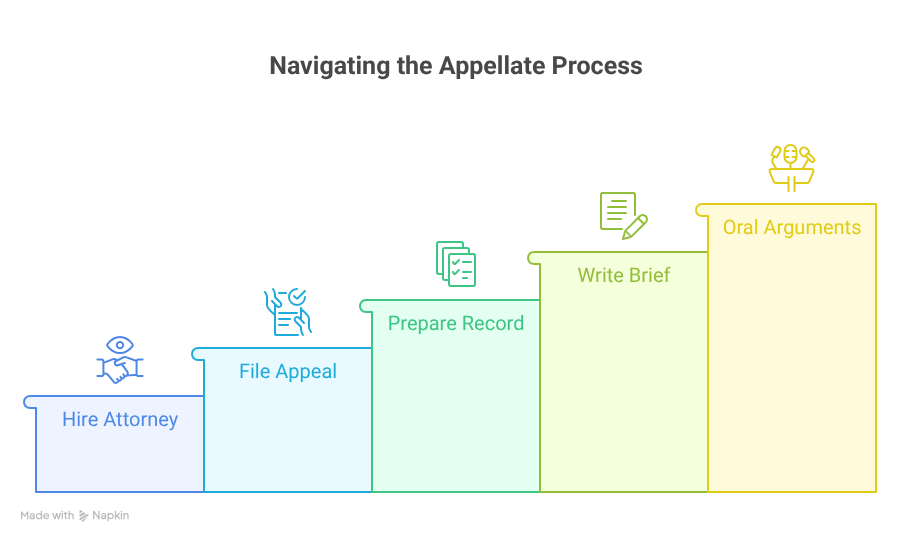
Step 1: Hire an Appellate Attorney
Appeals are not the same as trials. Not every lawyer handles appeals, so you need an attorney with proven appellate experience. In some jurisdictions, a motion for rehearing or reconsideration may be required before you can even file an appeal.
Step 2: Filing the Appeal
Once the trial court issues its final judgment, the clock begins to tick. Deadlines are strict: 30 days in Texas, 45 days in Florida. Missing these deadlines almost always results in dismissal.
- Step 3: Preparing the Record
Appeals are based only on what happened in the trial court — no new evidence is allowed. The clerk prepares the docket and sends the record to the appellate court. Your attorney must carefully review it to ensure nothing important is omitted.
Step 4: Writing the Brief
The appellate brief is the heart of the appeal. Here, your attorney explains why the trial court made errors. Strong legal research and persuasive writing are critical because judges rely heavily on briefs when making their decisions.
Step 5: Oral Arguments
In some cases, the court allows oral arguments. This is where judges question attorneys directly about the case. It’s the final chance to clarify issues before the appellate court issues its ruling.
The Reversal Formula: Standards of Review and Reversible Error
What is the Standard of Review?
Standard of Review | Issue Reviewed | Level of Deference | Likelihood of Reversal |
De Novo Review | Pure questions of law (e.g., statutory interpretation, constitutional issues, legal conclusions) | None (Court reviews anew) | Highest |
Abuse of Discretion | Judge’s discretionary rulings (e.g., evidentiary admissions, sentencing decisions, motions for continuance) | High (Ruling must be arbitrary or outside the bounds of reason) | Low to Moderate |
Clearly Erroneous | Factual findings made by the trial judge (in bench trials) | Highest (Court will not overturn unless convinced a mistake was made) | Lowest |
Harmless Error vs. Reversible Error
The mere existence of an error does not guarantee reversal. The appellate court must further determine the impact of the error.
- Harmless Error: A mistake that occurred but did not materially affect the outcome or influence the judgment. The court will affirm the decision despite the error.
- Reversible Error (Prejudicial Error): A mistake significant enough to have likely impacted the judgment and, therefore, justifies reversing or modifying the lower court’s decision. For example, a jury instruction that misstated the governing law is often deemed reversible error.
Appeal Outcomes: What Happens After the Decision?
The Four Possible Dispositions
Once the appellate court issues its decision, the judgment will result in one of four primary outcomes :
- Affirm: Upholding the lower court’s decision. The appellate court found no reversible error.
- Reverse: Overturning the judgment. The appellate court found a prejudicial error.
- Modify: Changing a specific part of the judgment (e.g., adjusting a financial award) while leaving the rest intact.
- Remand: Sending the case back to the trial court for further action, such as a new trial, resentencing, or specific factual findings. (The litigation continues).
- Reverse and Render: The appellate court issues a final, new judgment itself, typically when no further facts need to be determined, conclusively ending the litigation.
Expected Duration and Timeline
The appellate process is lengthy, demanding patience from clients.
- Total Process Duration: A standard civil appeal typically takes between 10 and 15 months from the filing of the Notice of Appeal to the issuance of the final decision.
- Judicial Deliberation Time: Once briefing is complete and arguments are held, the median time for the court to issue a written opinion is approximately 90 days, though complex cases can take a year or longer.
Grounds for Appeal: Identifying Reversible Legal and Procedural Mistakes
Not every courtroom error leads to a successful appeal. To overturn a verdict, the mistake must be severe enough to have affected the outcome. These are the key categories courts look at when deciding whether to reverse a decision:
Primary Categories of Appealable Error
1. Errors of Law
These are the strongest grounds for appeal. If the judge applied the wrong legal standard or misinterpreted the law, the appellate court may reverse the decision. Example: Misreading a statute or denying a legal right.
2. Procedural Errors
These involve mistakes in the conduct of the trial. Even if the law was correctly applied, flawed procedures can undermine fairness. Examples:
- Improper jury instructions
- Wrongfully admitted or excluded evidence
- Denial of a fair hearing
3. Judicial Bias or Unreasonable Verdict
If the judge showed favoritism, hostility, or made a ruling that no reasonable person would support, this may justify an appeal. Example: A verdict that ignores clear evidence or relies on speculation.
Prosecutorial Misconduct
Sometimes, the problem isn’t with the judge — it’s with the prosecution. Misconduct by the government’s lawyer can violate a defendant’s right to a fair trial.
Common Examples:
- Withholding Brady evidence (key information that could help the defense)
- Introducing false testimony or misleading the jury
Prejudice Requirement
To win an appeal based on misconduct, it’s not enough to show bad behavior. You must prove that the misconduct denied you due process — meaning it likely changed the outcome of the trial
Checklist: 5 Things to Do Before Filing an Appeal
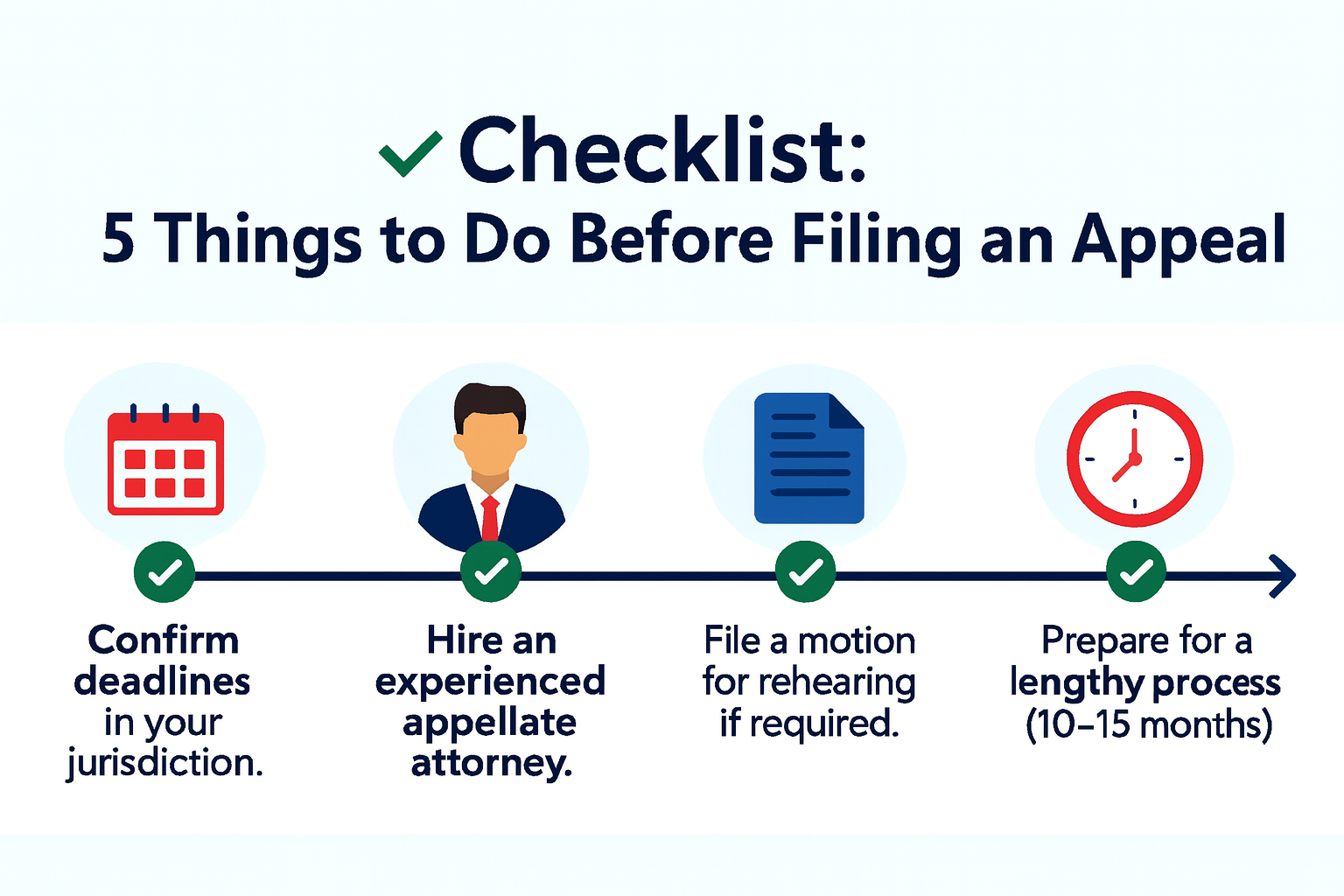
To maximize the chance of success, specialized counsel should address the following before initiating the appeal:
- Confirm Deadlines in Your Jurisdiction: Calculate the exact filing date for the Notice of Appeal, factoring in any applicable post-judgment motion tolling rules.
- Hire an Experienced Appellate Attorney: Secure counsel specializing in appellate strategy, legal research, and the application of standards of review.
- File a Motion for Rehearing if Required: Check local rules (like Florida’s) to see if a post-judgment motion is mandatory to preserve certain errors.
- Ensure Trial Records are Complete: Confirm that all necessary transcripts and exhibits are ordered, paid for, and secured by the trial clerk and court reporter.
- Prepare for a Lengthy Process (10–15 months): Set realistic client expectations regarding the time and resources required for this high-risk/high-reward undertaking.
Conclusion
The appeal process is complex and requires careful strategy. By understanding error preservation, jurisdictional mandates, and key stages, you can navigate the path to challenging a trial court’s decision effectively.