
The federal criminal appeals process begins when a defendant files a notice of appeal after a federal conviction or sentence and continues through a series of legal steps until the appellate court issues its decision or all available appellate review has been exhausted.
Rather than conducting a new trial, the United States Court of Appeals reviews the existing trial record to determine whether legal errors affected the conviction, sentence, or the defendant’s constitutional rights.
Because an appeal focuses on reviewing legal mistakes, not introducing new evidence or calling new witnesses, the process follows a structured framework governed by the Federal Rules of Appellate Procedure.
From filing the notice of appeal and preparing the appellate record to submitting briefs, presenting oral arguments where permitted, and receiving the court’s decision, each stage plays a specific role in the outcome of the appeal.
Since many appellate deadlines begin immediately after the district court enters judgment, understanding how the federal criminal appeals process works from start to finish is essential before valuable appeal rights are lost.
12 Steps of Federal Criminal Appeals Process
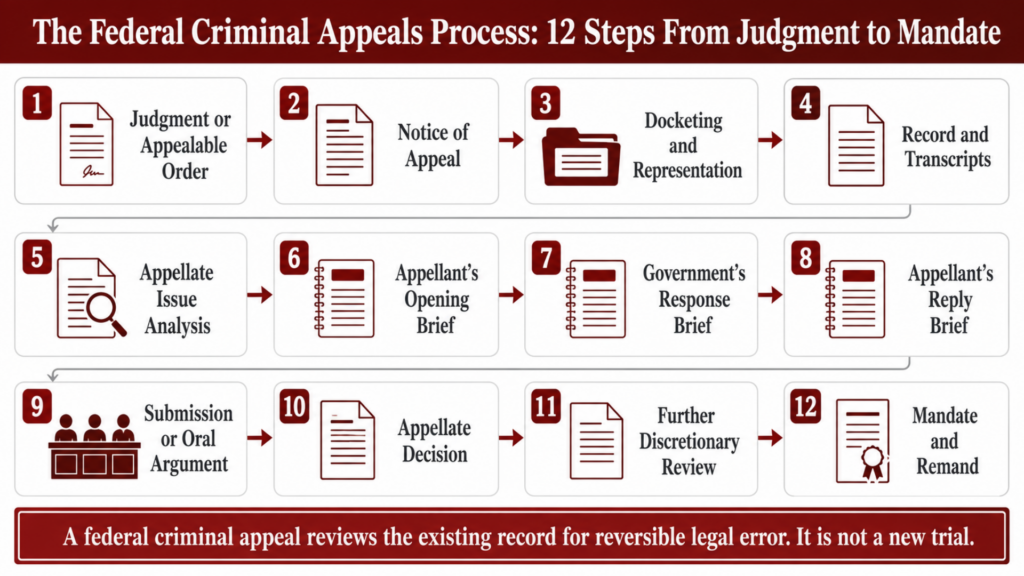
| Steps | What Happens | Purpose |
|---|---|---|
| 1. Judgment or Appealable Order | The district court enters the conviction, sentence, or another appealable ruling. | Establishes the decision being challenged. |
| 2. Notice of Appeal | A short notice is filed in the district court, generally within 14 days for a defendant’s criminal appeal. | Preserves and formally initiates appellate review. |
| 3. Docketing and Representation | The district clerk sends the necessary information to the circuit clerk, which opens the appellate case. Counsel’s appellate status is addressed. | Places the case under the court of appeals’ procedures. |
| 4. Record and Transcripts | District-court filings, exhibits, docket entries, and necessary transcripts are identified and assembled. | Gives the appellate judges the official history of the case. |
| 5. Issue Analysis | Appellate counsel studies the record, preservation questions, standards of review, controlling precedent, waivers, and available remedies. | Identifies the strongest legally reviewable claims. |
| 6. Opening Brief | The defendant, as appellant, presents the alleged errors and requested relief. | Explains why the conviction, sentence, or order should be changed. |
| 7. Government Response | Federal prosecutors answer the appellant’s claims and defend the judgment. | Gives the court the appellee’s factual and legal position. |
| 8. Reply Brief | The appellant responds to the government’s principal arguments. | Narrows the disputes and addresses the government’s defenses. |
| 9. Submission or Oral Argument | A three-judge panel decides the case on the written submissions or hears oral argument. | Allows judicial examination of the record, law, and requested remedy. |
| 10. Appellate Decision | The panel enters judgment and may issue a published or unpublished opinion. | Affirms, reverses, vacates, remands, or dismisses the appeal. |
| 11. Further Discretionary Review | A party may evaluate panel rehearing, rehearing en banc, or Supreme Court review. | Seeks limited reconsideration or higher-court review. |
| 12. Mandate and Remand | The court of appeals issues its mandate, and the district court conducts any required proceedings. | Makes the appellate judgment effective and implements its instructions. |
Step 1: Entry of the Judgment or Other Appealable Order
A direct criminal appeal ordinarily follows entry of the written judgment on the district court’s criminal docket. The judgment normally identifies the offenses of conviction and sets out the sentence, including imprisonment, supervised release, fines, restitution, forfeiture, and special assessments when applicable.
Some appeals concern a conviction, some concern only the sentence, and others challenge a separate appealable ruling. The order or judgment being challenged matters because it determines:
- Whether appellate jurisdiction exists.
- When the Notice of Appeal deadline begins.
- Which rulings are within the appeal’s scope.
- What relief the appellate court may legally provide.
An appellate attorney should review the written judgment promptly. The oral sentence announced in court and the written judgment should also be compared for possible inconsistencies.
A notice filed before entry of the written judgment
A defendant does not necessarily lose an appeal by filing after the judge announces the sentence but before the written judgment is entered. Under Federal Rule of Appellate Procedure 4(b)(2), a notice filed during that period is treated as filed on the date the judgment is entered.
Step 2: File the Notice of Appeal
The Notice of Appeal is the document that formally begins the appellate process. It is filed with the clerk of the federal district court, not initially with the court of appeals.
The notice ordinarily must:
- Identify the party taking the appeal.
- Designate the judgment or appealable order being challenged.
- Name the court of appeals to which the appeal is taken.
It is usually a short procedural filing. It does not ordinarily contain the complete appellate arguments or attempt to prove the alleged errors. Federal Rule of Appellate Procedure 3 governs the notice’s filing and essential contents.
The ordinary 14-day deadline
In a federal criminal case, a defendant generally must file the Notice of Appeal within 14 days after the later of:
- Entry of the judgment or order being appealed; or
- Filing of the government’s Notice of Appeal.
When the government is legally entitled to appeal, it generally has 30 days after the later of entry of the relevant judgment or order or the filing of a defendant’s notice.
Post-trial motions that can affect the deadline
Certain timely motions can change when the 14-day period begins. These include:
- A motion for judgment of acquittal under Federal Rule of Criminal Procedure 29.
- A qualifying motion for a new trial under Rule 33.
- A motion to arrest judgment under Rule 34.
When one of these qualifying motions is timely filed, the Notice of Appeal deadline generally runs from the later of entry of the judgment or entry of the order disposing of the last remaining qualifying motion.
There is an important limitation for newly discovered evidence. Rule 33 may allow a newly discovered evidence motion to be filed within three years after the verdict or finding of guilt. However, for such a motion to postpone the Notice of Appeal deadline under Appellate Rule 4(b)(3), it must be made no later than 14 days after entry of the judgment.
A motion to correct a sentence under Federal Rule of Criminal Procedure 35(a) does not suspend the time for filing the Notice of Appeal.
Can the district court extend the deadline?
Upon a finding of excusable neglect or good cause, the district court may extend the criminal Notice of Appeal deadline for no more than 30 days beyond the original deadline. The rule permits the court to act before or after the original period expires and with or without a formal motion and notice. Relief is not automatic, and a defendant should never assume that a late notice will be accepted.
Notices filed by incarcerated defendants
An incarcerated defendant may receive the benefit of the prison-mailbox rule when the notice is deposited in the institution’s legal-mail system by the filing deadline and the applicable declaration, postage, and evidentiary requirements are satisfied.
Practical rule: When there is any uncertainty about whether an appeal will be pursued, it is generally safer to protect the deadline promptly rather than wait for transcripts, a complete case review, or the resolution of fee arrangements.
Step 3: Docket the Appeal and Address Representation
After the Notice of Appeal is filed, the district clerk sends a copy of the notice, the relevant docket entries, and required information to the clerk of the appropriate United States Court of Appeals.
The circuit clerk then:
- Assigns an appellate case number.
- Opens the appellate docket.
- Identifies the appellant and appellee.
- Issues initial notices and procedural instructions.
- Establishes or later issues the briefing schedule.
- Manages motions, record access, oral-argument scheduling, judgment, and the mandate.
Under Federal Rule of Appellate Procedure 12, the circuit clerk dockets the appeal upon receiving the notice and docket entries from the district court. Unless the court establishes another deadline, the attorney who filed the notice must file a representation statement within 14 days identifying the parties represented on appeal.
Who Represents the Defendant on Appeal?
Once a federal criminal appeal is filed, the defendant must determine who will handle the appellate proceedings. In some cases, the attorney who represented the defendant during the trial continues to serve as appellate counsel. In others, the defendant retains new counsel or qualifies for court-appointed representation under the Criminal Justice Act (CJA).
Depending on the circumstances, appellate representation may involve:
- Trial counsel continuing to handle the appeal.
- Retaining an attorney who focuses on federal criminal appeals.
- Appointment of counsel for an eligible defendant under the Criminal Justice Act.
- Proceeding pro se (without an attorney), subject to the applicable procedural and legal requirements.
The applicable federal circuit’s local rules govern issues such as when trial counsel’s representation ends, the procedure for withdrawing from a case, and the requirements for substituting or appointing appellate counsel.
Why Does Appellate Representation Differ From Trial Representation?
Successfully handling a federal criminal appeal requires a different skill set than litigating a case in the district court. Unlike trial attorneys, appellate counsel does not present witnesses or introduce new evidence. Instead, the focus is on analyzing the existing record, researching applicable law, and demonstrating that a reversible legal error occurred.
Effective appellate counsel must be able to:
- Analyze the complete district court record.
- Identify preserved and unpreserved legal issues.
- Apply the appropriate standard of review to each claim.
- Evaluate the effect of plea agreements and appeal waivers.
- Distinguish harmless errors from reversible errors.
- Prioritize the strongest appellate issues instead of raising every possible argument.
- Prepare persuasive, well-supported appellate briefs with accurate record citations.
- Respond effectively to detailed questions from appellate judges during oral argument, when granted.
Step 4: Prepare the Record and Order the Necessary Transcripts
The court of appeals does not independently investigate what happened in the district court. It relies on the official appellate record.
Under Federal Rule of Appellate Procedure 10, the record consists of:
- The original papers and exhibits filed in the district court.
- The transcript of proceedings, if any.
- A certified copy of the district-court docket entries.
Depending on the case and the issues raised, relevant materials may include:
- The indictment or superseding indictment.
- Pretrial motions, responses, and rulings.
- Suppression-hearing materials.
- Plea agreements and plea-hearing transcripts.
- Trial transcripts and exhibits.
- Jury instructions and verdict forms.
- Rule 29, Rule 33, or Rule 34 motions and orders.
- Sentencing memoranda.
- Objections to the Presentence Investigation Report.
- Sentencing transcripts.
- Written judgments and restitution or forfeiture orders.
- Sealed materials transmitted under applicable protections.
- Certified docket entries.
A Presentence Investigation Report or statement of reasons may be subject to special confidentiality, sealing, and transmission procedures rather than ordinary public-record treatment.
The transcript-order deadline
Within 14 days after filing the Notice of Appeal, the appellant generally must either:
- Order the portions of the proceedings considered necessary for the appeal; or
- File a certificate stating that no transcript will be ordered.
If the appellant intends to argue that a finding or conclusion is unsupported by or contrary to the evidence, the record must include the transcript of all evidence relevant to that finding or conclusion.
When only part of the transcript is ordered, additional requirements apply, including providing a statement of the issues and allowing the appellee to designate additional portions.
Why transcripts matter?
Appellate judges were not present during the plea hearing, trial, evidentiary hearings, or sentencing. The transcripts show:
- What witnesses actually said.
- What evidence was admitted or excluded.
- What arguments the attorneys made.
- Whether an objection was timely and specific.
- How the district judge ruled.
- What explanation the judge gave.
- Whether the alleged error is visible in the record.
Without the necessary transcript, the appellate court may be unable to evaluate an argument. Failure to order required transcripts, make payment arrangements, or comply with record requirements can delay the case and may result in sanctions or dismissal for failure to prosecute. The district clerk and court reporter have separate responsibilities for preparing and transmitting the completed record.
Can New Evidence Be Introduced on Direct Appeal?
No. A federal direct appeal is generally limited to the record that was before the district court, so the Court of Appeals does not ordinarily consider new evidence that was never presented to the trial court.
This is because the purpose of a direct appeal is to review whether the district court committed a reversible legal error, not to conduct a new trial or reconsider the facts of the case. Instead, appellate judges examine the existing record, including the district court filings, exhibits, transcripts, and docket entries, to determine whether the conviction or sentence should be upheld, reversed, modified, or remanded. Consistent with Federal Rule of Appellate Procedure 10(a), the record on appeal is generally limited to the materials that were before the district court.
For that reason, Federal Rule of Appellate Procedure 10(e) serves a limited purpose. It allows the appellate record to be corrected if it does not accurately reflect what actually occurred in the district court, such as when material is omitted or misstated. However, it is not intended to expand the record by introducing evidence that was never presented to the trial court.
If genuinely new evidence is discovered after a conviction, a different legal procedure is generally required. Depending on the circumstances, a defendant may seek relief through a Federal Rule of Criminal Procedure 33 motion for a new trial based on newly discovered evidence or, where appropriate, a motion under 28 U.S.C. § 2255. The appropriate remedy depends on the nature of the evidence, the procedural posture of the case, and the applicable federal rules.
Step 5: Identify, Preserve, and Research the Appellate Issues
Once the necessary record is available, appellate counsel conducts a detailed review of the case.
For each potential issue, counsel should ask:
- Was there an adverse district-court ruling?
- Was a timely and sufficiently specific objection or motion made?
- Was the issue waived, forfeited, or preserved?
- Does a plea agreement contain an appeal waiver?
- Does the waiver cover this particular claim?
- Can the alleged error be demonstrated from the record?
- What standard of review applies?
- Which Supreme Court or circuit decisions control?
- Did the error affect the verdict or sentence?
- Could the government establish harmlessness?
- What precise relief could the court of appeals order?
- Would winning the issue materially change the result?
Why Preserving Issues at Trial Matters?
Not every error that occurs during a federal criminal case can be reviewed in the same way on appeal. Whether an issue was properly preserved in the district court often determines the standard of review the Court of Appeals will apply. A claim supported by a timely objection or motion is generally reviewed under a more favorable standard, whereas an issue that was not raised in the district court may be reviewed only for plain error, if it is reviewable at all.
Issue preservation is therefore more than a procedural technicality. It can significantly affect:
- Which party bears the burden of persuasion.
- The level of deference the appellate court gives to the district court’s ruling.
- Whether the defendant must demonstrate prejudice.
- The likelihood of obtaining appellate relief.
Appeal Waivers Can Limit Appellate Rights
Many federal criminal cases are resolved through plea agreements, and those agreements often include an appeal waiver that limits the defendant’s right to challenge the conviction, sentence, or both. However, the existence of an appeal waiver does not automatically prevent appellate review. Whether a waiver is enforceable depends on the facts of the case and the applicable law.
Courts typically consider factors such as:
- The precise language of the waiver.
- The plea agreement and plea-hearing record.
- Whether the waiver was entered knowingly and voluntarily.
- The nature of the claim being raised on appeal.
- Controlling precedent within the applicable federal circuit.
Strong Federal Appeals Focus on the Most Persuasive Issues
After evaluating the record, appellate counsel must decide which issues offer the strongest legal basis for relief. Raising every possible complaint is rarely an effective strategy. Instead, successful federal appeals typically focus on a limited number of well-developed arguments that are supported by both the record and controlling law.
The strongest appellate issues generally are:
- Supported by the applicable law and legal precedent.
- Properly preserved or otherwise reviewable on appeal.
- Clearly established by the district court record.
- Material to the conviction, sentence, or another substantial right.
- Capable of supporting a legally available remedy.
Ultimately, a successful federal criminal appeal is not based on identifying every mistake that may have occurred during the proceedings. Instead, it depends on demonstrating that the district court committed a reviewable legal error that materially affected the outcome and justifies relief under the applicable standard of review.
Step 6: File the Appellate Briefs
Once appellate counsel has identified the strongest legal issues, the next stage is preparing and filing the appellate briefs. These written briefs form the foundation of most federal criminal appeals because the Court of Appeals often decides cases primarily on the written submissions, and some appeals are resolved without oral argument. As a result, every legal argument, supporting authority, and request for relief must be presented clearly and comprehensively in the briefs.
The Appellant’s Opening Brief
The appeal begins with the appellant’s opening brief, which explains why the district court’s judgment should be reversed, vacated, modified, or remanded. Federal Rule of Appellate Procedure 28 establishes the required contents of the brief, including:
- A jurisdictional statement.
- A statement of the issues presented for review.
- A statement of the case and relevant procedural history.
- A statement of the facts supported by citations to the record.
- A summary of the argument.
- The legal argument.
- The applicable standard of review for each issue.
- Citations to controlling statutes and precedent.
- A conclusion identifying the precise relief requested.
Beyond satisfying these procedural requirements, an effective opening brief should demonstrate:
- What the district court decided.
- Where the relevant facts and rulings appear in the appellate record.
- Why the district court’s ruling was legally erroneous.
- Whether the issue was properly preserved for appellate review.
- Why the error was prejudicial rather than harmless.
- What remedy the Court of Appeals should grant.
Because appellate judges rely heavily on the written briefs, unsupported factual assertions, conclusory arguments, or claims lacking citations to the record or controlling authority are unlikely to succeed.
The Government’s Response Brief
After the appellant files the opening brief, the United States—acting as the appellee through federal prosecutors—files a response explaining why the district court’s judgment should be affirmed. The government’s brief typically addresses each appellate argument and may contend that:
- The district court correctly applied the law.
- The defendant waived the right to raise the issue.
- The claim was not properly preserved for appellate review.
- A deferential standard of review applies.
- The record does not support the appellant’s factual assertions.
- Binding precedent forecloses the claim.
- Any error was harmless and does not justify reversal.
- The requested relief exceeds the appellate court’s authority.
By presenting both parties’ legal arguments, the briefing process enables the appellate panel to evaluate the record, applicable law, and the appropriate remedy before deciding the appeal.
The Appellant’s Reply Brief
The appellant may then file a reply brief addressing the government’s principal arguments. Rather than repeating the opening brief, the reply focuses on answering the appellee’s response by:
- Responding to the government’s strongest legal arguments.
- Correcting material misunderstandings of the record.
- Explaining why the government’s authorities are distinguishable.
- Addressing arguments concerning preservation, waiver, or harmless error.
- Clarifying the specific relief requested.
The reply brief is generally not the proper place to raise entirely new claims or legal theories. Because the government has no opportunity to respond, appellate courts may decline to consider arguments presented for the first time in a reply brief.
Briefing Deadlines
The Federal Rules of Appellate Procedure establish default deadlines for filing appellate briefs. Unless modified by the court or the applicable circuit’s local rules:
- The appellant’s opening brief is generally due 40 days after the record is filed.
- The appellee’s response brief is generally due 30 days after service of the appellant’s brief.
- The appellant’s reply brief may generally be filed within 21 days after service of the appellee’s brief and must ordinarily be filed at least 7 days before oral argument.
These timeframes serve as the national baseline. However, individual federal circuits frequently issue case-specific briefing schedules or apply local rules that modify these deadlines, making it important to follow the court’s scheduling order rather than relying solely on the default rules.
Step 7: Apply the Correct Standards of Review
The standard of review describes how the appellate court examines a particular ruling. Different issues within the same appeal may be governed by different standards.
| Standard | What It Generally Means | Common Examples |
|---|---|---|
| De Novo | The appellate court independently reviews the legal issue without deferring to the district court’s legal conclusion. | Statutory interpretation, constitutional questions, and some interpretations of the Sentencing Guidelines. |
| Abuse of Discretion | The appellate court gives the district court a range of permissible judgment and reverses when the decision rests on legal error, clearly erroneous facts, or an unreasonable exercise of discretion. | Many evidentiary rulings, trial-management decisions, and review of sentencing reasonableness. |
| Clear Error | A factual finding ordinarily remains in place unless the appellate court is firmly convinced that a mistake occurred. | Sentencing facts, factual findings following suppression hearings, and judge-made factual determinations. |
| Plain Error | An unpreserved claim is reviewed under a demanding four-part framework, with the defendant bearing the burden of satisfying the applicable requirements. | Errors that were not brought to the district court’s attention through a timely objection. |
Plain-Error Review
When a defendant did not properly preserve an issue by raising a timely objection in the district court, the Court of Appeals may review the claim only under the plain-error standard, which is significantly more demanding than ordinary appellate review. To obtain relief, the defendant generally must establish that:
- An error occurred.
- The error was clear or obvious under the law.
- The error affected the defendant’s substantial rights.
- The error seriously affected the fairness, integrity, or public reputation of the judicial proceedings.
Because all four requirements must be satisfied, plain-error review is one of the most difficult standards under federal appellate practice. The U.S. Supreme Court has repeatedly emphasized that the burden rests on the defendant to establish each element before an appellate court may grant relief.
Harmless Error Review
Not every legal error requires a conviction or sentence to be reversed. Even if the Court of Appeals concludes that the district court made a mistake, it must also determine whether the error was sufficiently prejudicial to justify appellate relief. If the error is considered harmless under the applicable legal standard, the judgment may still be affirmed.
Whether an error is harmless depends on several factors, including:
- Whether the issue was properly preserved.
- Whether the error was constitutional or nonconstitutional.
- The applicable statute, rule, or standard of review.
- Which party bears the burden of proving prejudice or harmlessness.
- The strength of the remaining evidence supporting the judgment.
- The error’s effect on the conviction, sentence, or another substantial right.
Step 8: Submission on the Briefs or Oral Argument
Once the briefing process is complete, the appeal is submitted to a panel of three judges from the United States Court of Appeals. At this stage, the judges review the appellate record, the parties’ written briefs, and the applicable law before deciding whether oral argument would assist in resolving the case.
Is Oral Argument Guaranteed?
No. Although oral argument is an important part of some federal criminal appeals, it is not guaranteed. Under Federal Rule of Appellate Procedure 34, a three-judge panel may unanimously decide that oral argument is unnecessary if:
- The appeal is frivolous.
- The controlling legal issue has already been authoritatively decided.
- The facts and legal arguments are adequately presented in the briefs and record, and oral argument would not significantly assist the court’s decision-making process.
Because many federal criminal appeals are decided solely on the written submissions, appellate briefs must fully present every significant legal argument. Counsel should never assume that an opportunity to expand or clarify those arguments will be available during oral argument.
What Happens During Oral Argument?
When the Court of Appeals schedules oral argument, the attorneys for both parties appear before the three-judge panel to answer questions about the issues raised in the briefs. Oral argument is not a new trial and does not involve the presentation of additional evidence or witness testimony. Instead, it gives the judges an opportunity to clarify the parties’ legal positions before issuing a decision.
During oral argument:
- Appellate counsel present their legal arguments before the panel.
- No jury is present.
- Witnesses and experts do not testify.
- New evidence cannot be introduced.
- The judges may interrupt counsel with questions at any time.
- Questions often focus on jurisdiction, issue preservation, the appellate record, controlling precedent, standards of review, harmless error, and the requested remedy.
- The appellant ordinarily argues first and may reserve part of the allotted time for rebuttal.
- The government then presents its argument, after which the appellant may use any remaining rebuttal time.
Rather than repeating the written briefs, effective oral advocacy focuses on answering the judges’ questions, addressing their concerns, and explaining why the applicable law supports the requested outcome. In many cases, the judges’ questions provide valuable insight into the issues they consider most important when deciding the appeal.
Step 9: Panel Review and the Appellate Decision
After reviewing the appellate record, the parties’ briefs, and any oral argument, the three-judge panel deliberates and issues its decision. The court determines whether the district court committed a reversible legal error and, if so, what remedy is authorized under the law.
The Court of Appeals may issue its decision in different forms, including:
- A published opinion, which generally serves as binding precedent within the circuit.
- An unpublished or nonprecedential opinion, which resolves the appeal but generally has limited precedential effect under the circuit’s rules.
- A per curiam opinion, issued in the name of the court rather than a specific judge.
- A summary order or another form of disposition authorized by the applicable circuit rules.
The type of opinion issued depends on the circumstances of the case and the practices of the particular federal circuit.
What Are the Three Possible Outcomes of a Federal Criminal Appeal?
1. Affirmance
An affirmance means the Court of Appeals leaves the district court’s conviction, sentence, or other challenged order in effect. This does not necessarily mean that every aspect of the proceedings was flawless. Rather, it means the appellate court found no reversible error that warrants changing the judgment.
2. Reversal
A reversal means the appellate court overturns all or part of the district court’s judgment because it identified a reversible legal error. The consequences depend on the nature of that error. For example, the court may:
- Order a new trial because of a trial-related error.
- Direct the district court to reconsider an issue under the correct legal standard.
- Reverse a conviction where the evidence was legally insufficient, which may prevent retrial on the affected count.
A reversal does not necessarily terminate the prosecution or end the case.
3. Vacatur
When the Court of Appeals vacates a judgment, it nullifies all or part of the district court’s decision. Vacatur is commonly accompanied by a remand, allowing the district court to conduct further proceedings consistent with the appellate decision.
For example, the appellate court may vacate a sentence and remand the case for resentencing without disturbing the underlying conviction.
4. Remand
A remand returns the case to the district court for further proceedings. The appellate court’s opinion or mandate specifies what the district court must do, which may include:
- Conducting a new trial.
- Holding a complete or limited resentencing.
- Reconsidering a motion or legal issue.
- Making additional factual findings.
- Correcting the written judgment.
- Reconsidering restitution or forfeiture.
- Modifying conditions of supervised release.
- Taking any other action consistent with the appellate court’s instructions.
Some remands are broad, while others are limited to a specific issue. The district court must act within the scope of the appellate court’s mandate.
5. Dismissal
The Court of Appeals may dismiss an appeal without reaching the merits for procedural or jurisdictional reasons, including:
- An untimely Notice of Appeal.
- Lack of appellate jurisdiction.
- Failure to prosecute the appeal or comply with court orders.
- An enforceable appeal waiver.
- Mootness.
- Voluntary dismissal.
- Another procedural or jurisdictional defect.
6. Mixed Outcomes
A federal criminal appeal does not always result in a complete victory or complete loss. The Court of Appeals may grant relief on some issues while rejecting others. For example, it may:
- Affirm the conviction but vacate the sentence.
- Affirm some counts of conviction while reversing others.
- Reject most appellate claims but remand the case to correct a sentencing error.
- Dismiss one portion of the appeal while deciding another on the merits.
Because appellate courts evaluate each claim independently, a single appeal may produce multiple forms of relief in the same decision.
Step 10: Consider Panel Rehearing or Rehearing En Banc
After the Court of Appeals issues its decision, a party that believes the panel made a significant legal or factual error may consider filing a petition for panel rehearing, rehearing en banc, or both. These procedures provide a limited opportunity to request further review within the Court of Appeals, but they are not automatic second appeals and are granted only in limited circumstances.
Panel Rehearing
A petition for panel rehearing asks the same three-judge panel to reconsider its decision because it allegedly overlooked or misunderstood a material point of law or fact. The purpose is to bring the panel’s attention to a significant error in its analysis—not to reargue issues that were already considered or simply express disagreement with the outcome.
Rehearing En Banc
A petition for rehearing en banc asks the eligible active judges of the Court of Appeals to reconsider the panel’s decision. Because en banc review requires the participation of additional judges and is intended to preserve consistency in the circuit’s case law, it is not favored and is granted only in exceptional circumstances.
Courts generally consider en banc review when the case involves:
- A conflict with a decision of the U.S. Supreme Court.
- A conflict between the panel’s decision and prior decisions within the same circuit.
- An issue that creates inconsistency with decisions from other federal circuits.
- A question of exceptional public or legal importance.
Filing Deadline
Under Federal Rule of Appellate Procedure 40, a petition for panel rehearing, rehearing en banc, or both generally must be filed within 14 days after entry of judgment in a federal criminal appeal, unless the court orders otherwise. The 45-day deadline applies only in certain civil cases involving the United States or its agencies and does not apply to ordinary federal criminal appeals simply because the United States is the appellee.
What Happens If Rehearing Is Granted?
If the Court of Appeals grants rehearing, it may:
- Decide the case based on the existing record and briefs.
- Request additional briefing from the parties.
- Schedule a new oral argument.
- Modify, withdraw, or replace its prior opinion.
- Issue any other order appropriate under the circumstances.
Granting rehearing does not automatically change the outcome of the appeal. Instead, it gives the court an opportunity to reconsider the issues before issuing its final decision.
Step 11: Consider Filing a Petition for a Writ of Certiorari
After the Court of Appeals has entered its final judgment, and after any timely petition for rehearing has been resolved, a party may ask the United States Supreme Court to review the case by filing a petition for a writ of certiorari. This is the final stage of direct appellate review in the federal court system.
Is Supreme Court Review Automatic?
No. Unlike an appeal to the Court of Appeals, Supreme Court review is entirely discretionary. Filing a petition for a writ of certiorari does not entitle a party to another appeal or a hearing before the Supreme Court. Instead, the Court decides whether the case presents issues that warrant its limited review.
The Supreme Court is generally more likely to grant certiorari when a case involves:
- An important question of federal law.
- A conflict between decisions of different federal courts of appeals or state supreme courts.
- A significant constitutional issue.
- Another matter of exceptional national importance.
Because the Supreme Court hears only a small percentage of the petitions filed each year, most certiorari petitions are denied.
The 90-Day Filing Deadline
Under Supreme Court Rule 13, a petition for a writ of certiorari generally must be filed within 90 days after the Court of Appeals enters its judgment.
The 90-day period runs from the date the appellate judgment is entered, not from the date the appellate mandate is issued. However, if a timely petition for rehearing is filed in the Court of Appeals, the 90-day deadline generally begins to run from the date rehearing is denied or, if rehearing is granted, from the entry of the subsequent judgment.
Can the Deadline Be Extended?
In limited circumstances, a Justice of the Supreme Court may extend the time to file a certiorari petition by no more than 60 days upon a showing of good cause. Such extensions are not automatic and must comply with the procedural requirements set out in the Supreme Court’s rules.
Step 12: Issuance of the Mandate and Proceedings on Remand
After the appellate process is complete, the Court of Appeals issues its mandate, the formal document that makes the appellate judgment effective and returns jurisdiction to the district court. Until the mandate is issued, the Court of Appeals generally retains authority over the case.
Unless the court orders otherwise, the mandate typically includes:
- A certified copy of the appellate judgment.
- A copy of the court’s opinion, if one was issued.
- Any directions concerning costs.
Under Federal Rule of Appellate Procedure 41, the mandate generally issues:
- Seven days after the time to file a petition for rehearing expires, or
- Seven days after the court denies a timely petition for rehearing or a motion to stay the mandate,
whichever is later. The Court of Appeals may shorten or extend this period by order. Once issued, the mandate makes the appellate court’s judgment effective and authorizes the district court to proceed in accordance with the appellate decision.
Can the Mandate Be Stayed?
Yes, but not automatically. Filing or intending to file a petition for a writ of certiorari in the United States Supreme Court does not automatically stay the mandate. A party seeking to delay issuance of the mandate must file a motion and generally demonstrate that the proposed certiorari petition presents a substantial question and that there is good cause for granting a stay.
What Happens After a Remand?
If the Court of Appeals remands the case, jurisdiction returns to the district court, which must carry out the appellate court’s instructions. The scope of the district court’s authority depends on the terms of the appellate mandate, and the court may not take actions that exceed or conflict with those instructions.
Depending on the appellate decision, the district court may be required to:
- Schedule a new trial.
- Order an updated Presentence Investigation Report (PSR).
- Receive additional sentencing memoranda.
- Conduct a complete or limited resentencing.
- Reconsider a suppression or evidentiary ruling.
- Correct the written judgment.
- Dismiss one or more counts of conviction.
- Make additional factual findings.
- Conduct any other proceedings required by the appellate court’s opinion.
Although the parties may disagree about how broadly the mandate should be interpreted, the district court is required to follow both the letter and the spirit of the Court of Appeals’ mandate when conducting further proceedings.
Does Filing a Federal Criminal Appeal Stop the Sentence?
No. Filing a Notice of Appeal does not automatically suspend a prison sentence or entitle a defendant to release pending appeal.
A federal criminal appeal and a request for release pending appeal are separate legal proceedings governed by different rules. While filing a Notice of Appeal begins the appellate process, it does not, by itself, delay the execution of the sentence or require the defendant’s release from custody.
A defendant seeking release after conviction must ordinarily first file a motion in the district court. If that request is denied, the defendant may seek review in the United States Court of Appeals in accordance with Federal Rule of Appellate Procedure 9. In deciding whether release is appropriate, the courts apply the standards set forth in 18 U.S.C. §§ 3142, 3143, and 3145(c), which govern release and detention before and after conviction.
Whether a defendant remains in custody while an appeal is pending therefore depends on the applicable statutory requirements and the court’s determination, not simply on the filing of a Notice of Appeal.
How Long Does a Federal Criminal Appeal Take? (Typical Timeline)
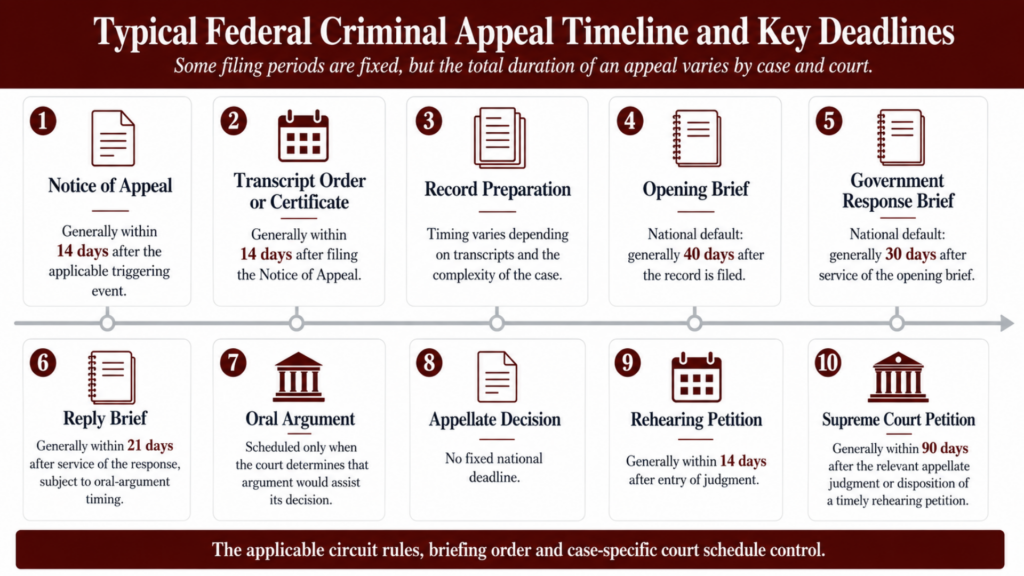
Every federal criminal appeal follows the same general procedural stages, but the overall timeline varies depending on factors such as transcript preparation, the complexity of the case, briefing extensions, the court’s schedule, and whether oral argument is granted. The table below provides a typical timeline based on the Federal Rules of Appellate Procedure and common appellate practice.
| Stage | What Happens | Approximate Time |
|---|---|---|
| Notice of Appeal | Defendant files a Notice of Appeal in the district court to begin the appellate process. | Generally within 14 days after entry of the judgment or appealable order (subject to certain post-trial motions). |
| Record and Transcripts | Transcript order or certificate is filed, and the appellate record is assembled. | Transcript order generally due within 14 days after filing the Notice of Appeal; record preparation varies by case. |
| Opening Brief | Appellant files the opening brief. | Typically 40 days after the record is filed, unless the court orders otherwise. |
| Government’s Brief | Appellee files its response brief. | Typically 30 days after service of the opening brief. |
| Oral Argument | Held if the court determines it would assist in deciding the appeal. | Varies; no fixed national deadline. |
| Appellate Decision | Court of Appeals issues its judgment and opinion. | No fixed national deadline. |
| Rehearing | Petition for panel rehearing or rehearing en banc, if appropriate. | Generally within 14 days after entry of judgment. |
| Supreme Court Review | Petition for a writ of certiorari filed with the U.S. Supreme Court. | Generally within 90 days after entry of judgment, or after denial of a timely rehearing petition. |
Who Is Involved in a Federal Criminal Appeal?
The participants in a federal criminal case change significantly once the case moves from the federal district court to the United States Court of Appeals. During the trial, the court determines the facts and decides whether the defendant is guilty. On appeal, the focus shifts to reviewing whether the district court committed a reversible legal error based on the existing record.
Trial vs. Appeal: How the Participants’ Roles Change
| Participant | Primary Role at Trial | Primary Role on Appeal |
|---|---|---|
| District Judge | Presides over the case, rules on motions, evidentiary objections, jury instructions, and sentencing. | Does not decide the appeal, although the district court may address limited post-judgment matters authorized by rule. |
| Court of Appeals Judges | No role during the district court proceedings. | Review the district court record, written briefs, and oral arguments (if granted) to determine whether reversible legal error occurred. |
| Jury | Determines disputed facts and decides guilt in jury trials. | No role in the appellate process. |
| Federal Prosecutor | Presents the government’s case and participates in plea and sentencing proceedings. | Represents the United States as the appellee and files the response brief defending the judgment. |
| Defense/Appellate Counsel | Defends the accused at trial, presents evidence, examines witnesses, and preserves issues for appeal. | Reviews the record, researches legal issues, prepares appellate briefs, and argues before the Court of Appeals if oral argument is granted. |
| Defendant | Exercises constitutional trial rights and decides whether to appeal after judgment. | Becomes the appellant and works with appellate counsel throughout the appeal. |
| Witnesses & Experts | Testify and are subject to examination and cross-examination. | Ordinarily have no role because the appeal is based on the existing record. |
| Court Clerks | Maintain the district court docket and filings. | Transmit the appellate record, docket the appeal, and manage appellate filings and scheduling. |
What Changes Once the Case Reaches the Court of Appeals?
Once a case reaches the Court of Appeals, the focus shifts from deciding the facts to reviewing whether the federal district court committed a reversible legal error based on the existing record. Unlike a trial, the appellate court does not hear new witnesses, receive new evidence, or determine guilt or innocence again.
Under Federal Rule of Appellate Procedure 10(a), appellate judges generally review only the official record from the district court, which includes:
- The original papers and exhibits filed in the district court.
- The transcript of the proceedings.
- A certified copy of the district court docket entries.
Because the appeal is limited to this record, the Court of Appeals evaluates whether the district court correctly applied the law and whether any legal error justifies affirming, reversing, vacating, or remanding the judgment.
How the Parties’ Roles Change on Appeal?
The responsibilities of both the prosecution and the defense also change after a Notice of Appeal is filed.
During the district court proceedings, federal prosecutors present the government’s case, participate in plea negotiations when applicable, and advocate for conviction and sentencing. Once the case reaches the Court of Appeals, the United States becomes the appellee and files a response brief explaining why the district court’s judgment should be affirmed.
The defendant becomes the appellant and ordinarily files the opening brief identifying the alleged legal errors and the relief being requested. The appellant may also file a reply brief addressing arguments raised by the government. The content of appellate briefs is governed primarily by Federal Rule of Appellate Procedure 28, while Rule 31 establishes the default national briefing schedule, subject to local circuit rules and court orders.
The Administrative Role of Court Clerks
Although judges decide the appeal, court clerks are responsible for managing much of the appellate process.
After the Notice of Appeal is filed, the district clerk serves notice and transmits the notice of appeal, docket entries, and other required materials to the appropriate United States Court of Appeals. The circuit clerk then dockets the appeal, manages filings, issues scheduling notices, and oversees the procedural administration of the case throughout the appellate process.
Why Is Appellate Counsel Different From Trial Counsel?
Federal appellate advocacy differs significantly from trial advocacy. While trial counsel focuses on presenting evidence, examining witnesses, and persuading a judge or jury, appellate counsel focuses on identifying legal errors that occurred during the district court proceedings and demonstrating why those errors warrant appellate relief.
Because a direct appeal is generally limited to the existing record, appellate counsel does not introduce new evidence or retry the case. Instead, the attorney conducts a comprehensive review of the record, applicable law, and relevant appellate standards to develop the strongest possible legal arguments.
What Does Federal Appellate Counsel Do?
Appellate counsel typically:
- Reviews the trial, plea, sentencing, and post-trial record.
- Identifies preserved and legally reviewable appellate issues.
- Evaluates the applicable standards of review and controlling precedent.
- Prepares persuasive appellate briefs supported by the record and relevant authority.
- Presents oral argument before the Court of Appeals when the court schedules argument.
One of the most important aspects of appellate representation is determining which issues have the greatest legal merit. Rather than raising every possible complaint, experienced appellate counsel focuses on arguments that are supported by the record, preserved for review where possible, and capable of affecting the outcome of the appeal.
Why Does Appellate Experience Matter?
Federal criminal appeals involve strict procedural deadlines, complex briefing requirements, and highly technical standards of review. Success often depends not only on identifying legal error but also on presenting that issue effectively within the framework of federal appellate procedure.
Summing Up
A federal criminal appeal is a carefully structured legal process that focuses on identifying and correcting reversible legal errors, not retrying the case. Understanding each stage, from filing the Notice of Appeal to the appellate court’s final decision, helps defendants make informed decisions and protect their legal rights. Because federal appeals involve strict deadlines, complex procedural rules, and specialized standards of review, experienced appellate representation can be critical.
How Brownstone Law Can Help?
Brownstone Law focuses on federal appellate litigation and represents clients in criminal appeals before the United States Courts of Appeals. The firm’s appellate attorneys conduct a detailed review of the district court record, evaluate potentially viable appellate issues, prepare comprehensive appellate briefs, and advocate for clients throughout each stage of the federal appeals process.
For more information, please contact our team on a toll-free number – 1-888-233-8895 (Toll-Free) or send us an email at robert@brownstonelaw.com
Frequently Asked Questions (FAQs)
Q1. What happens when you appeal in a federal court?
When you appeal in a federal court, the case is reviewed by a United States Court of Appeals to determine whether the district court made a legal error that affected the outcome. The appellate court does not conduct a new trial, hear new witnesses, or consider new evidence. Instead, it reviews the trial record, written briefs, and, in some cases, oral arguments. The court may affirm the judgment, reverse it, vacate it, remand the case for further proceedings, or dismiss the appeal, depending on whether it finds a reversible error under the applicable standard of review.
Q2. Does filing an appeal delay imprisonment?
No. Filing a federal criminal appeal does not automatically delay imprisonment or suspend a sentence. In most cases, a defendant must begin serving the sentence even after filing a Notice of Appeal. A defendant who wishes to remain free while the appeal is pending must separately request release pending appeal. The court will grant such a request only if the defendant satisfies the requirements of federal law, including showing that the appeal raises a substantial legal question and that the defendant is not likely to flee or pose a danger to the community. Release pending appeal is the exception, not the rule.
Q3. What is the maximum time for appeal?
There is no maximum time limit for completing a federal criminal appeal. While the Federal Rules of Appellate Procedure impose deadlines for specific steps, such as generally requiring a defendant to file a Notice of Appeal within 14 days after entry of the judgment or other triggering event—they do not require the Court of Appeals to decide the case within a fixed period. The overall length of an appeal depends on factors such as the complexity of the case, transcript preparation, briefing schedules, court workload, oral argument, and any rehearing or Supreme Court review. Federal criminal appeals commonly take several months to more than a year to resolve.
Q4. What Are Strong Grounds for a Federal Criminal Appeal?
A strong federal criminal appeal is generally based on a significant legal or procedural error that affected the outcome of the case. The Court of Appeals does not conduct a new trial or reconsider witness credibility. Instead, it reviews whether the district court committed a reversible error under the applicable standard of review.
Common grounds for a federal criminal appeal include:
- Incorrect application or interpretation of federal law by the district court.
- Violations of the defendant’s constitutional rights, such as unlawful searches and seizures, denial of the right to counsel, or due process violations.
- Improper admission or exclusion of evidence that may have affected the fairness of the trial.
- Legally incorrect jury instructions that could have influenced the jury’s verdict.
- Insufficient evidence to support the conviction under the applicable legal standard.
- Errors during guilty plea proceedings, including claims that the plea was not entered knowingly, voluntarily, or intelligently.
- Sentencing errors, including procedural mistakes, misapplication of the U.S. Sentencing Guidelines, or an unlawful sentence.
- Prosecutorial misconduct that substantially prejudiced the defendant’s right to a fair trial.
- Judicial errors, including incorrect legal rulings or an abuse of discretion.
- Plain errors that were not preserved at trial but satisfy the demanding federal plain-error standard.
Whether an appeal is likely to succeed depends on several factors, including the applicable standard of review, whether the issue was properly preserved in the district court, and whether the error materially affected the conviction or sentence. Not every legal mistake results in reversal; the error must generally be significant enough to justify appellate relief under federal law.
Q5. What Happens If the Defendant Wins a Federal Criminal Appeal?
If the defendant wins a federal criminal appeal, the Court of Appeals may grant different forms of relief depending on the legal error it identifies. The outcome depends on the specific issues raised in the appeal and the appellate court’s decision.
Possible outcomes include:
- Ordering a new trial if the conviction was affected by a reversible legal error.
- Vacating the sentence and sending the case back for resentencing.
- Reversing or dismissing one or more convictions when required by law.
- Remanding the case to the district court for additional proceedings or reconsideration under the correct legal standard.
- Correcting a judgment or addressing a specific legal error identified by the appellate court.
Winning an appeal does not automatically mean the charges are dismissed or the defendant is immediately released. In many cases, the Court of Appeals returns the case to the district court with instructions, and further proceedings are required before the case is finally resolved.
Q6. What Happens if the Defendant Loses a Federal Criminal Appeal?
If the defendant loses the appeal, the Court of Appeals generally affirms the conviction, sentence, or other challenged order, meaning the district court’s judgment remains in effect. An unsuccessful appeal does not necessarily end all legal options, but any further review is limited and depends on the circumstances of the case.
Possible next steps may include:
- Filing a petition for panel rehearing if the appellate court overlooked or misunderstood a material issue of law or fact.
- Requesting rehearing en banc, asking the full court (or a larger panel, depending on the circuit) to review the decision in limited circumstances.
- Filing a petition for a writ of certiorari asking the United States Supreme Court to review the case. Supreme Court review is discretionary, and only a small percentage of petitions are granted.
- Pursuing post-conviction relief, such as a motion under 28 U.S.C. § 2255, if there is a legally valid basis that falls outside the scope of the direct appeal, such as ineffective assistance of counsel or certain constitutional violations.
The appropriate next step depends on the appellate court’s decision, the issues raised, applicable deadlines, and whether any additional legal remedies remain available.
Q7. Can the Prosecutor Appeal?
Yes. Federal prosecutors may appeal certain district court rulings and sentences when Congress has authorized an appeal by statute, such as under 18 U.S.C. § 3731 for specified decisions or 18 U.S.C. § 3742(b) for certain sentencing issues. However, the government’s right to appeal is significantly more limited than a defendant’s. Constitutional protections, including the Double Jeopardy Clause of the Fifth Amendment, generally prevent the government from appealing an acquittal after a jury or judge has found the defendant not guilty.
| Glossary Term | Definition |
|---|---|
| Appellant | An appellant is the party who files an appeal asking a higher court to review and change a lower court’s decision. In most federal criminal appeals, the defendant is the appellant. |
| Appellee | An appellee is the party responding to an appeal and asking the appellate court to uphold the lower court’s decision. In federal criminal appeals, the United States government is usually the appellee. |
| Appeal Waiver | An appeal waiver is a provision in a plea agreement in which a defendant agrees to limit or waive certain rights to challenge a conviction or sentence on appeal. |
| Harmless Error | Harmless error is a legal mistake that does not justify reversing a conviction or sentence because the appellate court concludes that the error did not materially affect the outcome of the case. |
| Mandate | A mandate is the formal document issued by the Court of Appeals that makes its judgment effective and returns jurisdiction to the district court to carry out the appellate court’s instructions. |
| Plain Error | Plain error is a demanding standard of appellate review that applies when a party failed to preserve an issue in the district court by making a timely objection. |
| Rehearing En Banc | Rehearing en banc is a procedure in which the eligible active judges of a federal Court of Appeals reconsider a panel’s decision in exceptional cases involving important legal issues or conflicts in precedent. |
| Remand | To remand means the Court of Appeals sends a case back to the district court with instructions to conduct further proceedings consistent with the appellate court’s decision. |
| Reversible Error | A reversible error is a legal mistake that significantly affected the outcome of a case and justifies reversing, vacating, or remanding the district court’s judgment. |
| Standard of Review | A standard of review is the legal rule that determines how the Court of Appeals evaluates a district court’s ruling when deciding whether a legal error requires reversal or other relief. |
| Writ of Certiorari | A writ of certiorari is an order requested from the United States Supreme Court asking it to review a decision issued by a federal Court of Appeals or another lower court. |