
Key Takeaways
|
If you are considering an appeal in Michigan, it is important to understand that an appeal is not a second trial. The process is focused on determining whether the lower court made a legal or procedural error that affected the outcome of the case.
You generally will not call witnesses again, present your case to a new jury, or introduce new evidence simply because you disagree with the trial court’s decision. Instead, the Michigan Court of Appeals ordinarily reviews the existing lower-court record, including the documents, transcripts, and exhibits that were presented to the trial court.
As a result, a Michigan appeal is largely a deadline-driven and document-focused process. You can expect important stages involving the filing of the appeal, preparation of the record and transcripts, legal research, written appellate briefs, possible oral argument, and ultimately a decision from the appellate judges.
For many people, this can feel very different from the trial itself. There may be long periods when you are not appearing in court, even though your attorney is reviewing the record, researching the legal issues, preparing filings, or responding to the opposing side.
Understanding what happens at each stage can make the process easier to follow and help you know what to expect along the way. The sections below explain how a Michigan appeal generally progresses from the initial filing through the appellate court’s decision.
What Happens During a Michigan Appeal? – Quick Answer
| Appeal Stage | What Happens | What You Should Expect |
|---|---|---|
| After the lower-court ruling | Counsel determines whether the decision is appealable and identifies the applicable deadline and procedure. | Important decisions may need to be made quickly because appellate deadlines are strict. |
| Starting the appeal | Depending on the case, the appeal may be initiated by filing a claim of appeal or an application for leave to appeal. | Filing starts the appellate process, but it does not mean you will immediately appear before a panel of judges. |
| Record and transcripts | The relevant lower-court record and transcripts are identified, ordered, and filed as required. | There may be a period of waiting while transcripts are prepared and the appellate record is assembled. |
| Identifying appellate issues | Counsel reviews the record to determine which legal or procedural errors can properly be raised on appeal. | Not every disagreement with the lower court’s decision becomes an appellate issue. The arguments generally must be supported by the existing record. |
| Written briefing | The appellant presents the legal arguments in a brief, followed by the appellee’s response and, when permitted, the appellant’s reply. | Written legal arguments become a central part of the Court of Appeals’ review. |
| Appellate court review | The judges review the record, briefs, and applicable law. | An appeal generally does not involve a new trial, new testimony, or a chance to present the entire case again. |
| Oral argument, if scheduled | If oral argument is permitted or scheduled, attorneys answer questions from the appellate judges. | You generally will not testify or personally argue the appeal. Oral argument is not automatic in every appeal. |
| Appellate decision | The Court of Appeals issues an opinion or order resolving the appeal or addressing the application for leave. | The court may affirm, reverse, remand, or grant other appropriate relief. |
| After the decision | Depending on the outcome, the case may end, return to the lower court for further proceedings, or become subject to further appellate review. | Winning an appeal does not necessarily mean the underlying case is immediately over; the appellate court may send the case back for additional proceedings. |
How Does An Appeal Work In Michigan?
1. The Appeal Begins With Deadlines
One of the first matters addressed in a Michigan appeal is the deadline for seeking appellate review. The applicable time limit depends on the type of case, the judgment or order being challenged, and whether the matter is an appeal of right or requires an application for leave to appeal. Determining the correct deadline is critical because failure to comply with a jurisdictional filing deadline can prevent the Michigan Court of Appeals from considering the appeal.
At this stage, the attorney will typically determine:
- The decision being challenged: The judgment or order from which appellate review is sought.
- The applicable route of appeal: Whether the decision is appealable as of right or whether permission must be requested through an application for leave to appeal.
- The applicable filing deadline: The date by which the claim of appeal or application for leave must be filed under the Michigan Court Rules.
- The effect of postjudgment motions: Whether a timely motion for relief from the judgment or order affects when the appellate filing period begins or expires.
- The requirements for initiating the appeal: What documents, fees, notices, and other materials must be filed to properly begin appellate review.
- The record needed for review: Which transcripts and portions of the lower-court record will be necessary for the Court of Appeals to consider the issues raised on appeal.
Common Michigan Appeal Deadlines
| Type of Appellate Proceeding | General Timing | Important Considerations |
|---|---|---|
| Civil appeal of right | Generally 21 days after entry of the judgment or order. | The deadline is subject to applicable rules governing postjudgment motions and other circumstances that may affect the time for filing. |
| Criminal appeal of right | The applicable period depends on the judgment or order and the circumstances of the criminal case. MCR 7.204 contains specific timing provisions, including provisions involving a 42-day period. | Criminal appellate deadlines can vary depending on the type of judgment or order involved, so the applicable rule should be reviewed carefully. |
| Application for leave to appeal | Generally 21 days after entry of the judgment or order. | MCR 7.205 establishes different timing rules for certain proceedings, including specified criminal cases. |
NOTE – Under MCR 7.204, the time for filing an appeal of right is jurisdictional. MCR 7.205 likewise establishes specific jurisdictional timing requirements for applications for leave to appeal. The applicable period should therefore be calculated from the particular judgment or order and the circumstances of the case rather than assumed from a general deadline.
What Happens After The Deadline Is Established?
Once the applicable deadline and method of appellate review have been determined, the appeal can move into the preparation and filing stage. This may involve obtaining the necessary transcripts, assembling the relevant portions of the lower-court record, identifying the legal issues to be raised, and preparing the documents required by the Michigan Court Rules.
The initial stage of a Michigan appeal is therefore largely procedural. Before the Court of Appeals considers whether the lower court made a legal error, the requirements for obtaining appellate review must be satisfied, beginning with determining the correct deadline and filing the appeal through the proper appellate procedure.
2. The Appeal Reviews the Existing Record
You should generally expect a Michigan appeal to focus on the existing lower-court record rather than retrying the case. The Michigan Court of Appeals reviews the proceedings that took place in the lower court and considers the issues properly presented for appellate review. Under MCR 7.210, the record on appeal consists of the relevant proceedings and materials from the lower court, which may include pleadings, motions, orders, transcripts, exhibits, and other materials that form part of the record.
An appeal therefore does not ordinarily provide a second opportunity to present the entire case. You should not generally expect:
- A new jury trial: The Court of Appeals does not conduct a new jury trial to reconsider the case.
- Witnesses to automatically testify again: The appellate court generally reviews testimony through the transcripts and other materials contained in the existing record.
- New discovery simply because an appeal was filed: An appeal is not a continuation of the trial court’s discovery process.
- A second opportunity to introduce evidence: Parties generally cannot use an appeal to present evidence that was not properly introduced in the lower court.
- The entire case to be heard again: The Court of Appeals does not approach the appeal as though the original trial or hearing never occurred.
Instead, the Court of Appeals examines the existing record to determine whether the lower court made an error that warrants appellate relief. The standard of review depends on the issue being challenged. For example, questions of law are generally reviewed de novo, while factual findings are ordinarily reviewed for clear error where that standard applies.
What Does an Attorney Examine During a Michigan Appeal?
The focus of appellate work is therefore different from the focus of the original trial or hearing. Rather than simply arguing that the lower court reached the wrong result, the appeal generally requires identifying what the lower court did incorrectly, where the alleged error appears in the record, and why that error warrants relief on appeal.
Your attorney will typically examine:
- The ruling being challenged: What judgment, order, or decision is being appealed?
- The alleged error: What legal, factual, or procedural error is being raised?
- The appellate record: Where do the transcripts, exhibits, filings, or other record materials support the issue being raised?
- Issue preservation: Was the issue raised and decided in the lower court, or is there a recognized basis for appellate review despite a preservation issue?
- The standard of review: What standard will the Court of Appeals apply to the particular issue?
- The available relief: If an error is established, what remedy is available, such as affirmance, reversal, vacatur, or remand for further proceedings?
NOTE – This distinction is important because an appellate argument must be tied to the record and the legal issues properly before the Court of Appeals. Simply disagreeing with the lower court’s decision is generally not enough. The appellant must identify an issue that is reviewable on appeal and explain why the alleged error requires the judgment or order to be changed.
3. Expect a Period of Transcript and Record Preparation
A Michigan appeal can involve a period of record and transcript preparation during which there may be little visible activity for the appellant. The appellate process depends on assembling and reviewing the materials necessary for the Michigan Court of Appeals to consider the issues raised in the appeal. Depending on the case, those materials may include:
- Motions and responses filed in the lower court;
- Hearing and trial transcripts;
- Sentencing transcripts in criminal matters;
- Jury instructions;
- Exhibits admitted into evidence;
- Objections made during the proceedings;
- Written judgments and orders;
- Findings or rulings made by the lower-court judge; and
- Other portions of the lower-court record relevant to the appellate issues.
The time required for this stage can vary depending on the length and complexity of the proceedings, the number of transcripts required, and the issues being raised on appeal. In some cases, obtaining and reviewing the necessary transcripts and record materials can take considerable time.
The record is important because the appellate court does not decide the case based solely on the parties’ descriptions of what occurred in the lower court. Appellate arguments and factual assertions generally must be supported by the record, and Michigan’s appellate briefing rules require appropriate record references and discussion of the applicable standard of review.
What Happens During Record Preparation?
During this stage, your attorney may be working on the appeal even when there are few visible developments on the court docket. The work can include:
- Reviewing transcripts and lower-court filings;
- Comparing the record with the issues identified for appeal;
- Locating where particular rulings, objections, testimony, or evidence appear in the record;
- Determining whether potential appellate issues were preserved for review;
- Researching the law applicable to those issues; and
- Beginning to develop the arguments that will ultimately be presented in the appellate briefs.
You may therefore have fewer hearings and in-person court appearances than you experienced during the trial-court proceedings. The appellate process involves substantial written work and record review, so progress may not always be visible through frequent courtroom activity.
NOTE – A period of limited visible activity does not necessarily mean that the appeal is inactive. Much of the work at this stage takes place through transcript review, record analysis, legal research, and preparation for the appellate briefing that follows.
4. Your Appellate Lawyer May Narrow the Issues on Appeal
An appeal may begin with several concerns about what happened in the trial court, but not every concern will necessarily become an issue presented to the Michigan Court of Appeals. Appellate counsel may evaluate which issues are properly reviewable, supported by the record, and capable of providing a basis for appellate relief.
Before deciding which issues to raise, your attorney may consider:
- Whether the challenged ruling or alleged error is properly subject to appellate review.
- Whether the argument or objection was properly raised in the lower court for appellate review and, if not, whether an exception permits the Court of Appeals to consider it.
- What standard of review applies to the particular issue, such as de novo review, clear error, or abuse of discretion.
- Whether the transcripts, exhibits, pleadings, orders, and other portions of the lower-court record support the claimed error.
- Whether Michigan statutes, court rules, and controlling appellate decisions support the argument.
- Whether the alleged error is sufficient to warrant appellate relief.
- What remedy the Court of Appeals has authority to provide if the argument succeeds.
Michigan’s appellate briefing rules require parties to identify the applicable standard of review, support factual assertions with appropriate references to the record, and identify the relief being requested. The rules also require the appellant’s brief to address preservation where relevant.
Why Some Issues May Not Appear in the Brief?
As the appeal develops, the issues presented may become more focused. You may initially identify numerous problems with the trial or lower-court proceedings, but your appellate lawyer may recommend pursuing only the arguments with the strongest legal and factual foundation.
An issue may ultimately be left out because the record does not adequately support it, the issue presents a preservation problem, the applicable standard of review makes the argument difficult to establish, the alleged error does not warrant relief, or the governing law does not support the requested remedy.
NOTE – Not every concern raised at the beginning of an appeal will necessarily appear in the appellate brief. Appellate counsel may evaluate the potential issues as a whole and focus on those that are properly reviewable, supported by the record, grounded in applicable law, and capable of providing a basis for appellate relief. A stronger appeal is not necessarily one that raises the greatest number of issues, but one that presents the most supportable arguments clearly and effectively.
5. Written Briefs Become the Main Focus
At the Michigan Court of Appeals, written briefs are a central part of how the parties present their arguments to the court. Unlike a trial, where live testimony and evidence may occupy much of the proceeding, an appeal generally focuses on the lower-court record, the legal issues raised, and the parties’ written arguments.
The appellant’s brief generally addresses:
- The issues presented for review;
- The relevant facts and procedural history;
- The portions of the lower-court record supporting those facts;
- The applicable standard of review;
- The statutes, court rules, and judicial decisions that govern the issues;
- The reasons the challenged ruling should be affirmed, reversed, vacated, or otherwise addressed; and
- The specific relief being requested from the Court of Appeals.
Under MCR 7.212, the timing for filing an appellant’s brief depends on the applicable type of appeal and the triggering event specified by the rule. In an ordinary appeal, the rule generally provides a 56-day period, while certain expedited proceedings are subject to shorter deadlines. The applicable deadline should be determined from the specific case rather than assumed from the general 56-day period.
The appellee then has an opportunity to respond, and the appellant may file a reply brief. The applicable briefing periods also depend on the type of proceeding and the circumstances of the appeal. MCR 7.212 sets out these requirements and exceptions.
What Your Attorney May Be Doing During Briefing?
While the briefing is being prepared, you may have relatively little courtroom activity. Much of the appellate lawyer’s work takes place outside the courtroom and may involve:
- Reviewing transcripts and other portions of the lower-court record;
- Researching Michigan statutes, court rules, and appellate decisions;
- Developing and testing the legal arguments;
- Supporting factual statements with appropriate record citations;
- Reviewing and refining the brief for accuracy and clarity;
- Addressing weaknesses in the opposing side’s position; and
- Ensuring that the requested relief is supported by the arguments presented.
You may also be asked to clarify aspects of the procedural history or specific events that occurred in the lower court. However, the purpose of the brief is not to retell the entire case from the beginning. The arguments must remain focused on the issues properly before the Court of Appeals and supported by the existing appellate record.
For a client, this can make an appeal feel much less visible than a trial. A significant amount of work may be taking place through legal research, record analysis, drafting, and revision even when there are no frequent court appearances or hearings.
The result is that the written brief becomes one of the principal ways your appellate lawyer explains why the lower court’s decision should be upheld, changed, or otherwise addressed by the Court of Appeals.
6. The Other Side Will Have an Opportunity to Respond
Once the appellant’s brief is filed, the appellee generally has an opportunity to respond to the arguments presented by the appellant. You should expect the appellee’s brief to present the same record and events from a different legal perspective.
The appellee may argue that:
- the lower court correctly applied the law;
- the appellant has characterized the record incorrectly or left out relevant context;
- the issue was not properly preserved for appellate review;
- the applicable standard of review favors the lower court’s decision;
- the alleged error did not affect the outcome of the case;
- the appellant has not established a basis for reversal or other appellate relief; or
- the relief requested by the appellant is not available or is not warranted under the circumstances.
The appellee’s brief may therefore challenge both the substance of the appellant’s arguments and the basis for obtaining appellate relief. Your attorney will generally need to account for these opposing arguments when preparing the appeal and, where appropriate, responding to them in the reply brief.
The Reply Brief Is Limited to Rebuttal
The appellant may have an opportunity to file a reply brief after the appellee’s response. Under MCR 7.212(G), a reply brief is intended for rebuttal. It is not an opportunity to simply repeat the opening brief or introduce an entirely new set of arguments.
NOTE – A reply brief generally addresses the appellee’s arguments rather than introducing a new set of issues. You should expect disagreement throughout the briefing process, including different interpretations of the record and applicable law. Conflicting arguments are a normal part of appellate litigation and do not, by themselves, indicate a problem with the appeal.
7. Your Role Is Usually More Limited Than It Was at Trial
If you testified at trial or regularly attended lower-court hearings, an appeal may involve substantially less personal participation from you. Appellate proceedings are primarily handled through the attorneys, the existing record, and written briefs rather than through live testimony or the presentation of evidence by the parties.
You generally should not expect to:
- Testify again: The Court of Appeals ordinarily reviews the testimony contained in the existing record rather than taking testimony from the parties or witnesses.
- Be cross-examined: Appellate review does not ordinarily involve the trial-style examination and cross-examination of witnesses.
- Present evidence directly to the judges: Evidence is generally considered through the existing lower-court record rather than being introduced directly to the appellate panel.
- Argue the appeal personally: If oral argument is held, the attorneys generally present the legal arguments to the Court of Appeals.
- Attend frequent hearings: Appellate proceedings are largely conducted through written filings and review of the record, so there may be fewer courtroom appearances than during a trial.
Your involvement may instead include providing counsel with information about the case, answering questions about the lower-court proceedings, reviewing important developments, and making decisions about the issues and objectives of the appeal when your attorney needs your input.
New Evidence Usually Cannot Simply Be Added to the Appeal
You generally cannot use an appeal to introduce new evidence that was never presented to the lower court. Michigan appeals ordinarily proceed on the existing record, which means the Court of Appeals reviews the materials that were before the lower court rather than conducting a new evidentiary proceeding.
This is why discovering new information after the trial does not automatically mean that the information can be submitted to the Court of Appeals. Counsel must determine whether the information can be considered under a procedure authorized by Michigan law or whether another form of relief is available.
Michigan appellate procedure does provide circumstances in which the Court of Appeals may remand a case to the lower court for further proceedings, including proceedings involving additional evidence. A remand, however, is different from simply attaching new evidence to an appellate brief and asking the Court of Appeals to consider it as though the evidence had been presented at trial.
If potentially significant new information is discovered after the lower-court proceedings, tell your appellate attorney promptly. Counsel can then determine whether the information has legal significance and what procedural options, if any, may be available.
NOTE: An appeal generally gives you less direct participation than a trial because the Court of Appeals primarily reviews the existing record and the parties’ legal arguments. If new evidence or information arises after the lower-court proceedings, it should be brought to appellate counsel’s attention rather than simply added to the appellate filings.
8. Expect Oral Argument to Be Possible, but Not Guaranteed
You should expect that oral argument may be part of a Michigan appeal, but it is not guaranteed in every case. Some appeals are argued before a panel of the Michigan Court of Appeals, while others are decided based on the parties’ briefs and the existing record.
Under MCR 7.214, a party generally must properly request oral argument in a timely brief. Depending on the circumstances and the applicable rules, a case may be submitted without oral argument. The Court of Appeals may also decide a qualifying case without oral argument when the briefs and record adequately present the issues and oral argument would not significantly assist the court’s deliberations.
When oral argument is scheduled, the attorneys, not the parties, present the arguments to the appellate panel. Under the current Michigan Court Rules, a calendar case generally allows 30 minutes per side, while a side that is the only party represented at oral argument generally receives 15 minutes.
What Should You Expect at Oral Argument?
If oral argument is scheduled, do not expect another trial or a formal presentation in which your attorney simply reads the brief to the judges. Oral argument is an opportunity for the appellate judges to question the attorneys and explore the legal issues raised by the appeal.
The judges may ask about:
- The legal authority supporting an argument;
- A particular portion of the lower-court record;
- Whether an issue was preserved for appellate review;
- The applicable standard of review;
- How a Michigan statute, court rule, or prior decision applies;
- Weaknesses or consequences of a proposed argument; and
- What relief should be granted if the court agrees with the appellant or appellee.
Your attorney may therefore need to respond to questions that go beyond the precise wording of the written briefs. The discussion can move quickly between the legal authorities, the record, and the specific questions the panel considers important.
For a client, oral argument may feel shorter and more technical than a trial-court proceeding. Your attorney is generally responsible for presenting the argument and responding to the judges’ questions, while your role is ordinarily limited to observing the proceeding and providing any information or instructions your counsel may need.
The important expectation is that oral argument is not another opportunity to present evidence or retell the entire case. Its purpose is to help the appellate panel evaluate the legal issues already before it.
9. Expect Appellate Judges to Decide the Case
A Michigan Court of Appeals case is generally decided by a panel of three judges, rather than by a jury. The judges review the lower-court record, the parties’ appellate briefs, and, when applicable, the arguments presented at oral argument. The decision of the majority of the panel constitutes the decision of the Court of Appeals.
The panel may issue a written opinion or order addressing the issues raised on appeal and determining what relief, if any, is appropriate. Depending on the case, the court may affirm the lower court’s decision, reverse or vacate a ruling, remand the case for further proceedings, or provide another form of relief authorized by law.
How Long Does a Michigan Court of Appeals Decision Take?
There is no fixed number of days or months for a Michigan Court of Appeals decision. The time required to decide an appeal varies depending on the case, including the complexity of the issues, the size of the record, the briefing, any motions, whether oral argument is held, and the court’s scheduling and workload. Therefore, you should not expect an immediate decision after the briefs are filed or oral argument is completed.
Factors that can affect how long a Michigan appeal takes to reach a decision include:
- The size and complexity of the record: A case involving extensive transcripts, exhibits, and lower-court proceedings may require more time to review.
- The complexity of the legal issues: Appeals involving multiple or complicated legal issues may require additional analysis.
- The appellate briefs: The court considers the appellant’s arguments, the appellee’s response, and any reply, along with the authorities and record references cited in the briefs.
- Motions or other proceedings: Motions or other matters requiring the Court of Appeals’ attention can affect the progression of the case.
- Expedited treatment: Some appeals are subject to expedited procedures that can affect the applicable schedule.
- Oral argument: If oral argument is scheduled, the case may have additional scheduling considerations before it is submitted for decision.
- Court scheduling and workload: The timing of a decision also depends on the Court of Appeals’ calendar and the time required for the panel to consider and decide the case.
While waiting for a decision, there may be little visible activity on the case. Your attorney may monitor the docket for orders or other developments, but a period without a new filing does not necessarily mean that the appeal is inactive. The appellate panel may be reviewing the record, analyzing the parties’ arguments, researching the applicable law, and considering the appropriate disposition.
NOTE – The length of time an appeal remains pending does not, by itself, indicate whether the appeal is likely to succeed or fail. Appellate decisions depend on the record, the legal issues presented, the applicable law and standards of review, and the Court of Appeals’ determination of the case.
10. A Michigan Appeal Can Have Several Possible Outcomes
A Michigan Court of Appeals decision does not always result in a simple “win” or “loss.” The court may affirm, reverse, vacate, remand, dismiss the appeal, or provide relief on some issues while leaving other parts of the lower-court decision unchanged. The outcome depends on the issues raised, the appellate court’s analysis, and the relief supported by the record and applicable law.
Common outcomes include:
- Affirm: The Court of Appeals upholds the lower-court decision, either in its entirety or as to the issues addressed in the appellate decision.
- Reverse: The Court of Appeals determines that the lower court’s ruling, or a portion of it, should be overturned.
- Vacate: The Court of Appeals sets aside a judgment, order, or other ruling, in whole or in part, as specified in its decision.
- Remand: The Court of Appeals sends the case back to the lower court for further proceedings consistent with its decision.
- Dismiss: The Court of Appeals may dismiss an appeal when the applicable circumstances and procedural requirements support dismissal.
- Partial relief: The appellant may prevail on one or more issues while other portions of the lower-court decision remain unchanged.
These outcomes can also occur together. For example, the Court of Appeals may reverse or vacate part of a lower-court ruling and remand the case for further proceedings. The practical effect therefore depends on the specific language of the court’s opinion or order.
Michigan’s appellate rules authorize the Court of Appeals, in appropriate cases, to dismiss, affirm, reverse, vacate, or remand a case for further proceedings. The court also has authority to enter appropriate judgments and orders and to direct further proceedings consistent with its decision.
NOTE – These terms describe different types of appellate action and should not be treated as interchangeable. A reversal generally overturns a lower-court ruling, vacatur sets aside a judgment or order, and a remand sends the case back to the lower court for further proceedings.
To understand how reverse, vacate, and remand differ, and what each outcome can mean for a case, read our detailed guide – What Is the Difference Between Reverse, Vacate, and Remand?
What Should You Look For in the Appellate Decision?
When the decision arrives, do not look only for the words “affirmed” or “reversed.” Read the decision to determine exactly what the Court of Appeals decided, which portions of the lower-court ruling are affected, and what the lower court must do next, if anything.
For example, a decision that reverses a ruling may also remand the case with specific instructions. A decision that vacates an order may require further proceedings rather than ending the case. Similarly, an appellant may obtain relief on one issue while the remaining portions of the judgment stay in place.
The practical result of an appeal depends on the court’s specific ruling and any instructions accompanying it, not simply on whether the appeal is described as a “win” or “loss.”
11. A Successful Appeal May Return the Case to the Lower Court
A successful appeal does not necessarily bring the case to an immediate end. If the Michigan Court of Appeals determines that the lower court made a reversible error, it may send the case back to the lower court for further proceedings. This is known as a remand.
What happens after a remand depends on the appellate court’s decision and the specific instructions it provides. Depending on the case, the lower court may be required to:
- Reconsider an issue under the correct legal standard;
- Make additional findings;
- Conduct another hearing;
- Reconsider or impose a sentence where appropriate;
- Enter a different order or judgment;
- Conduct further proceedings consistent with the appellate decision; or
- Take other action specifically authorized or directed by the Court of Appeals.
In an appropriate case, the appellate court may also order or authorize further proceedings that could ultimately include a new trial. A remand, however, does not automatically mean that the entire case starts over from the beginning.
What Happens After a Michigan Appeal Is Remanded?
After a remand, your attorney will need to review the appellate opinion or order carefully to determine exactly what the Michigan Court of Appeals has directed the lower court to do.
The scope of a remand depends on the language of the appellate decision. The lower court generally proceeds consistently with the instructions and limits established by the appellate court rather than simply reopening every issue that was previously litigated.
For example, if the Court of Appeals remands a case because the lower court applied the wrong legal standard to a particular issue, the lower court may need to reconsider that issue under the correct standard. Other portions of the original decision may remain unaffected.
NOTE – A successful appeal can therefore change what happens next without necessarily ending the underlying case. The practical effect of the victory depends on the appellate court’s ruling, the scope of any remand, and the proceedings that follow in the lower court.
12. Do Not Expect Filing an Appeal to Automatically Stop the Judgment
Filing an appeal does not generally stay the effect or enforceability of the lower-court judgment or order. Under MCR 7.209(A)(1), an appeal does not stay a trial-court judgment or order unless the trial court or Court of Appeals orders otherwise, subject to specified exceptions.
This means that filing the appeal and obtaining a stay are separate matters. If the judgment could take effect or be enforced while the appeal is pending, your attorney may need to determine whether a stay should be requested and what requirements apply.
A stay may be particularly important when the judgment or order involves:
- Payment of money;
- Property or possession of property;
- Injunctive relief;
- Family-law obligations;
- Custody or parenting-related orders;
- A criminal sentence; or
- Other consequences that could occur before the appeal is decided.
MCR 7.209 also provides procedures concerning stays and appeal bonds, and the requirements can differ depending on the type of case and the circumstances.
What Should You Expect If You Need a Stay?
You should expect the question of a stay to be addressed separately from the appeal itself. Your attorney may need to determine whether the lower-court judgment can take effect while the appeal is pending, whether an automatic stay or other exception applies, and whether a motion for a stay or bond is necessary.
If a stay is needed, the timing can be important because waiting until the appeal is already underway may allow the underlying judgment or order to take effect before the stay is obtained.
Are Criminal and Civil Appeals the Same in Michigan?
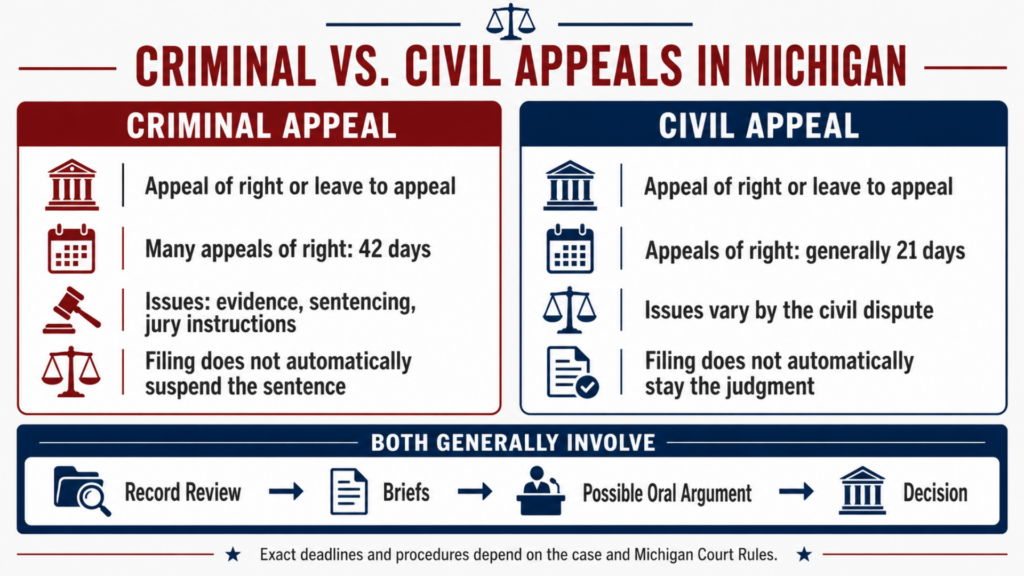
No. Criminal and civil appeals in Michigan follow the same basic appellate framework, but they are not the same process. Both generally involve review of the lower-court record, appellate briefing, possible oral argument, and a decision by the Michigan Court of Appeals. However, the applicable deadlines, route of appellate review, procedural requirements, and issues raised on appeal can differ between criminal and civil cases.
What Should You Expect During a Criminal Appeal in Michigan?
A Michigan criminal appeal generally focuses on whether the lower court committed a reviewable error that warrants appellate relief. The Court of Appeals ordinarily reviews the existing record rather than conducting another trial.
Depending on the case, the issues on appeal may involve:
- Evidentiary rulings;
- Pretrial rulings;
- Jury instructions;
- Sentencing;
- Constitutional issues;
- Sufficiency of the evidence;
- Preserved objections; or
- Other alleged legal errors supported by the appellate record.
Criminal Appeal Deadlines in Michigan
The deadline depends on the type of appellate review available.
For a criminal appeal as of right, MCR 7.204 generally requires the claim of appeal to be filed within 42 days after entry of the judgment or order being appealed. The rule also provides specific 42-day periods for certain orders, including an order denying a timely request for appointed appellate counsel and an order denying certain timely postjudgment motions.
Criminal cases that are not proceeding by appeal as of right may instead require an application for leave to appeal. Under MCR 7.205(A)(2), in a criminal case involving a final judgment or final order, a defendant’s application for leave to appeal generally must be filed within the later of six months after entry of the judgment or order, or 42 days after certain specified events, such as the appointment or denial of appellate counsel or the filing of certain ordered transcripts, when the rule’s conditions are met.
A particularly important distinction concerns plea-based convictions. A circuit-court criminal conviction based on a guilty or nolo contendere plea generally is not an appeal as of right under MCR 7.203; review generally proceeds by application for leave to appeal, subject to the applicable rules.
Because these deadlines can be jurisdictional, a criminal appellant should not assume that every criminal appeal has the same filing period or appellate procedure.
What Does the Criminal Appeal Process Involve?
Once the appropriate appellate route has been established, expect appellate counsel to review the trial, plea, and sentencing proceedings and determine which issues can properly be presented to the Court of Appeals.
That review may include:
- Trial and hearing transcripts;
- Motions and written rulings;
- Objections and responses;
- Jury instructions;
- Sentencing proceedings;
- Exhibits and other portions of the record;
- Applicable criminal statutes and court rules; and
- Michigan and federal appellate decisions relevant to the issues raised.
The appeal is therefore generally built around specific reviewable issues supported by the existing record, rather than an opportunity to retry the criminal case.
Another issue may be whether the judgment or sentence remains in effect while the appeal is pending. Filing a criminal appeal does not automatically mean that the sentence is suspended. MCR 7.209 contains specific provisions concerning the execution of criminal judgments and bond pending appeal.
For a criminal appellant, expect the early stages of the appeal to involve determining the correct route of review and deadline, reviewing the trial or plea record, identifying legally supportable appellate issues, and addressing any issues concerning the effect of the judgment while the appeal is pending.
What Should You Expect During a Civil Appeal in Michigan?
A Michigan civil appeal also generally involves review of the lower-court record and specific issues presented for appellate review, but the procedure can vary depending on the type of case and the judgment or order being challenged.
Civil appeals may arise from:
- Business and commercial disputes;
- Tort cases;
- Probate matters;
- Property disputes;
- Family-law matters; and
- Other civil judgments and orders.
Civil Appeal Deadlines in Michigan
For a civil appeal as of right, MCR 7.204 generally provides a 21-day filing period. The period generally runs from entry of the judgment or order being appealed, subject to the specific triggering events and exceptions provided by the rule.
Not every civil matter necessarily follows the same appellate route. Depending on the order being challenged and the circumstances of the case, appellate review may require an application for leave to appeal rather than an appeal as of right. Under MCR 7.205, the general deadline for an application for leave to appeal is 21 days, subject to specific rules and exceptions.
This is why identifying what order is being challenged and what type of appellate review applies is an important first step in a civil appeal.
What Does the Civil Appeal Process Involve?
After the appropriate appellate procedure is established, the civil appeal generally moves through the record-review and briefing process described earlier in this guide.
Depending on the case, appellate counsel may examine:
- The judgment or order being challenged;
- Motions and responses;
- Hearing or trial transcripts;
- Exhibits;
- Findings made by the lower court;
- Objections and preserved issues;
- Applicable statutes and court rules; and
- Michigan appellate decisions governing the issues.
Civil appeals can involve very different legal questions depending on the underlying dispute. A commercial appeal, for example, may involve contract interpretation, while a family-law appeal may concern a custody or property ruling.
A civil appellant should also consider whether the lower-court judgment will remain effective while the appeal is pending. Filing a civil appeal does not automatically stay the judgment or order. Depending on the circumstances, a party may need to seek a stay under the applicable Michigan appellate rules.
For a civil appellant, expect the early stages to focus on whether the order is appealable, which appellate procedure applies, what deadline governs, what issues are properly reviewable, and whether any action is needed to prevent the judgment from taking effect while the appeal is pending.
What Happens After the Michigan Court of Appeals Issues Its Decision?
Once the Michigan Court of Appeals issues its opinion or order, what happens next depends on the result of the appeal and the instructions contained in the court’s decision. The Court of Appeals may affirm the lower court’s ruling, reverse or modify it, vacate part or all of the ruling, or remand the case to the lower court for further proceedings.
A Court of Appeals decision does not necessarily end the case. Depending on the circumstances, a party may need to take additional action in the trial court, seek reconsideration, or ask the Michigan Supreme Court to review the decision.
What Should You Expect After the Decision?
The first step is to carefully review the Court of Appeals opinion or order. The decision should explain what the appellate court decided and, if the case is being remanded, what the lower court must do next.
Depending on the outcome, you may need to:
- Follow an affirmed judgment or order. If the Court of Appeals affirms the lower court’s ruling, the judgment or order generally remains in effect.
- Return to the trial court after a remand. If the Court of Appeals remands the case, the lower court must take whatever further action is required by the appellate court’s decision.
- Seek reconsideration. A party may ask the Court of Appeals to reconsider its decision when the requirements of the Michigan Court Rules are satisfied. The applicable filing period should be calculated from the specific opinion or order and the procedural circumstances of the case.
- Seek Michigan Supreme Court review. A party may file an application for leave to appeal asking the Michigan Supreme Court to review the Court of Appeals decision. Supreme Court review is generally discretionary.
- Conclude the case. If no further review is pursued and no additional proceedings are required, the Court of Appeals decision may bring the appellate litigation to an end.
How Long Do You Have to Seek Michigan Supreme Court Review?
A party seeking review of a Michigan Court of Appeals decision generally must file an application for leave to appeal within the deadline established by MCR 7.305.
For a qualifying Court of Appeals decision, the general deadlines are:
| Type of Case | General Deadline to Apply for Leave |
|---|---|
| Civil case | 42 days |
| Criminal case | 56 days |
The deadline is not necessarily calculated from the date a party simply receives the decision. MCR 7.305(C) identifies the events that trigger the filing period and contains additional provisions for matters such as timely motions for reconsideration, remands in which the Court of Appeals retains jurisdiction, and certain other appellate proceedings.
Because missing the applicable deadline can affect the right to seek further review, the exact Court of Appeals order, the procedural history, and any applicable exceptions should be reviewed before calculating the deadline.
Is Michigan Supreme Court Review Automatic?
No. In most cases, a party does not have an automatic right to another appeal after the Michigan Court of Appeals issues its decision.
Instead, the party files an application for leave to appeal under MCR 7.305 and asks the Michigan Supreme Court to exercise its discretion to review the case. The Supreme Court may grant leave, deny leave, or take other action authorized by the Michigan Court Rules.
This means that losing in the Court of Appeals does not automatically result in a second appeal to the Michigan Supreme Court. The party must satisfy the applicable procedural requirements and persuade the Supreme Court that further review is appropriate.
What Happens If the Court of Appeals Remands the Case?
A remand sends the case back to the lower court for additional proceedings. The Court of Appeals may provide specific instructions concerning what the lower court must do.
For example, the appellate court may require the trial court to reconsider an issue, conduct further proceedings, enter a new ruling, or take another action consistent with the appellate opinion.
The parties should follow the specific instructions in the Court of Appeals decision because the procedure following a remand depends on the language of the order and whether the Court of Appeals retains jurisdiction.
Under MCR 7.215, special procedures apply to certain criminal cases remanded by the Court of Appeals while the appellate court retains jurisdiction. In those circumstances, the rule establishes requirements for initiating the remand proceedings and for notifying the Court of Appeals of subsequent trial-court action.
What Should You Review After Receiving the Decision?
A Court of Appeals decision can create important next steps and deadlines. After the decision is issued, the parties should determine:
- What did the Court of Appeals decide?
- Was the lower court’s ruling affirmed, reversed, modified, or vacated?
- Did the Court of Appeals remand the case?
- If there was a remand, what instructions must the lower court follow?
- Did the Court of Appeals retain jurisdiction?
- Is a motion for reconsideration available and appropriate?
- Is an application for leave to appeal to the Michigan Supreme Court available?
- What deadline applies to any further filing?
- What action, if any, must be taken in the trial court?
The answer to these questions depends on the specific appellate decision and the procedural posture of the case.
NOTE – The Michigan Court of Appeals decision is therefore not always the final step in the litigation. It may end the case, send the matter back to the trial court, or lead to a request for review by the Michigan Supreme Court. Because appellate deadlines are strictly governed by the Michigan Court Rules, the decision should be reviewed promptly to determine what options and deadlines apply.
What Should You Expect From a Michigan Appellate Lawyer?
Because an appellate case is different from a trial, the work performed by a Michigan appellate lawyer can look very different from what you may expect in a trial-level case.
An appellate lawyer may spend much of the case:
- determining whether the Michigan Court of Appeals has jurisdiction;
- identifying and protecting important appellate deadlines;
- obtaining and reviewing the transcripts and record from the lower court;
- examining the trial-court record for potentially reversible errors;
- determining whether issues were properly preserved for appellate review;
- identifying the appropriate standard of review for each issue;
- researching Michigan statutes, court rules, and appellate decisions;
- evaluating the potential appellate issues and focusing on the strongest arguments;
- preparing and reviewing written appellate briefs;
- responding to arguments raised by the opposing party;
- handling motions and other procedural matters before the appellate court;
- preparing for oral argument when oral argument is granted or otherwise appropriate;
- analyzing the Court of Appeals’ decision; and
- advising on remand proceedings or whether further appellate review should be considered.
At Brownstone Law, Michigan appellate attorneys handle the legal and procedural issues that arise when a case moves from the trial court into the appellate process. This may include reviewing the record for potential errors, researching the applicable law, developing appellate arguments, preparing briefs, and advising on available options after the appellate court issues its decision.
As a result, you may have fewer courtroom appearances than you would during a trial, but considerably more emphasis on record review, legal research, and written advocacy. Much of an appellate lawyer’s work takes place outside the courtroom, where the attorney examines what happened in the lower court and uses the record and applicable law to develop arguments for affirming, reversing, vacating, or otherwise modifying the decision.
Frequently Asked Questions (FAQs)
Q1. Is an Appeal a New Trial?
No. An appeal is generally not a new trial. An appeal is a review of the lower court’s decision and the proceedings that led to it, rather than a complete restart of the case.
Unlike a trial, an appeal generally does not involve:
- selecting a new jury;
- having witnesses testify again;
- presenting the entire case from the beginning;
- introducing new evidence simply to strengthen the case; or
- asking appellate judges to decide which witnesses were more believable.
Instead, the appellate court reviews the existing record, the parties’ written arguments, and the applicable law and standard of review. The appellate judges generally determine whether the lower court made a legal or other reversible error based on the record before it.
An appeal is therefore best understood as a review of the lower court’s decision, not a second trial. Depending on the issues presented and the applicable law, the appellate court may affirm the decision, reverse or modify it, vacate it, or send the case back to the lower court for further proceedings.
Q2. How Do You File an Appeal in the Michigan Court of Appeals?
To file an appeal in the Michigan Court of Appeals, an appellant must first determine whether the case qualifies for an appeal of right or requires an application for leave to appeal. The basic filing process is:
- Determine whether the order is appealable. Not every trial-court order can be appealed as of right. If the order qualifies under Michigan law and court rules, the appellant may file a claim of appeal. Otherwise, the appellant may need to ask the Court of Appeals for permission by filing an application for leave to appeal.
- Check the filing deadline. For most civil appeals of right, a claim of appeal must be filed within 21 days after entry of the judgment or order being appealed. A timely post-judgment motion for reconsideration, rehearing, a new trial, or other relief may affect when the appeal period runs.
- File a claim of appeal when an appeal of right is available. The claim identifies the judgment or order being challenged, the lower court, and the judge who entered it. It must be dated and signed and filed with the Michigan Court of Appeals within the applicable deadline.
- Include the required documents. A claim of appeal generally must be accompanied by the judgment or order being appealed, the required jurisdictional checklist, proof of service, information concerning the transcript, and other documents required by Michigan Court Rule 7.204.
- Pay the filing fee or establish indigency. The appellant generally must pay the required Court of Appeals entry fee when filing. A person who qualifies as indigent may be able to proceed without paying the fee. The Michigan Court of Appeals’ civil appeal guide currently lists a $375 filing fee for a claim of appeal.
- File an application for leave to appeal if an appeal of right is unavailable. An application for leave to appeal explains the alleged errors, the relief requested, and why the Court of Appeals should accept the case. In most cases, the application must be filed within 21 days after entry of the order being challenged, subject to exceptions in the Michigan Court Rules.
- Complete the remaining appellate requirements. After the appeal is initiated, the appellant must comply with additional requirements concerning the record, transcripts, docketing statements, briefing, service, and other appellate procedures. In civil appeals, for example, a docketing statement generally must be filed within 28 days after the claim of appeal is filed.
Q3. How long does the Michigan Court of Appeals take?
A Michigan Court of Appeals case can take roughly 10 to 17 months to resolve, depending on the type of appeal and how the case proceeds. Expedited matters may move more quickly, while appeals requiring full briefing, record review, oral argument, and a written opinion generally take longer.
The timeline can also be affected by transcript preparation, the size of the trial-court record, briefing extensions, procedural motions, and the complexity of the legal issues. As a result, there is no guaranteed completion date for a Michigan appeal, and some cases may fall outside this general range.
Q4. Can New Evidence Be Presented During an Appeal in Michigan?
Generally, no. New evidence is not presented directly to the Michigan Court of Appeals. An appeal is normally decided using the record created in the trial court, including the documents, testimony, transcripts, and exhibits that were already part of the case. Michigan Court Rule 7.210 specifically provides that Court of Appeals cases are heard on the original record.
However, there are limited situations in which additional evidence may still become relevant. The Michigan Court of Appeals has authority to remand a case to the trial court so additional evidence can be taken rather than receiving and deciding that new evidence itself. The Court may also permit certain corrections or additions to the appellate record when appropriate.
Therefore, discovering important evidence after judgment does not automatically mean it can simply be attached to an appellate brief. The appropriate procedure depends on the type of case, why the evidence was unavailable earlier, and the relief being requested.
Q5. What Happens After an Appeal Is Filed in Michigan?
After an appeal is filed in Michigan, the Court of Appeals first reviews the filing to confirm that the required documents are complete and that the Court has jurisdiction over the case. For an appeal as of right, the case is assigned a Court of Appeals docket number and then generally moves into preparation of the transcripts and lower-court record.
Once the record is being prepared, the parties move into appellate briefing. The appellant files a brief explaining the claimed legal errors, the appellee may file a response, and the appellant may be permitted to file a reply. The Court then reviews the briefs and record, may hear oral argument, and ultimately issues a written decision.
If the case was started through an application for leave to appeal, the Court must first decide whether to grant permission to appeal. If leave is granted, the case generally proceeds through the same record, briefing, review, and decision process used for an appeal as of right.
Q6. What Happens After an Appeal Is Filed in Michigan?
After an appeal is filed in Michigan, the case generally moves through the following steps:
- The Court reviews the filing to confirm that the required documents have been submitted and that it has jurisdiction over the appeal.
- The case is assigned a docket number and formally opened in the Michigan Court of Appeals.
- The trial-court record and relevant transcripts are prepared and transmitted for appellate review.
- The appellant files a brief explaining the alleged legal errors and why the lower court’s decision should be changed.
- The appellee may file a response brief defending the lower court’s ruling.
- The appellant may then file a reply brief addressing arguments raised in the response.
- A panel of appellate judges reviews the briefs and the trial-court record.
- Oral argument may be held if the Court schedules the case for argument.
- The Court issues a written decision, which may affirm, reverse, vacate, modify, or remand the case for further proceedings.
If the case begins with an application for leave to appeal, the Court must first decide whether to allow the appeal to proceed before the full appellate process begins.
Q7. What Is the Michigan Court of Appeals Process?
The Michigan Court of Appeals process generally follows these steps:
- The appeal begins with either a claim of appeal, when there is an appeal as of right, or an application for leave to appeal when permission from the Court is required.
- The trial-court record and relevant transcripts are prepared for appellate review.
- The appellant files a brief identifying the alleged legal errors and explaining why the lower court’s decision should be reversed, modified, vacated, or otherwise changed.
- The appellee files a response brief addressing the appellant’s arguments, and the appellant may file a reply brief.
- A panel of Michigan Court of Appeals judges reviews the briefs and the existing trial-court record. The Court generally does not retry the case or hear new evidence.
- Oral argument may be scheduled if properly requested and permitted by the Court. Some cases may instead be submitted and decided on the briefs.
- The Court issues its decision. Depending on the legal issues and errors identified, it may affirm the lower court, reverse or modify the ruling, vacate it, or remand the case for additional proceedings.
The exact Michigan appellate process can differ depending on whether the case is civil or criminal and whether the appeal is as of right or requires leave to appeal.
Claim of Appeal – A claim of appeal is the document used to begin an appeal of right in the Michigan Court of Appeals. Filing a proper claim of appeal invokes appellate review when the judgment or order is appealable as of right.
Issue Preservation – Issue preservation refers to whether a legal argument, objection, or issue was properly raised in the lower court so that it can be reviewed on appeal. Preservation can affect whether and under what standard the Michigan Court of Appeals may consider an issue.
Abuse of Discretion – Abuse of discretion is an appellate standard used for certain decisions that the lower court had discretion to make. The appellate court evaluates whether the challenged decision falls outside the range permitted by the governing law and circumstances.
Oral Argument – Oral argument is a proceeding in which attorneys present the appellate issues and answer questions from a panel of judges. Oral argument is not a new trial and is not guaranteed in every Michigan appeal.
Clear Error – Clear-error review is a standard commonly used when reviewing certain factual findings. Under this standard, the appellate court does not simply substitute its own view of the facts for that of the lower court.