
|
Winning a criminal appeal is a challenging and complex process because appellate courts generally uphold trial court decisions unless a significant legal or procedural error affected the outcome of the case.
According to the Administrative Office of the U.S. Courts, 7.5% of federal criminal appeals decided on the merits during the 12-month period ending September 30, 2025, resulted in a reversal. These figures apply only to appeals decided on the merits and do not include every favorable appellate outcome, such as remands or other procedural dispositions.
Several factors make criminal appeals difficult:
- Appellate courts generally defer to trial courts, especially on factual findings.
- Appeals focus on reviewable legal or procedural errors rather than retrying the case.
- Most issues must have been properly preserved during the trial.
- Appellate courts rely on the existing trial court record and generally do not consider new evidence.
- Strict filing deadlines, procedural rules, and persuasive legal arguments are essential.
Although these statistics provide useful context, they do not determine the outcome of any individual appeal. A well-prepared appeal supported by a strong trial record, preserved legal issues, timely filing, and persuasive appellate advocacy can significantly strengthen your case.
Here are nine important steps that can help improve the strength of a criminal appeal.
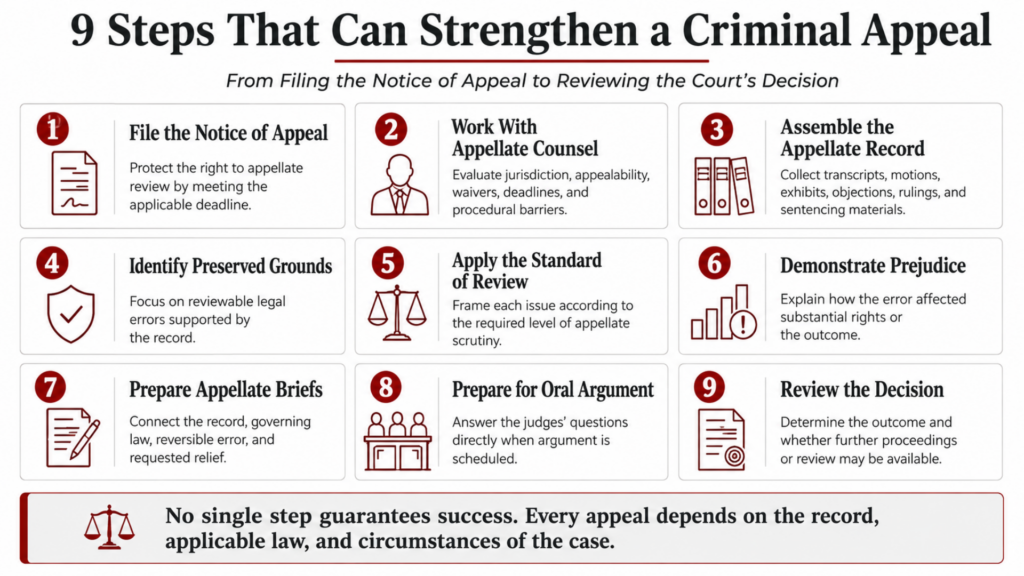
The Criminal Appeal Process: 9 Steps at a Glance
| Step | What Happens | Why It Matters |
|---|---|---|
| 1. File the Notice of Appeal | The appeal is initiated by filing a timely notice of appeal within the applicable deadline. | Preserves the right to appellate review and invokes the appellate court’s jurisdiction. |
| 2. Work With Appellate Counsel | Counsel evaluates appealability, jurisdiction, filing deadlines, preservation issues, and potential procedural barriers. | Helps avoid procedural errors and identifies the strongest issues for appeal. |
| 3. Assemble the Appellate Record | Trial transcripts, motions, exhibits, objections, rulings, and other record materials are compiled and reviewed. | Provides the official record the appellate court will ordinarily rely on when deciding the appeal. |
| 4. Identify Preserved Grounds | Counsel identifies reviewable legal errors that were properly preserved and supported by the record. | Focuses the appeal on viable legal issues rather than factual disagreements or unpreserved claims. |
| 5. Apply the Standard of Review | Each issue is analysed under the applicable standard of review. | Determines the level of deference the appellate court gives to the trial court’s ruling. |
| 6. Demonstrate Prejudice | The appeal explains how the alleged error affected substantial rights or the outcome of the case. | Distinguishes reversible error from harmless error. |
| 7. Prepare Appellate Briefs | The appellant presents the facts, legal authorities, arguments, and requested relief in written briefs. | Written briefs are the primary means of persuading the appellate court. |
| 8. Prepare for Oral Argument | Counsel responds to the judges’ questions if oral argument is scheduled. | Gives the court an opportunity to test the parties’ legal arguments and clarify key issues. |
| 9. Review the Decision and Available Next Steps | The appellate court may affirm, reverse, vacate, modify, remand, or dismiss the appeal. | Determines the outcome of the appeal and whether further proceedings or additional review may be available. |
How To Win a Criminal Appeal: Criminal Appeal Process Stages
Step 1: File a Notice of Appeal as Soon as Possible
The first, and perhaps the most important step, is to file a Notice of Appeal within the applicable deadline. Failing to comply with that deadline can result in the loss of appellate review, regardless of how potentially significant the underlying legal issue may be.
In a federal criminal case, a defendant generally must file the notice in the district court within 14 days after the later of:
- Entry of the judgment or order being appealed; or
- Filing of the government’s Notice of Appeal.
Certain timely post-trial motions, including qualifying motions under Federal Rules of Criminal Procedure 29, 33, or 34, can affect when the federal deadline begins. A federal district court may also grant a limited extension based on excusable neglect or good cause, but relief is not automatic and should never be assumed.
State criminal-appeal deadlines are established by the rules of the applicable jurisdiction. They may differ substantially from the federal deadline, so the governing state rule and the precise triggering judgment or order must be checked immediately.
What Is a Notice of Appeal?
It is a formal, written document that informs the court and the involved parties of the defendant’s intention to appeal the judgment or another appealable order.
The notice is generally filed in the trial court that entered the judgment, even though the appeal will be decided by a higher court. It is usually a relatively short procedural document and does not contain the complete appellate arguments.
Key Tips:
- Retain experienced appellate counsel immediately after conviction or sentencing.
- Ensure that trial transcripts and case records are preserved.
- Obtain and review the written judgment rather than relying only on what was announced orally in court.
- Do not delay filing merely because transcripts have not yet been prepared or counsel has not completed a full merits review.
- Determine whether any post-trial motion changes the applicable deadline.
Step 2: Work With Appellate Counsel and Confirm the Right to Appeal
Criminal trials and criminal appeals require different forms of advocacy. Trial lawyers focus heavily on witnesses, evidence, objections, factual development, and persuading a judge or jury. Appellate lawyers generally work from an existing written record and focus on legal research, standards of review, issue preservation, briefing, and appellate remedies.
This does not mean that trial counsel can never handle an appeal. It means that the attorney responsible for the appeal should have the experience and skills required to evaluate a record-based legal challenge. In some cases, retaining new appellate counsel also provides an independent review of the trial proceedings.
Before proceeding, appellate counsel should determine:
- Whether the judgment or order is appealable
- Which appellate court has jurisdiction
- Whether the appeal is from a conviction, sentence, or separate ruling
- Whether the defendant entered a guilty plea
- Whether the plea agreement contains an appellate waiver
- Whether the proposed issue falls within or outside that waiver
- Whether post-trial motions remain available
- Whether direct appeal or another post-conviction procedure is the appropriate remedy
A guilty plea or appeal waiver may narrow the issues available for review, but it should not be assumed that every possible claim is automatically barred. The language of the agreement, the plea-hearing record, governing law, and the nature of the proposed claim must be reviewed.
Step 3: Assemble and Review the Appellate Record to Identify the Strongest Grounds for Appeal
Now that the notice has been filed, the court begins the process of preparing the appellate record, which is the collection of documents, transcripts, exhibits, and docket materials from the trial-court proceedings.
The record may include:
- Trial transcripts
- Motions, orders, and other filings
- Evidence presented by the prosecution and defense
Depending on the case, a complete review may also require:
- The indictment or superseding indictment
- Plea agreements and plea-hearing transcripts
- Pretrial motions and written responses
- Suppression-hearing transcripts
- Evidentiary rulings
- Trial exhibits
- Jury instructions and verdict forms
- Objections made by trial counsel
- Rule 29, 33, or 34 motions
- The Presentence Investigation Report and written objections
- Sentencing memoranda and the sentencing transcript
- Restitution, forfeiture, or other sentencing orders
- The written judgment
- The trial-court docket sheet
Under the federal appellate rules, the record generally consists of the original papers and exhibits filed in the trial court, the transcript of the proceedings, and a certified copy of the docket entries.
This record is crucial because the appellate court generally cannot consider evidence that was not presented to the trial court.
An appellate court does not ordinarily conduct an independent investigation, hear new witnesses, or accept new evidence during a direct appeal. Its task is to review the legal validity of the lower court’s rulings based on the record that already exists.
Federal Rule of Appellate Procedure 10 permits correction of an appellate record that inaccurately reflects what occurred below, but it is not ordinarily a method for introducing genuinely new evidence. New evidence may require a motion for a new trial or a separate post-conviction proceeding, depending on the circumstances
Step 4: Identify the Strongest Preserved Grounds for Appeal
A criminal appeal is not simply about revisiting the facts or asking a new panel of judges whether it agrees with the verdict. It is about demonstrating that a reviewable legal error occurred.
Common grounds for a criminal appeal may include:
- Procedural or Evidentiary Errors
The trial judge may have made an error in admitting or excluding evidence, deciding a pretrial motion, limiting testimony, handling the jury, or conducting another part of the proceedings.
A successful evidentiary argument generally requires more than showing that the judge could have ruled differently. Counsel must apply the governing standard of review and explain why the ruling was legally erroneous and prejudicial.
- Improper Jury Instructions
A jury may have been given an incorrect statement of the law, an essential instruction may have been omitted, or the instructions may have improperly described the elements of the offense, the government’s burden, or a legally available defense.
Potential issues may include:
- Using or failing to correct materially false testimony
- Improperly withholding evidence
- Making legally improper or prejudicial statements
- Misstating the burden of proof
- Violating a court order
- Engaging in conduct that undermined the fairness of the proceedings
Not every improper statement or action requires reversal. Its effect must be evaluated in the context of the complete record and the applicable standard.
- Insufficient Evidence
A defendant may argue that the evidence was legally insufficient to support one or more essential elements of the offense. This is different from asking the appellate judges to reweigh conflicting evidence or make new credibility determinations.
- Improper Sentencing
The trial court’s sentence may have resulted from a misapplication of the law.
Potential sentencing issues may involve an incorrectly calculated sentencing range, an unlawful enhancement, failure to address a properly raised argument, reliance on impermissible information, an illegal sentence, or another procedural or substantive sentencing error.
- Juror Misconduct or Bias
Possible issues can include undisclosed bias, exposure to outside information, improper communications, or other conduct that affected the defendant’s right to an impartial jury. The claim must be supported by the record or developed through the proper procedural mechanism.
- Constitutional Errors
Potential constitutional issues may involve the right to counsel, confrontation, due process, protection against unreasonable searches and seizures, self-incrimination, or the right to an impartial judge or jury.
- Ineffective Assistance of Counsel
Your trial attorney may have failed to provide constitutionally adequate representation in a way that affected the outcome.
However, ineffective-assistance claims require careful procedural analysis. Such claims often depend on information outside the trial record, such as counsel’s investigation, preparation, advice, or strategic reasoning. The Supreme Court has explained that a collateral proceeding is ordinarily better suited to developing those facts, although an ineffective-assistance claim may sometimes be raised on direct appeal when the alleged deficiency is sufficiently apparent from the existing record.
Why Preservation Matters?
Appellate counsel must determine whether each potential issue was properly preserved in the trial court. Under Federal Rule of Criminal Procedure 51, a party generally preserves an error by informing the court of the requested action or by stating an objection and its grounds when the ruling is made or sought.
The record should therefore be examined for:
- A timely objection
- The specific legal ground stated for the objection
- An adverse ruling
- A motion or request that presented the issue to the trial judge
- Whether the issue was waived, forfeited, or preserved
- Whether the court prevented counsel from making an objection
An unpreserved claim may still be reviewed in limited circumstances, but it usually faces a more demanding standard.
Step 5: Select the Strongest Issues and Apply the Correct Standard of Review
Appellate judges use different standards of review to evaluate different kinds of claimed errors. Knowing the correct standard helps counsel frame a legally effective argument.
The same appeal may involve several standards because each issue must be analyzed separately. Federal appellate briefs are required to identify the applicable standard of review for each issue.
| Standard of Review | General Meaning | Common Application |
|---|---|---|
| De Novo | The appellate court independently reviews a legal question without deferring to the trial court’s legal conclusion. | Statutory interpretation, constitutional questions, and other legal issues. |
| Abuse of Discretion | The trial court is given a permissible range of judgment. Reversal may be warranted when the decision was based on legal error, clearly erroneous facts, or an unreasonable exercise of discretion. | Many evidentiary rulings, trial-management decisions, and discretionary rulings. |
| Clear Error | The appellate court gives substantial deference to the trial judge’s factual findings and reverses only when the required level of error is established. | Judge-made factual findings, including certain suppression and sentencing findings. |
| Sufficiency Review | The court examines whether the evidence, viewed under the governing legal standard, was sufficient to support the conviction. It does not ordinarily retry credibility disputes. | Challenges to whether the prosecution proved every required element. |
| Plain Error | A demanding standard generally used when the issue was not properly preserved in the trial court. | Claims raised without a timely objection or motion. |
Although some important appellate issues are reviewed de novo, criminal appeals frequently involve evidentiary rulings, factual findings, sentencing decisions, preservation problems, and mixed questions governed by more deferential standards.
De novo review also does not automatically produce reversal. Even when the appellate court independently concludes that an error occurred, the court may still ask whether the error was harmless or whether it affected substantial rights.
Why Focusing on Fewer Issues Can Strengthen an Appeal?
A lengthy record may reveal numerous potential complaints, but raising every conceivable issue can weaken the presentation of the strongest claims. Appellate counsel should ordinarily prioritize issues that:
- Are clearly supported by the record
- Were properly preserved or remain reviewable
- Are supported by governing precedent
- Involve a material legal error
- Can be connected to actual prejudice
- Permit a meaningful and legally available remedy
A focused brief allows the court to understand why the most important errors, not merely the largest number of alleged errors, justify appellate relief.
Step 6: Demonstrate Prejudice and Address Harmless Error
Proving that an error occurred is often only part of the appellate analysis. The appellant must also address whether the error affected substantial rights or had the legally required effect on the proceedings.
Federal Rule of Criminal Procedure 52 provides:
- A harmless error that does not affect substantial rights must be disregarded.
- A plain error affecting substantial rights may be considered even though it was not brought to the trial court’s attention.
The precise burden and test can depend on the type of error, whether it was preserved, whether it was constitutional or nonconstitutional, and the law of the relevant jurisdiction.
A persuasive appellate argument should explain:
- What error occurred
- Where the error appears in the record
- Which legal rule was violated
- Which standard of review applies
- How the error affected the verdict, sentence, or substantial rights
- Why the error cannot properly be treated as harmless
- What relief the appellate court has authority to order
For example, it may not be enough to establish that evidence was admitted incorrectly. The appeal should explain how that evidence affected a contested issue, why the remaining evidence did not eliminate the prejudice, and why the mistake justifies the requested remedy.
Similarly, an unpreserved claim reviewed for plain error generally faces additional requirements beyond showing an ordinary legal mistake. That is why preservation and prejudice should be considered together rather than treated as separate technicalities.
Step 7: Prepare and File a Persuasive Appellate Brief
The appellate brief is the foundation of most criminal appeals. In many cases, the appellate court decides the appeal primarily based on the written briefs and the trial court record, making clear, well-supported legal arguments essential to obtaining appellate relief.
The appellant’s opening brief should explain:
- The appellate court’s jurisdiction
- The issues presented for review
- The relevant procedural history
- The material facts, supported by record citations
- The applicable standard of review for each issue
- The governing statutes, constitutional provisions, rules, and precedent
- What the trial court decided
- Why that ruling was erroneous
- How the issue was preserved
- Why the error was prejudicial rather than harmless
- The precise relief requested
Federal Rule of Appellate Procedure 28 identifies the required components of a federal appellate brief, including the issues presented, case history, statement of facts, summary of the argument, standard of review, legal argument, citations to the record and authorities, and the relief requested.
What Makes an Appellate Brief Persuasive?
A persuasive appellate brief does not simply argue that the trial was unfair or that the outcome was incorrect. Instead, it demonstrates that a reviewable legal error occurred, explains why that error warrants appellate relief, and supports every argument with the trial court record and controlling legal authority.
A strong appellate brief typically connects four essential elements:
Record → Governing Law → Reversible Error → Available Relief
The factual presentation should be accurate and supported by citations to the official record. The legal argument should address the controlling statutes, rules, constitutional provisions, and precedent, while also explaining issue preservation, the applicable standard of review, and why any error was prejudicial rather than harmless.
The brief should also request a remedy that the appellate court is legally authorized to grant. Depending on the circumstances, that may include reversal, vacatur, a new trial, resentencing, modification, dismissal of a count where legally appropriate, or remand for further proceedings.
Response and Reply Briefs
After the appellant files the opening brief, the appellee (typically the government in a criminal appeal) files a response brief defending the judgment. The appellant may then file a reply brief addressing the appellee’s principal arguments.
A reply brief should not simply repeat the opening brief. Instead, it should respond to issues raised in the response brief, such as waiver, issue preservation, the applicable standard of review, harmless error, interpretation of the record, controlling precedent, and the appropriate remedy.
In federal criminal appeals, Federal Rule of Appellate Procedure 31 establishes the default briefing schedule, although a circuit court’s local rules or case-specific scheduling order may set different deadlines. Failure to file the appellant’s opening brief within the applicable deadline may result in dismissal of the appeal.
Step 8: Prepare for Oral Argument When Scheduled
Not every criminal appeal includes oral argument. Many appeals are decided solely on the written briefs and the trial court record. However, when oral argument is scheduled, it gives appellate counsel an opportunity to answer the judges’ questions, clarify legal issues, and address concerns raised by the record or the parties’ briefs.
Oral argument is not:
- A new trial
- An opportunity to call witnesses
- A chance to introduce new evidence
- A repetition of the written briefs
- A prepared speech that ignores the judges’ questions
NOTE – Under Federal Rule of Appellate Procedure 34, a three-judge panel may unanimously decide that oral argument is unnecessary if the appeal is frivolous, the controlling legal issues have already been authoritatively decided, or the briefs and record adequately present the issues and oral argument would not significantly assist the court.
Because oral argument is not guaranteed, every significant legal argument should be fully developed in the written briefs. Counsel should never rely on oral argument to cure an incomplete or inadequately supported brief.
When oral argument is scheduled, effective appellate counsel should:
- Know the trial court record and controlling legal authority thoroughly.
- Answer the judges’ questions directly and concisely.
- Explain how the applicable standard of review supports the appeal.
- Address preservation, jurisdiction, and harmless-error issues when relevant.
- Acknowledge weaknesses in the case while explaining why they do not defeat the appeal.
- Clearly explain the specific relief being requested and its legal basis.
- Avoid raising new arguments that were not properly presented in the written briefs.
Step 9: Review the Court’s Decision and Understand the Possible Outcomes
After the parties have filed their briefs and any oral argument has concluded, the appellate court considers the case and issues its decision. There is no fixed deadline for an appellate ruling. Depending on the complexity of the case, the size of the record, and the court’s workload, a decision may take several months or longer.
The appellate court may issue a written opinion or an order explaining its decision. Possible outcomes include:
- Affirmance – The appellate court upholds the conviction, sentence, or ruling.
- Reversal – The court overturns all or part of the lower court’s decision. Depending on the circumstances, the case may proceed to a new trial or other proceedings.
- Remand – The case is returned to the trial court for further action, such as applying the correct legal standard, conducting a new sentencing hearing, making additional factual findings, or holding a new trial.
- Vacatur – The appellate court sets aside the challenged conviction, sentence, or order, often with instructions for further proceedings.
- Modification – The court changes part of the judgment or sentence without requiring an entirely new proceeding.
- Dismissal – The appeal is dismissed for procedural, jurisdictional, or other legal reasons without granting the requested relief.
- Mixed outcome – The court may affirm some parts of the judgment while reversing, vacating, modifying, or remanding others. For example, it may uphold the conviction but vacate the sentence for resentencing.
What Happens After a Criminal Appeal Is Decided?
Once the appellate court issues its decision, the case may end or continue depending on the relief granted and the applicable procedural rules. If further review is available, a party may seek panel rehearing, rehearing en banc (where permitted), review by the state’s highest court, or file a petition for a writ of certiorari with the U.S. Supreme Court. These forms of review are generally discretionary, subject to strict filing deadlines, and granted only in limited circumstances.
A successful criminal appeal should be measured by the relief obtained rather than solely by whether the conviction is completely reversed. Depending on the appellate court’s ruling, meaningful relief may include a new trial, resentencing, vacatur of a conviction or sentence, modification of the judgment, or a remand for further proceedings.
Summing Up
Winning a criminal appeal is challenging, but success depends on far more than the overall reversal rate. A strong appeal requires identifying a reviewable legal error, preserving the issue in the trial court, building a complete appellate record, applying the correct standard of review, and presenting persuasive legal arguments supported by the record and governing law. No single step guarantees success, as every appeal depends on the specific facts, procedural history, jurisdiction, and applicable legal standards.
Brownstone Law focuses exclusively on appellate litigation and represents clients in federal and state criminal appeals. The firm’s appellate attorneys review trial court records, identify viable grounds for appeal, prepare persuasive appellate briefs, and advocate for clients at every stage of the appellate process.
If you are considering a criminal appeal, don’t wait. Appellate deadlines are often short and strictly enforced.
Contact Brownstone Law today to discuss your case, review your appellate options, and determine whether viable grounds for appeal or post-conviction relief may be available.
Frequently Asked Questions (FAQs)
Q1. What Percentage of Criminal Appeals Are Successful?
Only 7.5% of federal criminal appeals decided on the merits resulted in a reversal during the 12-month period ending September 30, 2025, according to the Administrative Office of the U.S. Courts. However, a successful criminal appeal is not limited to a reversal and may also result in a remand, resentencing, vacatur, modification, or other meaningful appellate relief.
Whether a criminal appeal is considered successful depends on the relief granted by the appellate court. Depending on the legal issues raised and the court’s decision, a successful outcome may include:
- Complete or partial reversal of the conviction or sentence.
- Vacatur of the conviction, sentence, or another challenged order.
- Remand for a new trial, resentencing, or further proceedings.
- Modification of part of the judgment while affirming the remainder.
Because every criminal appeal depends on the trial court record, the legal issues presented, the applicable standard of review, and the governing law, appellate statistics provide general context but cannot predict the outcome of any individual case.
Q2. Why do criminal appeals rarely succeed?
Criminal appeals rarely succeed because they focus on legal errors rather than general disagreement with the verdict. Appellate courts also apply standards of review that may give substantial deference to the trial court.
In addition, an appeal may fail because the issue was not properly preserved, the record does not support the claim, controlling precedent forecloses the argument, an appellate waiver applies, or the alleged error is considered harmless.
Q3. What Are Strong Grounds for a Criminal Appeal?
Strong grounds for a criminal appeal generally involve a significant legal or procedural error that affected the outcome of the case. Common grounds include:
- Incorrect jury instructions.
- Improper admission or exclusion of important evidence.
- Legally insufficient evidence to support the conviction.
- Constitutional violations, such as denial of the right to counsel or due process.
- Prosecutorial misconduct.
- Juror bias or juror misconduct.
- An unlawful or procedurally defective sentence.
- A properly preserved procedural or legal error.
- Ineffective assistance of counsel, when reviewable through the appropriate appellate or post-conviction procedure.
The strongest appellate issues are those supported by the trial court record, preserved for review, governed by favorable legal authority, reviewed under an appropriate standard of review, and significant enough to justify a remedy such as reversal, vacatur, remand, resentencing, or a new trial.
Q4. How Long Do You Have to File a Criminal Appeal?
In a federal criminal case, a defendant generally has 14 days to file a notice of appeal after the applicable triggering event under Federal Rule of Appellate Procedure 4(b). State criminal appeal deadlines vary by jurisdiction and may be longer or shorter than the federal deadline.
Certain timely post-trial motions may affect when the filing period begins. Because appeal deadlines are strictly enforced and missing them can forfeit the right to appellate review, the applicable deadline should be determined as soon as the judgment or sentencing order is entered.
Q5. What Are the Three Main Outcomes of an Appeal?
The three main outcomes of an appeal are:
- Affirmance – The appellate court upholds the lower court’s judgment, conviction, or sentence.
- Reversal or Vacatur – The appellate court overturns or sets aside all or part of the challenged judgment because it identifies a reversible legal error.
- Remand – The appellate court returns the case to the lower court for further proceedings, such as a new trial, resentencing, additional factual findings, or application of the correct legal standard.
Depending on the circumstances, an appellate court may also modify part of the judgment, dismiss the appeal, or issue a mixed decision that affirms some issues while reversing, vacating, or remanding others.
Q6. Can New Evidence Be Used in a Criminal Appeal?
Generally, no. A direct criminal appeal is decided using the existing trial court record, and appellate courts ordinarily do not consider new evidence or hear new witness testimony.
However, limited exceptions may apply. Depending on the jurisdiction and the nature of the evidence, newly discovered evidence may be raised through a motion for a new trial or another post-conviction proceeding rather than on direct appeal. In some circumstances, appellate courts may also permit correction or supplementation of the record to accurately reflect what occurred in the trial court, but this is not a procedure for introducing genuinely new evidence.
As a general rule, criminal appeals focus on whether the trial court committed a legal or procedural error based on the record already before it, rather than on evidence discovered after the trial.
Q7. Can a Criminal Appeal Reduce a Prison Sentence?
Yes. A criminal appeal can reduce a prison sentence if the appellate court determines that the trial court made a reversible sentencing error. Rather than overturning the conviction, the appellate court may vacate the sentence and remand the case for resentencing under the correct legal standards.
Whether a sentence is ultimately reduced depends on the nature of the error, the appellate court’s instructions, and the outcome of the resentencing proceedings in the trial court.
Trial Transcript – A trial transcript is the official written record of courtroom proceedings, including testimony, objections, and judicial rulings.
Evidentiary Ruling – An evidentiary ruling is a trial court’s decision to admit or exclude evidence during legal proceedings.
Abuse of Discretion – Abuse of discretion occurs when a trial court makes a decision outside the range of reasonable judicial choices or applies the wrong legal standard.
Burden of Proof – The burden of proof is the legal obligation to establish a fact or claim according to the applicable evidentiary standard.
Sentencing Error – A sentencing error occurs when a court imposes a sentence contrary to law or fails to follow required sentencing procedures.
Plea Agreement – A plea agreement is a negotiated agreement in which a defendant pleads guilty in exchange for specified concessions from the prosecution.
Appeal Waiver – An appeal waiver is a provision in a plea agreement in which a defendant agrees to limit or waive certain appellate rights, subject to applicable law.
Prosecutorial Misconduct – Prosecutorial misconduct refers to improper actions by a prosecutor that may violate a defendant’s right to a fair trial, such as withholding exculpatory evidence or making improper arguments.