
Key Takeaways
|
An appeal can be successful when an appellate court determines that a significant legal or procedural error affected the outcome of the case. Whether an appeal succeeds depends on the legal issues raised, the trial court record, the applicable standard of review, and whether the appellate court finds reversible error.
According to the Administrative Office of the U.S. Courts, 7.9% of federal appellate cases decided on the merits during the 12-month period ending September 30, 2025, resulted in a reversal. The reported reversal rate was 7.5% for criminal appeals and 11.5% for other private civil appeals.
NOTE – These figures should be interpreted carefully. They reflect only appeals in which the appellate court reached a decision on the legal merits and do not represent every possible favorable appellate outcome. Many appeals are dismissed for procedural reasons, voluntarily withdrawn, or resolved through outcomes other than a complete reversal. The reported statistics also exclude cases decided by the U.S. Court of Appeals for the Federal Circuit.
While reversal statistics provide useful context, they cannot predict the outcome of any individual appeal. Every appeal is decided on its own legal issues, the applicable law, the trial court record, and the standard of review applied by the appellate court.
What Counts as a Successful Appeal?
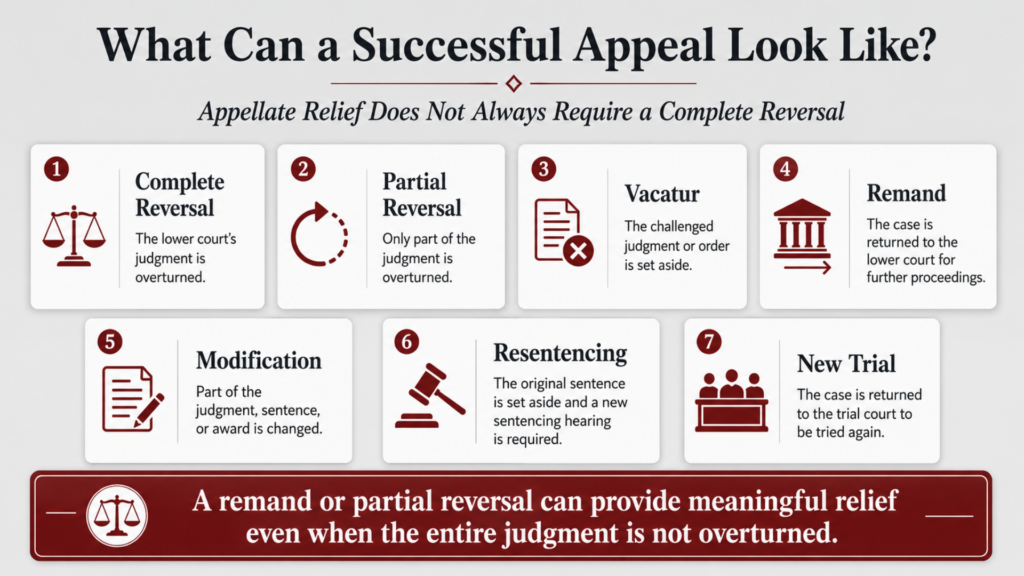
Not every successful appeal results in a complete reversal of the lower court’s decision. In appellate practice, a favorable outcome may include any decision that grants meaningful legal relief, even if the judgment is not entirely overturned. Depending on the issues raised on appeal, the appellate court may reverse all or part of the judgment, vacate an order, modify the judgment, remand the case for further proceedings, or order a new trial or a new sentencing hearing.
| Appellate Outcome | What It Means | May Be Considered a Successful Outcome? |
|---|---|---|
| Complete reversal | The lower court’s judgment is overturned. | Yes |
| Partial reversal | Part of the judgment is overturned while the remainder stays in effect. | Yes |
| Vacatur | The appellate court sets aside the judgment or order. | Yes |
| Remand | The case is returned to the lower court for additional proceedings consistent with the appellate court’s ruling. | Often |
| Modification | The appellate court changes part of the judgment, sentence, or award. | Yes |
| New sentencing hearing (Resentencing) | The original sentence is set aside, and the trial court must impose a new sentence. | Yes |
| New trial | The appellate court orders the case to be tried again. | Yes |
| Affirmance | The appellate court upholds the lower court’s judgment. | Generally No |
| Dismissal of the appeal | The appellate court dismisses the appeal without granting the requested relief. | Generally No |
A remand can be a significant victory even though the appellate court does not finally resolve every issue in the case.
For example, the appellate court may instruct the trial court to conduct a new sentencing hearing, apply the correct legal standard, reconsider certain evidence, or make additional factual findings before entering a new decision.
Even when an appeal is successful, the appellate court may not immediately change the final outcome of the case. Instead, it may order additional proceedings, such as a new trial, a new sentencing hearing, or reconsideration by the lower court under the correct legal standard. The ultimate result depends on the appellate court’s instructions and the proceedings that follow in the lower court.
What Does an Appeal Do (and Doesn’t Do)?
An appeal is not a second trial. Instead, it is a legal process in which an appellate court reviews the trial court’s decision to determine whether a reviewable legal error affected the outcome of the case. In most appeals, the court relies on the existing trial court record rather than hearing new testimony or considering new evidence.
The appellate court reviews the issues raised by the parties, applies the appropriate standard of review, and determines whether the lower court correctly interpreted and applied the law. Depending on the circumstances, the court may affirm, reverse, vacate, modify, or remand the case for further proceedings.
| An Appeal May | An Appeal Ordinarily Does Not |
|---|---|
| Review whether the trial court correctly applied the law. | Conduct a completely new trial. |
| Review legal, procedural, constitutional, evidentiary, or sentencing errors. | Hear witnesses testify again. |
| Review jury instructions and certain evidentiary rulings. | Allow parties to introduce new evidence simply because it supports their position. |
| Review whether legally sufficient evidence supports the judgment under the applicable standard. | Reweigh witness credibility or retry disputed facts. |
| Review the existing trial court record. | Use a new jury. |
| Affirm, reverse, vacate, modify, or remand the case. | Automatically overturn a verdict or change a sentence. |
Information that does not appear in the trial court record is generally difficult and in many cases impossible to introduce for the first time on a direct appeal. For that reason, appellate courts ordinarily decide appeals based on the record created in the lower court and the legal arguments presented by the parties.
Who Can Appeal a Court Decision?
The right to appeal depends on the type of case, the applicable law, and whether the party seeking review is legally entitled to challenge the decision. In both civil and criminal cases, the party that receives an unfavorable judgment is generally the one that files an appeal.
In criminal cases, a defendant who has been convicted may generally appeal the conviction, the sentence, or both, subject to applicable procedural rules. Prosecutors may appeal certain legal rulings or sentencing issues where authorized by law, but constitutional protections, such as the prohibition against double jeopardy, generally prevent the government from appealing a jury’s not guilty verdict.
In civil cases, either party may usually appeal a final judgment or another appealable order if they believe the trial court committed a reversible legal error. Whether an order may be appealed immediately depends on the governing appellate rules and the jurisdiction.
Because appeal rights vary by jurisdiction and case type, determining whether a judgment or order is appealable is often one of the first steps in evaluating a potential appeal.
What Grounds Can Lead to a Successful Appeal?
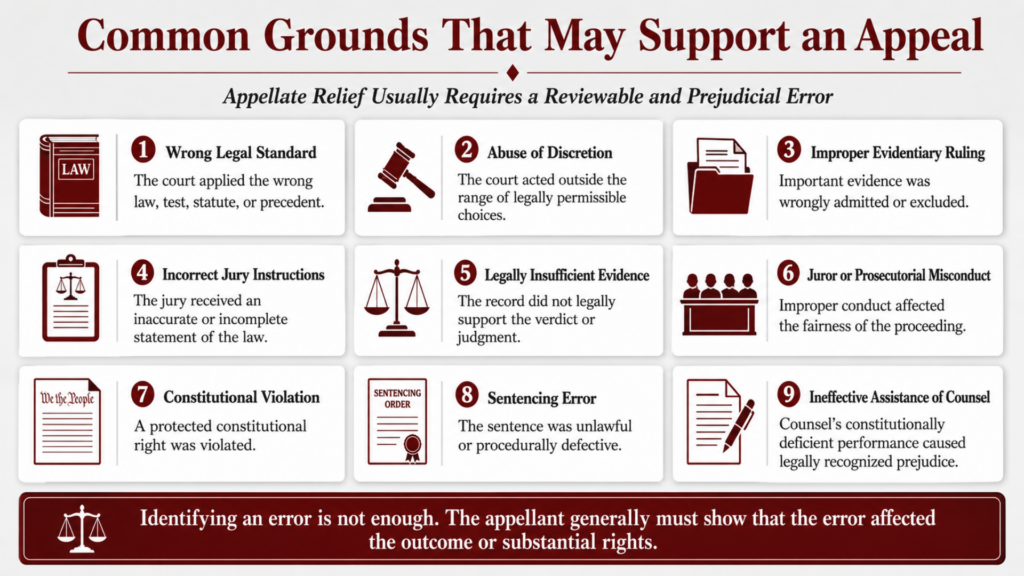
A successful appeal is generally based on a reviewable legal error rather than simply disagreeing with the trial court’s decision. While every appeal is decided on its own facts, applicable law, and the standard of review, certain legal errors appear more frequently than others in cases where appellate courts grant relief.
Some of the most common grounds that may lead to a successful appeal include:
- Legally incorrect jury instructions
- Improper admission or exclusion of important evidence
- Legally insufficient evidence
- Juror or prosecutorial misconduct
- Application of the wrong legal standard
- Abuse of judicial discretion
- Constitutional violations
- Unlawful or procedurally defective sentencing
- Ineffective assistance of counsel (when properly raised and established)
No particular ground guarantees reversal or other appellate relief. The alleged error must generally be preserved in the trial court, supported by the appellate record, reviewed under the applicable standard of review, and significant enough to have affected the outcome of the case.
1. The Court Applied the Wrong Law
An appellate court may grant relief when the trial court applies the wrong statute, legal standard, or controlling precedent. Legal errors may also occur if the court uses the wrong burden of proof, applies an incorrect constitutional test, misinterprets a contract, or exceeds the scope of its legal authority.
Because questions of law are often reviewed de novo, the appellate court generally considers the legal issue independently rather than deferring to the trial court’s legal conclusions.
2. The Court Abused Its Discretion
Trial judges have discretion over many procedural, evidentiary, discovery, and sentencing decisions. However, that discretion is not unlimited.
An abuse-of-discretion claim generally argues that the trial court relied on improper considerations, ignored required legal factors, applied an incorrect legal standard, or reached a decision that fell outside the range of reasonable judicial choices. Simply disagreeing with the judge’s decision is usually not enough to obtain appellate relief.
3. Evidence Was Improperly Admitted or Excluded
Appellate courts may review whether the trial court improperly admitted evidence that should have been excluded or excluded evidence that should have been admitted.
To obtain relief, the appellant must generally show that the evidentiary ruling affected the fairness of the proceedings or the outcome of the case. Errors that do not affect the result may be treated as harmless error and may not justify reversal.
4. The Jury Received Incorrect Instructions
Jury instructions explain the law jurors must apply when deciding a case. Incorrect instructions may create a valid appellate issue when they:
- Misstate the governing law
- Omit an essential legal element
- Incorrectly shift the burden of proof
- Prevent the jury from considering a legally supported defense
- Incorrectly define a civil claim or criminal offense
Appellate courts evaluate jury instructions in the context of the entire trial record rather than focusing on isolated statements.
5. The Evidence Was Legally Insufficient
An appellant may argue that the evidence presented at trial was legally insufficient to support the verdict, conviction, or judgment under the applicable legal standard.
This differs from asking the appellate court to decide which witnesses were more credible or how the evidence should have been weighed. Instead, the court determines whether the evidence was legally sufficient to support the result reached by the trial court.
6. Juror or Prosecutorial Misconduct
Certain forms of juror or prosecutorial misconduct may also support appellate relief if they affected the fairness of the proceedings.
Examples may include juror bias, improper outside influence on jurors, withholding exculpatory evidence where legally required, improper comments during trial, or prosecutorial conduct that deprived the defendant of a fair trial. Whether such misconduct warrants reversal depends on the record, the applicable legal standards, and whether the error prejudiced the outcome.
7. A Constitutional Right Was Violated
Some appeals involve alleged violations of constitutional rights that affected the fairness or legality of the proceedings. Depending on the circumstances, these issues may involve:
- Due process
- The right to counsel
- Unlawful searches and seizures
- The privilege against self-incrimination
- Confrontation rights
- Equal protection
- Freedom of speech
- Improper burden shifting
Whether appellate relief is available depends on the constitutional issue involved, the appellate record, preservation of the issue, the applicable standard of review, and whether the violation prejudiced the appellant.
8. The Sentence Was Unlawful or Procedurally Defective
Appeals may challenge sentencing decisions when the trial court:
- Miscalculates the applicable sentencing guidelines or range
- Imposes a sentence not authorized by law
- Relies on impermissible factors during sentencing
- Misunderstands the scope of its sentencing authority
- Fails to follow required sentencing procedures
- Does not adequately explain the sentence imposed
- Enters an unlawful restitution or forfeiture order
A successful sentencing appeal does not necessarily overturn the underlying conviction. Instead, it may result in the appellate court ordering a new sentencing hearing (resentencing) or other appropriate relief.
9. Ineffective Assistance of Counsel (When Properly Raised)
Claims of ineffective assistance of counsel do not automatically result in a successful appeal. To succeed, the appellant generally must establish that counsel’s performance was constitutionally deficient and that the deficiency caused legally recognized prejudice.
Depending on the jurisdiction and the nature of the claim, some ineffective-assistance claims may be reviewed on direct appeal, while others rely on evidence outside the trial record and must be raised through a separate post-conviction proceeding rather than a direct appeal.
NOTE – Even when an appellant identifies one of these issues, obtaining appellate relief is not automatic. Many appeals are unsuccessful because the alleged error is not reversible, was not properly preserved, or does not satisfy the applicable standard of review.
Why Do Many Appeals Fail?
Most appeals are unsuccessful because appellate courts do not reconsider every trial court decision from the beginning. Instead, they review only certain legal errors under established appellate standards. If the alleged error was harmless, not properly preserved, unsupported by the record, or insufficient to justify appellate relief, the court will generally affirm the lower court’s decision.
1. The Trial Court Did Not Commit a Reversible Error
Not every mistake made during a trial provides grounds for appellate relief. An appellate court generally will not reverse a judgment simply because it might have reached a different conclusion. Instead, the appellant must identify a reviewable legal, procedural, constitutional, evidentiary, or sentencing error that affected the outcome of the case.
2. The Error Was Considered Harmless
Even if the appellate court determines that the trial court made a mistake, it may still affirm the judgment if the error did not affect the appellant’s substantial rights or influence the outcome of the proceedings. For this reason, appellants generally must show both that an error occurred and that it caused meaningful legal prejudice.
3. The Appeal Challenges the Facts Rather Than the Law
An appeal is not an opportunity to retry the case or ask appellate judges to decide which witnesses were more believable. Appellate courts generally review whether the law was applied correctly rather than reweighing evidence or reassessing witness credibility. Challenges based primarily on factual findings often receive substantial deference.
The Issue Was Not Properly Preserved
Many appellate issues must first be raised in the trial court through a timely objection, motion, or other procedural step. If an issue was not properly preserved, the appellate court may:
- Decline to review the issue altogether
- Treat the issue as waived or forfeited
- Apply a more demanding standard of review, such as plain-error review
- Require the claim to be raised in a separate post-conviction proceeding, where permitted
5. The Trial Court Record Does Not Support the Claim
Direct appeals are generally decided using the record created in the lower court. If the alleged error does not appear in the transcripts, pleadings, exhibits, orders, or other parts of the appellate record, the court may be unable to consider the argument on direct appeal.
6. The Applicable Standard of Review Is Highly Deferential
The standard of review plays an important role in every appeal because it determines how closely the appellate court examines the trial court’s decision. Some legal issues allow the appellate court to review the matter independently, while others require the court to give considerable deference to the trial judge’s findings or discretionary decisions.
As a result, two appeals raising similar legal issues may have very different chances of success depending on the applicable standard of review. In general, appeals involving issues that receive less deference are often easier to challenge than those involving factual findings or discretionary rulings, which appellate courts are generally reluctant to overturn.
7. The Appeal Focuses on Too Many Weak Arguments
Presenting every possible disagreement with the trial court rarely strengthens an appeal. Effective appellate advocacy usually focuses on the strongest legal issues that are supported by the record and most likely to satisfy the applicable standard of review.
Rather than raising numerous weak arguments, experienced appellate counsel typically concentrates on issues that can demonstrate:
- A significant legal or procedural error
- A favorable standard of review
- Meaningful prejudice resulting from the error
- A legally available form of appellate relief
How to Win an Appeal in Court?
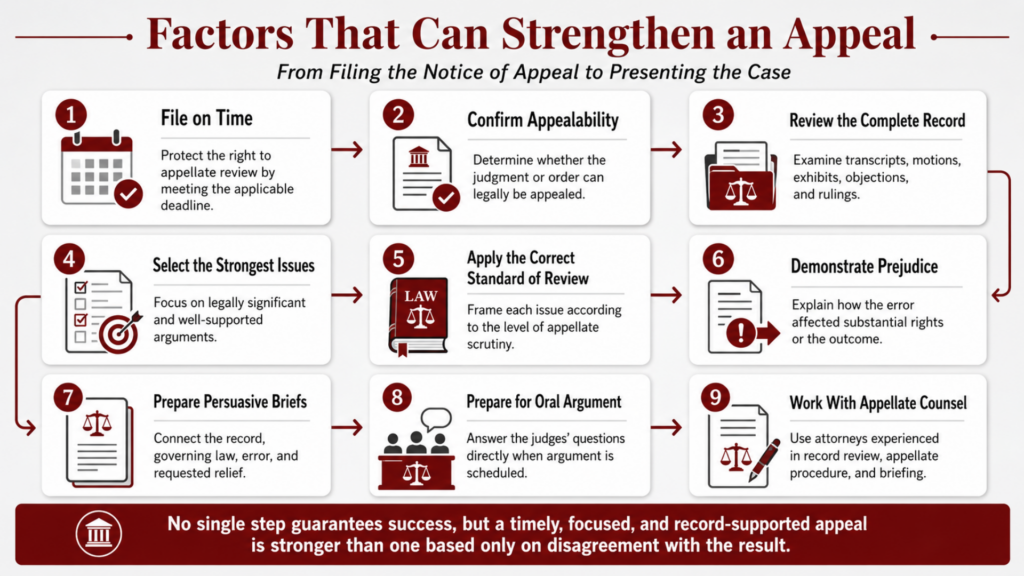
To improve the chances of winning an appeal in court, the appellant must identify a reversible legal or procedural error supported by the trial court record and present persuasive legal arguments under the applicable standard of review. Because appellate courts review legal issues rather than conduct a new trial, the strength of the record, the applicable law, and the quality of the appellate advocacy are often decisive factors.
The following steps can help strengthen an appeal and improve the likelihood of obtaining appellate relief.
| Factor | Why It Matters | What a Strong Appeal Should Show |
|---|---|---|
| Timely filing | A late notice of appeal may eliminate the right to appellate review. | The appeal was initiated within the applicable deadline. |
| Appellate jurisdiction | Not every ruling can be appealed immediately. | The challenged judgment or order is legally appealable. |
| Complete record | Appellate courts generally rely on what appears in the trial court record. | The relevant transcripts, exhibits, motions, objections, and rulings are included. |
| Strong issue selection | Weak or repetitive arguments can distract from stronger claims. | The brief focuses on the most legally significant errors. |
| Correct standard of review | The level of deference varies according to the issue. | Each argument is framed under the appropriate standard. |
| Demonstrated prejudice | Not every error justifies reversal. | The appellant explains how the error affected substantial rights or the outcome. |
| Persuasive briefing | Written briefs are the primary method of appellate advocacy. | The facts, law, error, prejudice, and requested relief are clearly connected. |
| Appropriate remedy | The court must have authority to grant the relief requested. | The requested outcome matches the identified error. |
1. File the Appeal Within the Required Deadline
Appellate deadlines are strictly enforced. Failing to file a timely notice of appeal may permanently forfeit the right to appellate review, even when the case presents a potentially strong legal issue.
The applicable deadline may depend on:
- Whether the case is civil or criminal
- Whether it is pending in state or federal court
- The type of judgment or order being challenged
- Whether a qualifying post-trial motion was filed
- Whether the government is a party
- Whether an extension is permitted under the applicable rules
Because the deadline may begin running when the judgment or order is entered, a party considering an appeal should consult appellate counsel as soon as possible.
2. Confirm That the Judgment or Order Is Appealable
Not every trial court ruling may be appealed immediately.
Most appeals are taken from a final judgment that resolves the case. However, certain interlocutory or non-final orders may also qualify for immediate review under an applicable statute, court rule, or appellate doctrine.
Before filing, appellate counsel should determine:
- Whether the order is final
- Whether an exception permits an immediate appeal
- Which appellate court has jurisdiction
- Whether another form of review is required
- Whether the notice of appeal must identify a particular judgment or order
An appeal may be dismissed without reaching the merits if the appellate court lacks jurisdiction.
3. Conduct a Thorough Review of the Trial Court Record
A strong appeal begins with a detailed review of the record created in the lower court.
Appellate counsel will typically examine:
- Pleadings and motions
- Written court orders
- Hearing and trial transcripts
- Admitted exhibits
- Evidentiary objections and rulings
- Jury instructions and verdict forms
- Sentencing submissions
- Post-trial motions
- The final judgment
The purpose is not merely to locate every possible mistake. It is to identify errors that are legally reviewable, supported by the record, properly preserved, and serious enough to justify appellate relief.
Because appellate courts generally do not consider new evidence, the contents of the trial court record can significantly affect which arguments are available on appeal.
4. Focus on the Strongest Appellate Issues
One of the most important parts of appellate advocacy is deciding which issues to raise.
An appeal is not necessarily stronger because it includes more arguments. Raising numerous weak, repetitive, or poorly preserved claims may distract from the issues most likely to receive serious consideration.
A well-developed appellate argument should explain:
- What the lower court decided
- Which legal rule or controlling authority applied
- How the lower court departed from that rule
- Which standard of review governs the issue
- Why the error was not harmless
- What relief the appellate court should grant
A focused appeal allows the court to understand the central legal problem and its effect on the judgment.
5. Apply the Correct Standard of Review
Every appellate issue is reviewed under a particular standard of review. This standard determines how closely the appellate court examines the lower court’s ruling and how much deference it gives to that decision.
A persuasive appellate brief should identify the correct standard of review for each issue and frame the argument accordingly. A question of law, factual finding, discretionary ruling, and unpreserved error may each be reviewed differently.
Simply stating that the lower court was wrong is not enough. The appellant must explain why the ruling fails under the standard that governs that specific issue.
6. Explain Why the Error Was Prejudicial
Not every legal or procedural error requires reversal.
An appellate court may conclude that an error occurred but still affirm the judgment because the mistake was harmless. The appellant must therefore explain why the error affected substantial rights, undermined the fairness of the proceeding, or could have changed the outcome.
A strong prejudice analysis connects the error to the result. For example, it may show that:
- Improperly admitted evidence influenced the verdict
- A faulty jury instruction misstated an essential legal requirement
- The court applied the wrong sentencing rule
- Excluded evidence prevented the party from presenting a legally supported claim or defense
- The use of an incorrect legal standard affected the court’s decision
Showing an error is only part of the argument. The appellant must also explain why the error justifies appellate relief.
7. Prepare a Persuasive Appellate Brief
In most appeals, the written briefs are the primary means of persuading the court.
A well-prepared opening brief should clearly present:
- The relevant facts and procedural history
- The issues presented for review
- The applicable standard of review
- The controlling statutes, rules, and precedent
- The lower court’s alleged error
- The prejudicial effect of that error
- The precise relief requested
The brief should be accurate, focused, supported by the record, and organized so that the judges can follow the argument efficiently.
The requested remedy should also match the error. Depending on the case, the appellant may seek:
- Reversal
- Partial reversal
- Vacatur
- Modification
- A new trial
- Resentencing
- Recalculation of damages
- Additional factual findings
- Remand under the correct legal standard
- Dismissal when legally authorized
8. Prepare for Oral Argument When Scheduled
Not every appeal includes oral argument. Many appellate courts decide cases solely on the written briefs and record.
When oral argument is scheduled, counsel should be prepared to:
- Answer the judges’ questions directly
- Address weaknesses in the appeal
- Explain the applicable standard of review
- Distinguish unfavorable precedent
- Clarify why the error was prejudicial
- Identify the exact relief requested
Oral argument is generally not an opportunity to repeat the entire brief. It is a focused exchange in which the judges test the parties’ legal positions and the practical consequences of the requested decision.
9. Work With an Experienced Appellate Attorney
Appellate litigation differs substantially from trial practice. It requires detailed knowledge of appellate jurisdiction, preservation rules, standards of review, record analysis, legal research, written advocacy, and appellate remedies.
An experienced appellate attorney can:
- Determine whether the judgment or order is appealable
- Calculate and protect filing deadlines
- Review the complete trial court record
- Identify preserved and potentially reversible errors
- Select the strongest appellate issues
- Prepare persuasive written briefs
- Present oral argument when scheduled
- Evaluate rehearing or further review after the decision
Brownstone Law focuses on appellate litigation and represents clients in state and federal appellate courts. The firm’s appellate attorneys review trial court records, identify viable grounds for appeal, prepare detailed appellate briefs, and advocate for clients throughout each stage of the appellate process.
Conclusion
Appeal success rates provide useful general context, but they cannot determine the strength or likely outcome of an individual case. A successful appeal does not always mean that the entire judgment is overturned. Depending on the issues raised, the appellate court may order a reversal, vacatur, modification, resentencing, a new trial, or further proceedings in the lower court.
The strength of an appeal depends on whether the record contains a significant and reviewable legal error, whether the issue was properly preserved, which standard of review applies, and whether the error affected the outcome of the case. Careful issue selection, detailed record analysis, and persuasive appellate briefing can therefore be more important than general reversal statistics.
Because appeal deadlines are often strict, anyone considering an appeal should have the judgment and trial court record reviewed as early as possible to determine whether viable grounds for appellate relief may exist.
Frequently Asked Questions (FAQs)
Q1. What is the purpose of the Court of Appeals?
The primary purpose of a Court of Appeals is to review whether a lower court made legal or procedural errors that may have affected the outcome of a case. Unlike a trial court, an appellate court does not hear new witnesses, accept new evidence, or conduct a new trial. Instead, it reviews the existing trial court record, the parties’ written appellate briefs and, in some cases, oral arguments to determine whether the law was correctly applied.
A Court of Appeals helps ensure that court decisions are legally correct, consistent with established precedent and reached through a fair judicial process. Depending on its findings, the appellate court may:
- Affirm the lower court’s decision, leaving the judgment unchanged.
- Reverse the decision if a significant legal error affected the outcome.
- Modify part of the judgment when appropriate.
- Remand the case to the lower court for further proceedings consistent with the appellate court’s ruling.
Rather than deciding whether a party should have won the case based on new facts, the Court of Appeals focuses on whether the trial court correctly interpreted and applied the law. This appellate review promotes consistency across similar cases, protects the rights of the parties and helps maintain confidence in the judicial system.
Q2. What Is an Intermediate Appellate Court?
An intermediate appellate court reviews decisions made by trial courts before a case can reach the highest court in the jurisdiction. It does not conduct a new trial, hear witnesses again, or usually consider new evidence. Instead, it examines the trial court record to determine whether the law was applied correctly and whether any prejudicial error affected the judgment.
In the federal system, the U.S. courts of appeals serve as intermediate appellate courts between the U.S. district courts and the U.S. Supreme Court. Many states follow a similar structure:
Trial court → Intermediate appellate court → State supreme court
An intermediate appellate court may affirm, reverse, modify, vacate, or remand a trial court’s decision. Its ruling may be final unless the jurisdiction’s highest court agrees to review the case. Not every state has an intermediate appellate court, and the court’s name, jurisdiction, and procedures vary by state.
Q3. Can you appeal a Supreme Court decision?
No. A final decision of the U.S. Supreme Court cannot be appealed to another court because the Supreme Court is the highest judicial authority in the United States.
In limited circumstances, however, a party may ask the Court to reconsider its own ruling by filing a petition for rehearing under Supreme Court Rule 44. A petition for rehearing generally must be filed within 25 days of the Court’s judgment and is granted only in exceptional circumstances. It must be based on intervening circumstances of a substantial or controlling effect or other substantial grounds not previously presented. A rehearing is not an appeal to another court, does not involve a new trial, and is ordinarily decided without oral argument.
Because petitions for rehearing are subject to strict procedural requirements and are rarely granted, many parties consult experienced Supreme Court lawyers to determine whether a valid legal basis exists before pursuing this option.
Q4. How can I appeal a court decision?
To appeal a court decision, a party must file a notice of appeal within the applicable deadline and follow the appellate court’s procedural requirements. An appeal is not a new trial. Instead, the appellate court reviews the existing record to determine whether the trial court made a legal or procedural error that affected the outcome of the case.
Although the exact process varies by jurisdiction and case type, most appeals involve the following steps:
- Determine whether the decision is appealable. Not every order or ruling can be appealed immediately. An appellate attorney can evaluate whether the judgment or order qualifies for appellate review.
- Identify the filing deadline. Appeal deadlines are typically strict and vary depending on the court and the type of case. Missing the deadline may result in losing the right to appeal.
- File a notice of appeal. The appeal usually begins by filing a notice of appeal with the appropriate trial or appellate court within the required timeframe.
- Prepare the appellate record. The appellate court reviews the official record from the lower court, including pleadings, motions, transcripts, exhibits and court orders. New evidence is generally not considered on appeal.
- Identify reviewable legal issues. Appellate counsel examines the record to determine whether the trial court made reviewable legal or procedural errors, such as misinterpreting the law, improperly admitting or excluding evidence, or applying the wrong legal standard.
- Submit appellate briefs. Each side files written briefs explaining the relevant facts, legal authorities, and arguments supporting their position.
- Participate in oral argument, if scheduled. In some appeals, the court allows attorneys to answer the judges’ questions and clarify the legal issues during oral argument. Many appeals are decided based solely on the written briefs and the record.
- Receive the appellate court’s decision. The court may affirm the lower court’s decision, reverse it, modify the judgment, remand the case for further proceedings, or dismiss the appeal if procedural requirements were not met.
Because appellate deadlines can be short and procedural requirements are often complex, it is important to seek legal advice as soon as possible after a judgment or appealable order is entered. You do not need to wait until every transcript or court document has been obtained before consulting an appellate attorney. Early case evaluation helps preserve filing deadlines, identify potential appellate issues, and begin preparing the appeal while the record is being assembled.
Q5. Which Court Reviews an Appellate Court’s Decision for Errors?
The court that may review an appellate decision depends on where the case originated:
- Federal district court judgment: Review may be sought in the U.S. Court of Appeals.
- U.S. Court of Appeals decision: Review may be sought in the U.S. Supreme Court by filing a petition for a writ of certiorari.
- State trial court judgment: Review is generally sought in the state intermediate appellate court, where one exists.
- State intermediate appellate court decision: Review may be sought in the state supreme court or other court of last resort.
- Highest state court decision involving a federal question: The U.S. Supreme Court may review the case through a petition for a writ of certiorari.
- U.S. Supreme Court decision: No higher court exists, although a party may seek rehearing by the Supreme Court itself in the limited circumstances permitted under Supreme Court Rule 44.
The U.S. Supreme Court has discretionary jurisdiction in most cases, meaning it is generally not required to hear an appeal simply because a petition for a writ of certiorari is filed.
Q6. What evidence helps win an appeal?
The evidence that most often helps win an appeal is the existing trial court record showing that a legal or procedural error affected the outcome of the case. Appellate courts generally decide appeals by reviewing the record from the lower court rather than considering new evidence. A successful appeal typically depends on demonstrating that the trial court misapplied the law, made an incorrect legal ruling, or reached a decision that is not supported by the record.
Evidence and materials commonly relied upon in an appeal include:
- Trial transcripts documenting testimony, objections and court rulings.
- Court filings, motions and written orders.
- Evidence and exhibits admitted during the trial.
- Jury instructions or judicial findings that may contain legal errors.
- The final judgment or sentencing order being appealed.
- Applicable statutes, court rules and appellate decisions supporting the legal arguments.
For example, an appeal may succeed if the record shows that the trial court improperly admitted or excluded evidence, applied the wrong legal standard, gave incorrect jury instructions or failed to follow required procedures. These types of legal errors may provide grounds for reversing, modifying, or remanding the decision.
Because appellate courts review the existing record, new evidence is generally not considered except in limited circumstances permitted by law. The focus of an appeal is whether the trial court committed a reviewable legal error, not whether additional evidence could have been presented.
Q7. Will the court of appeals hold a trial all over again?
No. A Court of Appeals does not hold a new trial or hear the case all over again. Instead, the appellate court reviews the trial court record to determine whether the lower court made a legal or procedural error that affected the outcome of the case.
Unlike a trial court, the Court of Appeals generally does not:
- Hear new witness testimony.
- Accept new evidence or exhibits.
- Reconsider disputed facts decided by the judge or jury.
- Retry the case from the beginning.
Instead, appellate judges review the existing record, including trial transcripts, court filings, admitted evidence, and the parties’ appellate briefs. In some cases, the court may also hear oral arguments from the attorneys before issuing a decision.
If the Court of Appeals finds that the trial court committed a reversible legal error, it may affirm the judgment, reverse or modify the decision, or remand the case to the lower court for further proceedings. If no reversible error is found, the appellate court will generally uphold the original judgment.
In most appeals, the question is not whether the trial court reached the correct result based on new evidence, but whether it correctly interpreted and applied the law using the evidence already presented.
Q8. How many times can a trial be appealed?
There is no fixed limit on how many times a trial can be appealed. In most cases, however, a party is entitled to one appeal as of right to an intermediate appellate court. Any further review is generally discretionary, meaning a higher court may choose whether to hear the case.
Depending on the jurisdiction and the type of case, the appellate process may include:
- An appeal to an intermediate appellate court.
- A request for review by the state’s highest court or the U.S. Supreme Court, if applicable.
- In limited circumstances, additional post-conviction or collateral proceedings that raise different legal issues rather than a direct appeal.
A party cannot repeatedly appeal the same judgment simply because they disagree with the outcome. Each appeal or request for further review must satisfy specific procedural requirements, comply with filing deadlines, and present legally reviewable issues. Once all available appeals have been exhausted and the judgment becomes final, additional review is available only in limited circumstances permitted by law.
The number of appeals available therefore depends on the court system, the type of case and whether a higher court agrees to review the matter.
Standard of Review – The standard of review is the legal framework an appellate court uses to evaluate a lower court’s decision. Different issues receive different levels of judicial scrutiny, such as de novo review, abuse of discretion, or clear error review, which can significantly affect an appeal’s likelihood of success.
Abuse of Discretion – Abuse of discretion occurs when a trial judge makes a decision outside the range of reasonable judicial choices by applying the wrong legal standard, ignoring relevant factors, or relying on improper considerations. It is a common ground for appeal in evidentiary and procedural rulings.
De Novo Review – De novo review is a standard of review under which an appellate court examines a legal issue independently without giving deference to the trial court’s legal conclusions. It commonly applies to questions of law.
Appellate Brief – An appellate brief is the primary written legal argument submitted to an appellate court. It explains the relevant facts, legal issues, applicable law, standard of review, alleged errors, and the relief requested. Most appeals are decided primarily on the written briefs rather than oral argument.
Resentencing – Resentencing is a new sentencing hearing ordered after an appellate court determines that the original sentence was unlawful or affected by a significant legal error. A resentencing order changes the sentence without necessarily overturning the underlying conviction.
Vacate – To vacate means an appellate court sets aside a judgment or court order because of a legal error. A vacated decision is no longer legally effective and may require further proceedings in the lower court.